Published March 21, 2026
Last updated August 14, 2026
8 min
What to Expect at Basic Training: A Complete 2026 Guide
Week-by-week breakdown of military basic training. What happens at boot camp, how to prepare physically and mentally, and what each branch's BCT looks like.
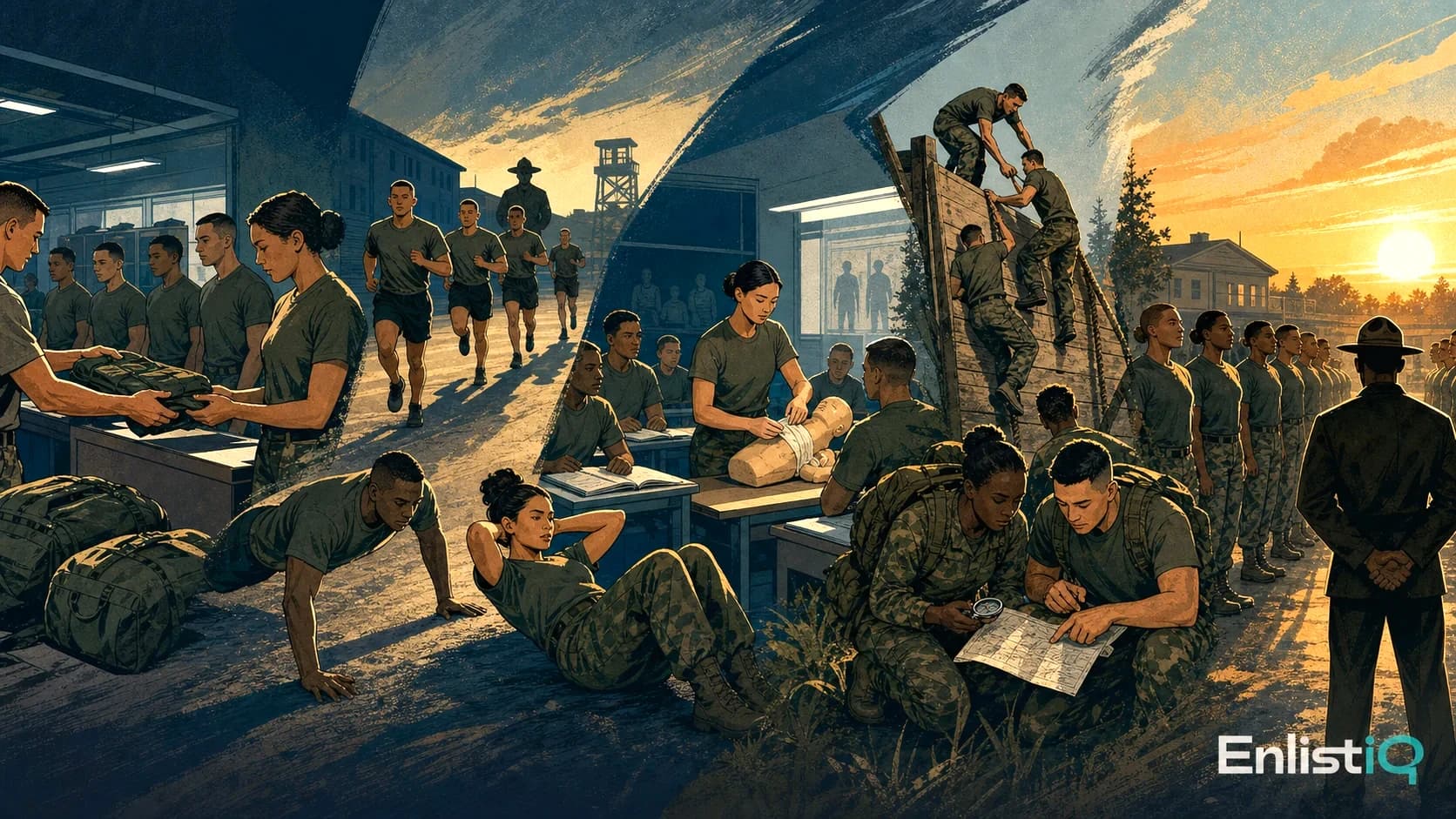
Basic training is the structured transition from civilian life to enlisted military service. The experience, terminology, fitness standards, communication rules, and follow-on training differ by branch, so there is no honest week-by-week script that applies to everyone.
This guide gives you a current cross-service overview and then uses the Army's published four-phase schedule as a detailed example. Always follow your recruiter and training command's latest instructions over a general article.
Basic Training by Branch: Current Duration and Location
| Branch | Name | Current Published Duration | Location |
|---|---|---|---|
| Army | Basic Combat Training (BCT) | 10 weeks | Multiple Army training sites |
| Marine Corps | Recruit Training | 13 weeks | MCRD Parris Island or MCRD San Diego, as assigned |
| Navy | Recruit Training Command (boot camp) | 9 weeks | Great Lakes, Illinois |
| Air Force | Basic Military Training (BMT) | About 7.5 weeks | Joint Base San Antonio-Lackland, Texas |
| Coast Guard | Recruit Basic Training | 8 weeks | Cape May, New Jersey |
| Space Force | Basic Military Training (BMT) | 7.5 weeks | Joint Base San Antonio-Lackland, Texas |
Space Force Guardians attend Air Force BMT with additional Space Force-specific curriculum. Training schedules can change, and medical, fitness, administrative, or preparatory programs can lengthen an individual's time at a training site.
Before You Ship: Use the Waiting Period Well
The time between enlistment and shipping varies. Your service may call it the Delayed Entry Program or use another future-service program. Stay in contact with your recruiter, maintain eligibility, and report material medical, legal, or personal changes instead of waiting until ship day.
Physical Preparation
Do not build your plan around generic internet targets such as a particular two-mile time or a fixed number of push-ups. Services test different events and publish different standards.
A better approach is to:
- Start early and increase running or other aerobic work gradually.
- Build full-body strength, core endurance, mobility, and recovery habits.
- Practice correct form before adding volume or weight.
- Use the current official program for your service, such as the Air Force's BMT preparation plan or the fitness guidance linked by your recruiter.
- Get medical advice before beginning a new program if you have an injury, symptoms, or health concerns.
The goal is not to beat an unofficial benchmark. It is to arrive healthy enough to train safely and meet the standards your service actually uses.
Mental and Practical Preparation
Expect a highly structured schedule, frequent correction, limited privacy, and less control over your time than you have at home. The intensity and instructional style vary, but preparation helps:
- Practice following detailed instructions the first time.
- Establish a consistent sleep and wake schedule before shipping.
- Arrange recurring bills, direct deposit, dependent care, and emergency contacts.
- Learn the knowledge your service tells you to study—not a random branch's creed or general orders.
- Discuss realistic communication expectations with family.
Army Basic Combat Training: The Current Four Phases
The Army's official Basic Combat Training page currently describes four phases across 10 weeks.
Yellow Phase (Weeks 1–2): Adapt to Army Life
The first phase focuses on Army values, discipline, teamwork, and the beginning of physical and tactical training. Expect reception and administrative tasks around the start of training, but the exact sequence can vary by installation and unit.
Red Phase (Weeks 3–4): Hands-On Soldier Skills
The Army says trainees begin familiarization with assigned weapons, practice lifesaving and hand-to-hand skills, and complete an initial field exercise called the Hammer.
White Phase (Weeks 5–7): Marksmanship and Small-Team Skills
This phase develops rifle marksmanship, maintenance, target engagement, teamwork, and combatives. It includes a field training exercise called the Anvil. Qualification details can change, so do not memorize old hit-count tables from unofficial guides.
Blue Phase (Weeks 8–10): Apply and Integrate
Trainees refine earlier skills, work with additional equipment, continue marksmanship and maneuver training, and complete the Forge, a multi-day culminating field exercise. Graduation follows successful completion of all current requirements.
Physical Fitness Standards: Check the Current Test
Fitness information ages quickly. A major example: the Army Fitness Test (AFT) replaced the Army Combat Fitness Test as the test of record on June 1, 2025. The official Army Fitness Test site lists five current events:
- Three-Repetition Maximum Deadlift
- Hand-Release Push-Up
- Sprint-Drag-Carry
- Plank
- Two-Mile Run
Standards can differ by context and have continued to evolve for designated combat specialties. Use the official score standards and your training cadre's instructions rather than an old six-event ACFT chart.
Other branches use their own assessments. Check the official recruiting or training-command page for your service, age or sex category where applicable, and program. Passing an unofficial Army benchmark tells you nothing definitive about Navy, Marine Corps, Air Force, Space Force, or Coast Guard graduation.
Communication During Basic Training
Phone, mail, and device policies vary by service, training week, unit, and status. Do not promise family a regular call schedule.
Before shipping:
- Give family the official training-command and emergency-contact information.
- Bring a written list of important phone numbers and mailing addresses if your packing instructions allow it.
- Tell family to wait for the correct recruit mailing address before sending mail.
- Explain that a missed call or quiet period is not automatically an emergency.
- Use the American Red Cross Hero Care process for qualifying family emergencies if directed by the service.
For an example of how specific policies can be, the Navy's official Recruit Training Command reporting page and family FAQ explain what recruits may bring and when phone contact occurs. Those Navy rules should not be copied onto another branch.
What to Bring: Follow Your Branch's List
There is no safe universal packing list. Required identification, medical documents, banking information, clothing, medications, and prohibited items differ by service and can change.
Use the current list provided by your recruiter and training command. Examples include:
- Army: Your First Weeks and Basic Training packing guidance
- Air Force: BMT preparation and packing list
- Navy Recruit Training Command: Reporting and required items
If two official instructions appear to conflict, ask your recruiter which version applies to your ship date. Do not improvise with medication, legal documents, electronics, or travel paperwork.
Common Preparation Mistakes
1. Training too hard, too late. A last-minute mileage or lifting spike can send you to training injured. Build gradually.
2. Memorizing stale standards. Fitness events, training lengths, installation names, and packing rules change. Recheck official pages before shipping.
3. Ignoring administrative preparation. Unpaid bills, missing documents, dependent-care problems, or incorrect bank information are harder to solve with limited communication.
4. Treating correction as a personal argument. Listen, respond professionally, and focus on the required standard.
5. Using another service's advice. Navy phone rules, Army packing guidance, and Air Force fitness preparation are not interchangeable.
After Basic: What Comes Next
After graduation, most enlisted members continue to occupation-specific training. The name varies—Army AIT, Navy A School, Air Force or Space Force technical training, Marine Corps follow-on combat and MOS training, and Coast Guard specialty pathways.
Duration and location depend on the exact occupation and training pipeline. Some members also follow service-specific assignment processes before specialty school. Use the official career page for the job in your contract, and ask your recruiter to distinguish initial training, job training, and any additional required schools.
Start Preparing Now
The best preparation is current and specific: follow your service's fitness plan, organize your responsibilities, study the assigned material, and verify every instruction before you ship.
Your ASVAB results affect enlistment and occupational qualification before training. If you are still preparing to test, take a free ASVAB practice test to identify content gaps—but remember that a practice result is not an official score or job guarantee.
Official References
- Today's Military: Military education and training overview
- U.S. Army: Basic Combat Training
- U.S. Navy: Navy Boot Camp
- U.S. Air Force: Training
- U.S. Space Force: Training
- U.S. Coast Guard: Basic Training
- U.S. Marine Corps: Recruit Training
Related Reading
Share this article