Subprueba Tecnica

ASVAB Comprension Mecanica (MC)

MC evalua tu comprension de principios mecanicos — engranajes, palancas, poleas y fisica basica. Clave para trabajos de combate, ingenieria y mantenimiento.

Uso de la puntuación
Ayuda a calificar para empleos
Áreas de enfoque
5
Ejemplos en esta guía
5
Resumen de la sección

Qué mide MC

Comprension de principios mecanicos: palancas, engranajes, poleas, planos inclinados, hidraulica y soporte estructural. Frecuentemente incluye preguntas basadas en diagramas.

Contenido que aparece en el examen

  • Maquinas SimplesPalancas, poleas, engranajes, cuñas, planos inclinados
  • Ventaja MecanicaMultiplicacion de fuerza y compensaciones
  • Mecanica de FluidosHidraulica, presion, flotabilidad
  • Soporte EstructuralDistribucion de carga, centro de gravedad
  • Movimiento y FuerzasFriccion, momento, aceleracion
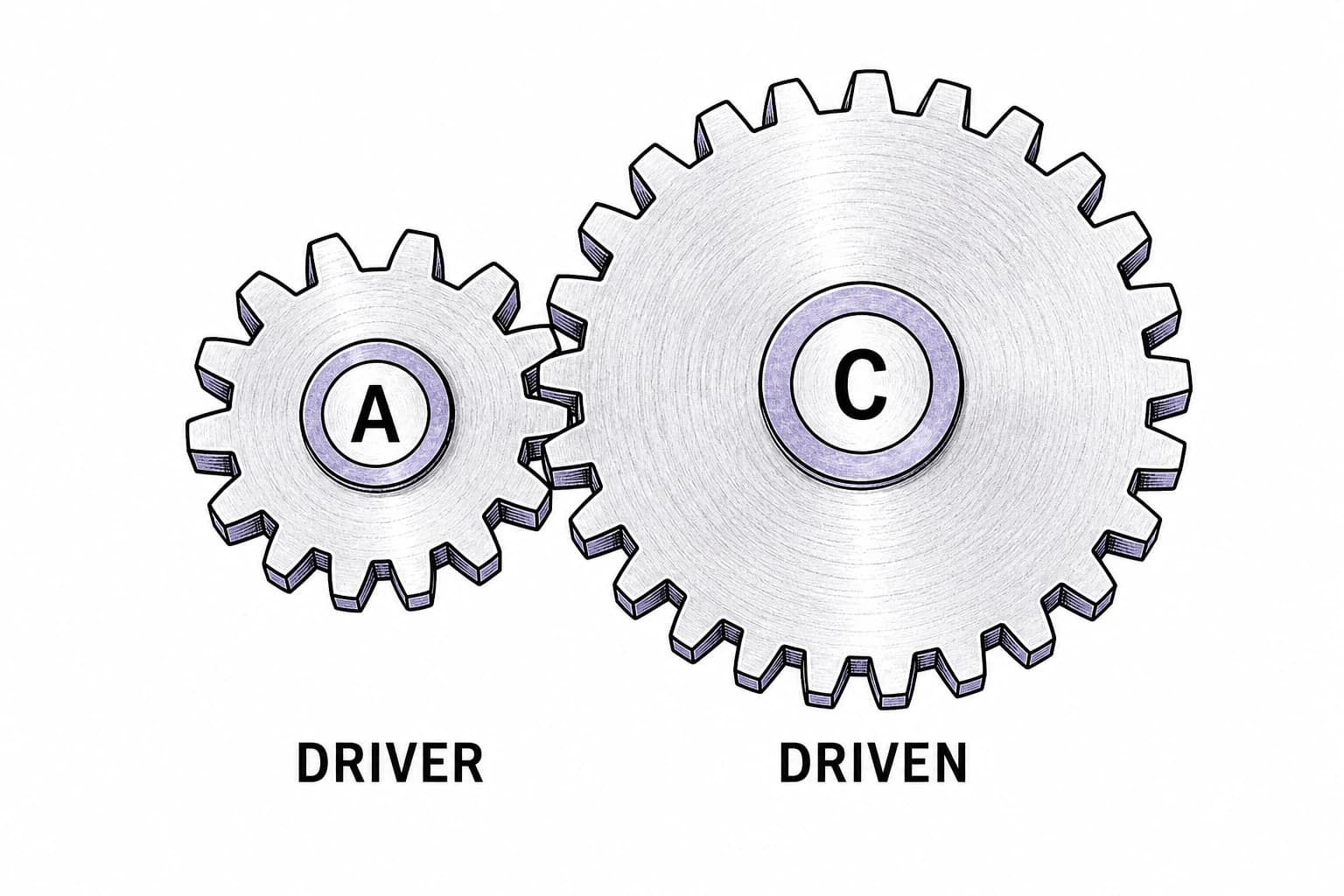
Concepto visual

Compara tamano, velocidad y direccion de engranajes

Un engranaje impulsor pequeno A conectado con un engranaje impulsado grande C
Los engranajes conectados giran en direcciones opuestas. El engranaje grande gira mas lento y produce mas torque.

5 ASVAB-style practice questions

Open a question to review the choices, correct answer, and a short explanation.

Q1A 12-tooth external gear directly meshes with a 36-tooth external gear on fixed parallel shafts. Viewed from the same side, the driven gear turns:View question and answer
  1. Three times as fast in the same direction
  2. At the same speed in the opposite direction
  3. One-third as fast in the opposite direction
  4. One-third as fast in the same direction
Correct answerC. One-third as fast in the opposite direction

Why: The driven gear has three times as many teeth, so it turns at one-third the driving speed. Two directly meshed external gears on fixed parallel shafts rotate in opposite directions when viewed from the same side.

Q2A force of 200 pounds is applied over an area of 4 square inches. What pressure is produced?View question and answer
  1. 25 psi
  2. 800 psi
  3. 100 psi
  4. 50 psi
Correct answerD. 50 psi

Why: Pressure = force ÷ area = 200 ÷ 4 = 50 pounds per square inch.

Q3An ideal single fixed pulley mainly:View question and answer
  1. Changes the direction of the applied force
  2. Doubles the lifting force
  3. Cuts the load weight in half
  4. Stores elastic energy
Correct answerA. Changes the direction of the applied force

Why: A fixed pulley has an ideal mechanical advantage of 1; its primary benefit is changing the direction of pull.

Q4Why does a longer wrench make it easier to loosen a tight bolt?View question and answer
  1. It reduces the bolt diameter
  2. It increases the torque for the same force
  3. It eliminates friction in the threads
  4. It increases the bolt mass
Correct answerB. It increases the torque for the same force

Why: Torque equals force times perpendicular distance from the pivot. A longer handle increases that distance.

Q5Which change generally makes an object harder to tip over?View question and answer
  1. Raise its center of gravity
  2. Narrow its base
  3. Lower its center of gravity
  4. Move its weight outside its base
Correct answerC. Lower its center of gravity

Why: A lower center of gravity allows more tilt before the line of action of the weight moves outside the support base.

Estrategia para MC

  1. Visualiza el problema — dibuja engranajes, palancas y poleas si puedes.
  2. Recuerda: la ventaja mecanica siempre intercambia fuerza por distancia.
  3. Para preguntas de engranajes, traza la direccion de rotacion a traves de cada engranaje.

¿Listo para practicar MC?

Comienza una prueba gratis para practicar Comprension Mecanica y revisar tus errores por tema.

Comenzar practica de MCProbar examen AFQT gratis

Hoja de referencia ASVAB gratis

Fórmulas clave, puntuaciones compuestas y referencias en un PDF imprimible.

Páginas relacionadas

Guías de las diez secciones del ASVAB