High school or GED — you have the foundation
Military services can accept GED and alternative-credential applicants, but the score and education rules are service-specific. This guide shows the current standard AFQT floor for each branch and how exceptions work.
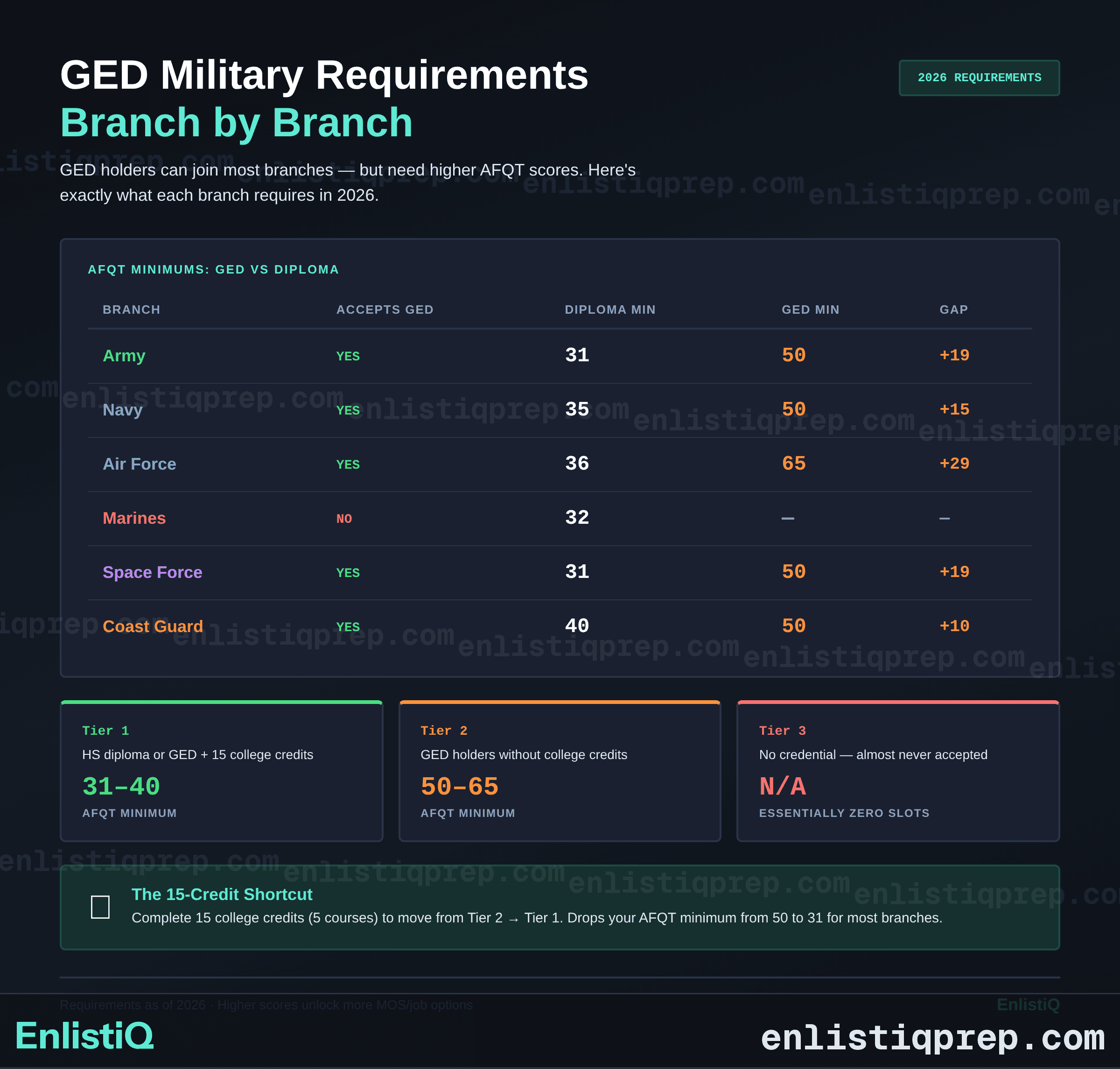
Branch-by-branch GED requirements
Every service sets its own rules for GED and alternative credentials. These figures are the current standard non-prior-service floors, before any limited preparatory, waiver, or eligibility-determination pathway.
| Branch | Accepts GED | Diploma AFQT | GED AFQT | Official source |
|---|---|---|---|---|
| Army | YES | 31 | 31 | U.S. Army ASVAB requirements |
| Marines | YES | 31 | 50 | Marine Corps eligibility requirements |
| Navy | YES | 31 | 50 | U.S. Navy joining requirements |
| Air Force | YES | 31 | 50 | U.S. Air Force ASVAB requirements |
| Space Force | YES | 36 | 50 | DAFMAN 36-2032 aptitude standards |
| Coast Guard | YES | 32 | 47 | Coast Guard Recruiting Instruction 1100.2I |
The military education tier system
The Department of Defense and individual services use education-credential classifications, but the way a particular diploma, GED, home-school record, or college transcript is treated depends on current service policy.
Who: Applicants whose education credential the service treats as its primary enlistment tier
Who: Some GED and alternative-credential applicants, depending on how the service classifies the credential
Who: Applicants without a recognized secondary credential
College-credit options to ask about
Some services publish enlistment paths involving college semester hours, but credits are not a universal automatic shortcut. Confirm the exact rule, approved institution, course level, and transcript documentation first.
Questions to ask before enrolling
- How many semester or quarter hours does this service require?
- Which accreditation and course levels are accepted?
- Are online, dual-enrollment, or transfer credits treated differently?
- Must the official transcript arrive before processing?
- How would accepted credits change my education classification?
Your recruiter must classify the credential.
The result depends on that service’s current rule.
Ready to start practicing?
5,000+ ASVAB questions across all 10 sections. Free practice test — no account required.
What to compare: GED vs diploma
A single numeric gap is not reliable across all services. Compare the complete rules that affect your application.
Ask how the service classifies your exact GED, diploma, home-school record, or transcript.
Standard GED floors: Army 31, Marines 50, Navy 50, Air Force 50, Space Force 50, and Coast Guard 47.
Ask whether the rule changes for active duty, reserve, preparatory, or other current recruiting programs.
Confirm the line or aptitude-area scores for the exact job; AFQT alone does not establish job eligibility.
Study plan for GED holders
Build a focused plan around the official AFQT calculation and your target service’s current requirements.
Start with a free practice test to see where you stand. Your AFQT is based on four sections: Arithmetic Reasoning (AR), Math Knowledge (MK), Word Knowledge (WK), and Paragraph Comprehension (PC). Focus here first.
The AFQT uses AR, MK, WK, and PC standard scores. Prioritize the areas where practice shows the clearest knowledge gaps, and remember that an unofficial estimate is not an official score.
Consistency beats cramming. 30–45 minutes a day of targeted practice is more effective than weekend marathons. Use adaptive drills that adjust to your level.
If you're stuck on a math concept or unfamiliar word, don't skip it. Use the AI tutor for step-by-step explanations until it clicks.
Watch accuracy and topic-level progress over time. Compare any practice estimate with the current official requirement for your service rather than treating a third-party target as guaranteed eligibility.
Frequently asked questions
You have the foundation. Start prepping.
GED holders who prepare with targeted practice consistently hit their AFQT targets. Start with a free practice test and see where you stand today.