Published February 22, 2026
Last updated September 8, 2026
9 min
Army ASVAB Score Requirements 2026
Current Army AFQT minimums for diploma and GED applicants, how Army composites support MOS qualification, and how to research job-specific requirements.
The Army uses ASVAB results for two different decisions: the Armed Forces Qualification Test (AFQT) helps determine basic enlistment eligibility, while Army category or line scores help determine which Military Occupational Specialties (MOSs) you may qualify for. A qualifying score does not by itself guarantee enlistment or a particular MOS.
Reviewed August 22, 2026: The Army publishes an AFQT score of at least 31 to enlist and accepts a high-school diploma or GED. The standard minimum shown here is therefore 31 for both paths. Applicants scoring 21–30 may be considered for the academic track of the Future Soldier Preparatory Course.
Need to interpret GT, ST, CL, or another composite? Use the Army ASVAB line-score chart and sample report, then return here for basic enlistment requirements.
Army AFQT Requirement: The Current Answer
| Applicant path | Current public guidance |
|---|---|
| High school diploma | AFQT of at least 31 |
| GED or other high school equivalency | AFQT of at least 31 |
| Specific Army MOS | Qualifying Army category or line scores vary by job |
The official Army ASVAB page publishes the 31 enlistment score and explains that ASVAB category scores determine job opportunities. The Army's joining requirements accept a high-school diploma or equivalent. The Army does not publish a higher GED-only cutoff on those current requirements, so this guide applies the stated 31 standard to both paths.
The 31 figure is a threshold, not a promise. Applicants must also meet the Army's education, age, medical, physical, legal, and other accession requirements. Program rules and waiver availability can change, so confirm your individual path before relying on a number.
AFQT Score vs. Army Line Scores
These scores answer different questions:
- AFQT: Are you within the score range the service can consider for enlistment?
- Army category or line scores: Which job areas or MOSs may your ASVAB profile support?
The AFQT is computed from Arithmetic Reasoning (AR), Mathematics Knowledge (MK), Paragraph Comprehension (PC), and Word Knowledge (WK). It is reported as a percentile from 1 to 99. For example, an AFQT of 31 is a percentile result, not a claim that you answered 31 percent of the questions correctly. The official ASVAB scoring explanation describes both the four contributing subtests and percentile reporting.
Army line scores are separate composites built from ASVAB subtest results. That is why two applicants with the same AFQT can have different MOS options: their performance outside the four AFQT subtests, or their pattern within the subtests, may differ.
How Army Job Categories Use ASVAB Subjects
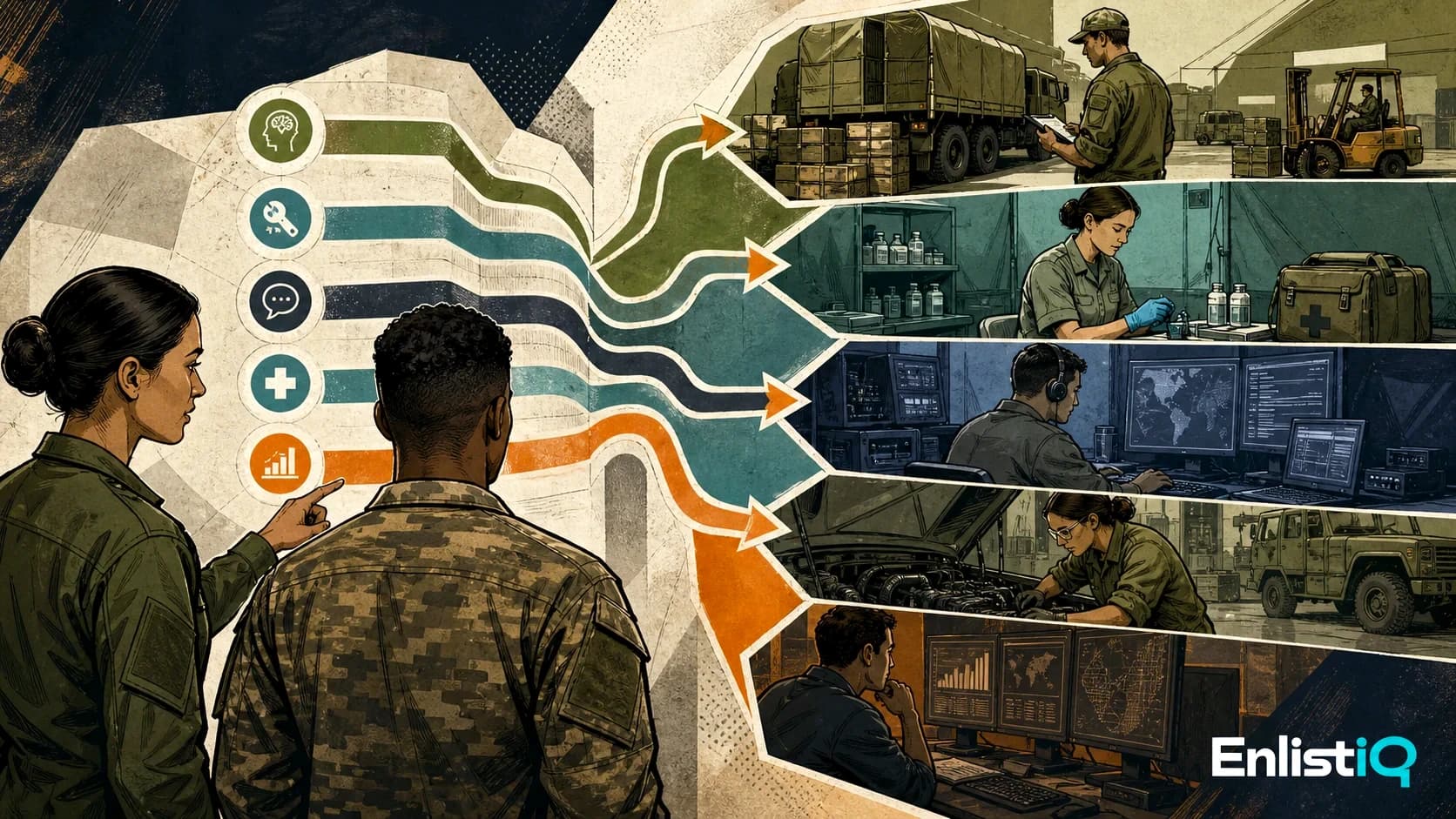
The Army's current recruiting page gives examples of career categories and the subjects emphasized in each. It does not present a permanent numeric cutoff table for every MOS.
| Army category shown by GoArmy | Subjects the current page highlights |
|---|---|
| Clerical | Verbal Expression, Arithmetic Reasoning, Mathematics Knowledge |
| Combat | Verbal Expression, Auto and Shop Information, Mechanical Comprehension |
| Operators & Food | Verbal Expression, Auto and Shop Information, Mechanical Comprehension |
| Surveillance & Communication | Verbal Expression, Arithmetic Reasoning, Auto and Shop Information, Mechanical Comprehension |
| Skilled Technical | General Science, Verbal Expression, Mechanical Comprehension, Mathematics Knowledge |
These are subject-area examples from the Army's ASVAB overview, not substitute qualification formulas. Your official score record and Army counselor determine how your results apply to a current MOS.
What the GT score means
General Technical (GT) is an Army aptitude-area score. It is not your AFQT percentile, and a practice-test percentage cannot be converted reliably into an official GT score. Some Army programs publish a specific technical or GT requirement on their own current pages, but there is no single GT number that unlocks every technical, intelligence, medical, aviation, or special-operations job.
If a target MOS or program matters to you, ask the recruiter for all of the following:
- The current MOS code and title.
- Each qualifying aptitude-area or line-score requirement.
- Any alternative qualifying combination.
- Non-ASVAB prerequisites such as citizenship, clearance eligibility, education, medical screening, or physical assessment.
- Whether the job is available for your component and ship window.
Why This Guide Does Not Publish a Large MOS Cutoff Table
An old table can be more harmful than helpful. MOS codes, titles, prerequisites, qualification rules, and recruiting availability can change. A table may also mix requirements for new applicants with rules for Soldiers seeking reclassification or a specialized program.
The Army says that, at MEPS, available jobs depend on multiple factors, including your ASVAB scores and which positions are open at the time. You then work with a Guidance Counselor to choose a career field and sign your contract. See the official Army MEPS process.
Use the official Army job directory to build a shortlist, then check the current qualification standard for each MOS. Before signing, read the enlistment contract and confirm that the job or program shown matches what you agreed to.
A Safer MOS Research Workflow
1. Start with job duties, not a rumored cutoff
Choose several roles whose work, training, service commitment, and prerequisites interest you. Do not select a job only because an unofficial chart labels it easy or difficult to qualify for.
2. Separate eligibility from job qualification
First make sure your AFQT preparation supports basic eligibility. Then learn which additional ASVAB subtests feed the current Army composite for your target jobs.
3. Check the current requirement
Show your shortlist to a recruiter and ask for the current qualifying scores. Save the exact MOS codes and titles so similarly named jobs are not confused.
4. Ask about availability separately
Qualifying for an MOS and finding an open training seat are different questions. The Army's MEPS page expressly notes that open positions affect the jobs available to an applicant.
5. Keep acceptable alternatives
Build a short list of jobs you would genuinely accept. An alternative should fit your goals, not merely be a way to enter quickly.
How to Prepare for an Army ASVAB Target
Build the AFQT foundation first
Because AR, MK, PC, and WK produce the AFQT, begin with arithmetic word problems, high-school mathematics, vocabulary in context, and reading comprehension. The official ASVAB preparation page recommends preparing in advance, learning the subtest content, using sample questions, and reviewing weak areas.
Add the subjects used by your target category
Once a recruiter confirms the relevant Army composite, add focused work in subjects such as General Science, Electronics Information, Auto Information, Shop Information, Mechanical Comprehension, or Assembling Objects as needed. The official ASVAB sample-question page provides retired examples for all ten subtests.
Review errors by cause
For each missed practice question, identify whether the issue was missing knowledge, a setup error, a vocabulary gap, or time management. Rework the problem without the answer visible and return to the underlying topic later.
Use practice results as diagnostics
EnlistiQ's ASVAB practice test can help you identify subjects to review. Practice results are not official AFQT or Army line scores, cannot establish enlistment eligibility, and cannot show current MOS availability.
What If Your AFQT Is Below 31?
The Army currently describes academic tracks within its Future Soldier Preparatory Course for some applicants. Eligibility, score ranges, course options, and openings are Army decisions; do not assume the program or a waiver will be available to you. Review the current information on the Army ASVAB page and ask a recruiter what applies to your case.
You can also prepare before retesting. OfficialASVAB recommends reviewing subtest content and practicing the areas that need improvement rather than relying on a promised point increase.
Army ASVAB Retest Timing
The official policy is:
- Wait one calendar month after the initial ASVAB for the first retest.
- Wait another calendar month after the first retest for the second retest.
- After the second retest, wait six calendar months between additional retests.
OfficialASVAB also says enlistment scores may be used for up to two years from the test date, provided they can be verified as yours. See the OfficialASVAB FAQ and retest policy. The Army's own ASVAB page says it uses your most recent score, not your highest score, so plan a retest with your recruiter rather than treating it as risk-free.
Frequently Asked Questions
Is 31 enough to join the Army?
The current Army recruiting page publishes 31 as the AFQT score required to enlist. Reaching it does not guarantee acceptance because all other accession requirements still apply, and it does not guarantee a specific MOS.
What Army ASVAB score does a GED applicant need?
The current standard minimum is 31. The Army accepts a high-school diploma or equivalent and does not publish a higher GED-only cutoff on its current requirements pages. Limited program and eligibility decisions may still affect an individual applicant.
Does a college degree remove the ASVAB requirement for an enlisted applicant?
The Army says every enlisted Soldier takes the ASVAB. Officer paths use different selection requirements, so discuss the correct accession route with an Army recruiter.
Does a higher AFQT automatically unlock more MOSs?
Not by itself. AFQT and Army job composites serve different purposes. A stronger overall ASVAB profile can help, but an MOS still may require particular line scores and other qualifications, and a position must be open.
Can I calculate an official Army line score from an online practice test?
No. Practice performance is useful for study planning, but the military calculates official scores from an authorized ASVAB administration. Ask your recruiter to explain your official Army composites.
Are Army MOS score requirements permanent?
No assumption of permanence is safe. Check the current requirement on an official Army career or program page close to the date you make a job decision.
Next Steps
Already qualified and getting ready to ship? Use the Army basic training packing list to review documents, approved essentials, and departure preparation.
- Take an ASVAB practice test
- Understand ASVAB scores and percentiles
- Compare minimum ASVAB scores by branch
- Browse official Army jobs
Official Sources Reviewed
Reviewed August 22, 2026 against:
- U.S. Army ASVAB test and preparation
- U.S. Army eligibility requirements
- U.S. Army MEPS process and job selection
- OfficialASVAB score explanation
- OfficialASVAB enlistment eligibility
- OfficialASVAB retest policy
The standard AFQT floor is 31 for both diploma and GED applicants. Limited preparatory, waiver, eligibility, component, and job rules may differ.
EnlistiQ is an independent ASVAB study resource. It is not affiliated with or endorsed by the U.S. Army, the Department of Defense, or the official ASVAB Testing Program.
Share this article