Published July 30, 2026
11 min
Army 09M and ARMS Explained: Options After a Below-31 AFQT Score
Learn how the Army's 09M delayed-trainee academic route differs from ARMS 2.0, what may happen after an AFQT score of 21–30, and which questions to ask.
An AFQT score below 31 can feel like a closed door. For standard Army enlistment, 31 is the usual minimum score. But a score in the 20s does not automatically mean your Army goal is over.
The Army has a preparatory pathway for some otherwise-qualified applicants who score from 21 through 30. You may hear recruiters call it the 09M program—pronounced "zero-nine Mike"—or describe it as the academic track of the Future Soldier Preparatory Course.
You may also hear ARMS in the same conversation. The programs can operate under the same preparation umbrella, but they solve different accession problems: 09M is associated with academic preparation, while ARMS 2.0 is associated with body composition and physical readiness.
Most importantly, 09M is not the permanent Army job you will perform after training. It is a delayed-trainee or preparatory identifier. Your eventual Military Occupational Specialty (MOS) depends on your qualifying scores, eligibility, available openings, Army needs, and the terms placed in writing.
The Short Answer
Here is the current public-facing Army framework:
| Your situation | Potential Army pathway |
|---|---|
| AFQT 21–30 | You may qualify for the 09M delayed-trainee academic route within the Future Soldier preparation system |
| AFQT 31–49 | You already meet the standard AFQT floor and may qualify for a shorter score-improvement option |
| AFQT below 21 | The Army's public guidance does not list you as eligible for the academic track; study and retest before processing |
| Over the Army's body-composition standard | ARMS 2.0 or the fitness track may apply, depending on current eligibility rules |
| Both an academic and body-composition barrier | An eligible recruit may be offered a dual-track sequence, when available |
These programs are not automatic. Education, medical history, conduct, body composition, available training seats, and other enlistment standards still matter. A recruiter must evaluate your complete situation under the policy in effect when you process.
First, 31 Refers to Your AFQT Score
People often say "ASVAB score" when they mean the Armed Forces Qualification Test (AFQT) score. Your AFQT is calculated from four ASVAB subtests:
- Arithmetic Reasoning (AR)
- Mathematics Knowledge (MK)
- Word Knowledge (WK)
- Paragraph Comprehension (PC)
The result is a percentile from 1 to 99. A 31 does not mean you answered exactly 31% of the questions correctly. It means your performance is at the 31st percentile compared with the test's reference population.
The AFQT determines basic enlistment eligibility. Your other ASVAB composite or line scores help determine which Army jobs—called Military Occupational Specialties, or MOSs—you may qualify for.
That difference matters. Raising your AFQT above 31 can make you eligible to move forward, while stronger line scores can give you more career choices.
What 09M Actually Means
09M is commonly used as a delayed-trainee or reporting identifier for Army recruits attending academic preparation before Basic Combat Training. In practical terms, it tells you where you are in the accession pipeline; it does not name the career you will hold after you qualify.
Public Army course documents and recruiting language do not always use exactly the same label. Depending on the current policy, score band, and paperwork, you may see terms such as 09M, academic track, Academic Skills Development, or a cohort label such as CAT III B. That is why the precise wording on your contract matters more than a nickname used online.
Before you sign, ask:
- Does my paperwork list 09M as a temporary delayed-trainee identifier?
- What is the official name of the course and score cohort I will attend?
- What score must I earn to continue?
- When will I select or renegotiate my permanent MOS?
- What happens if I do not meet the standard within the allowed time?
Do not assume that a job discussed before academic preparation is guaranteed afterward. A guarantee belongs in the written contract.
What ARMS Actually Means
ARMS stands for Assessment of Recruit Motivation and Strength. ARMS 2.0 is associated with body composition, physical readiness, nutrition education, and helping eligible recruits meet Army accession standards.
It is not another name for the 09M academic route, and it is not an academic waiver for a low AFQT score.
The confusion is understandable because the Army's Future Soldier preparation system includes both academic and fitness pathways. Some recruits may need only one track, while certain qualified recruits may move through both. In casual conversation, people sometimes use "ARMS" as a catch-all name for the entire process.
The useful distinction is:
- Academic barrier: 09M delayed-trainee academic preparation
- Body-composition barrier: ARMS 2.0 or the fitness track
- Both barriers: A dual-track option may be available to an otherwise qualified recruit
Current body-composition thresholds are detailed and can change. Do not try to determine ARMS eligibility from a social-media chart. Ask your recruiter to measure you and explain the current standard that applies to your age and sex.
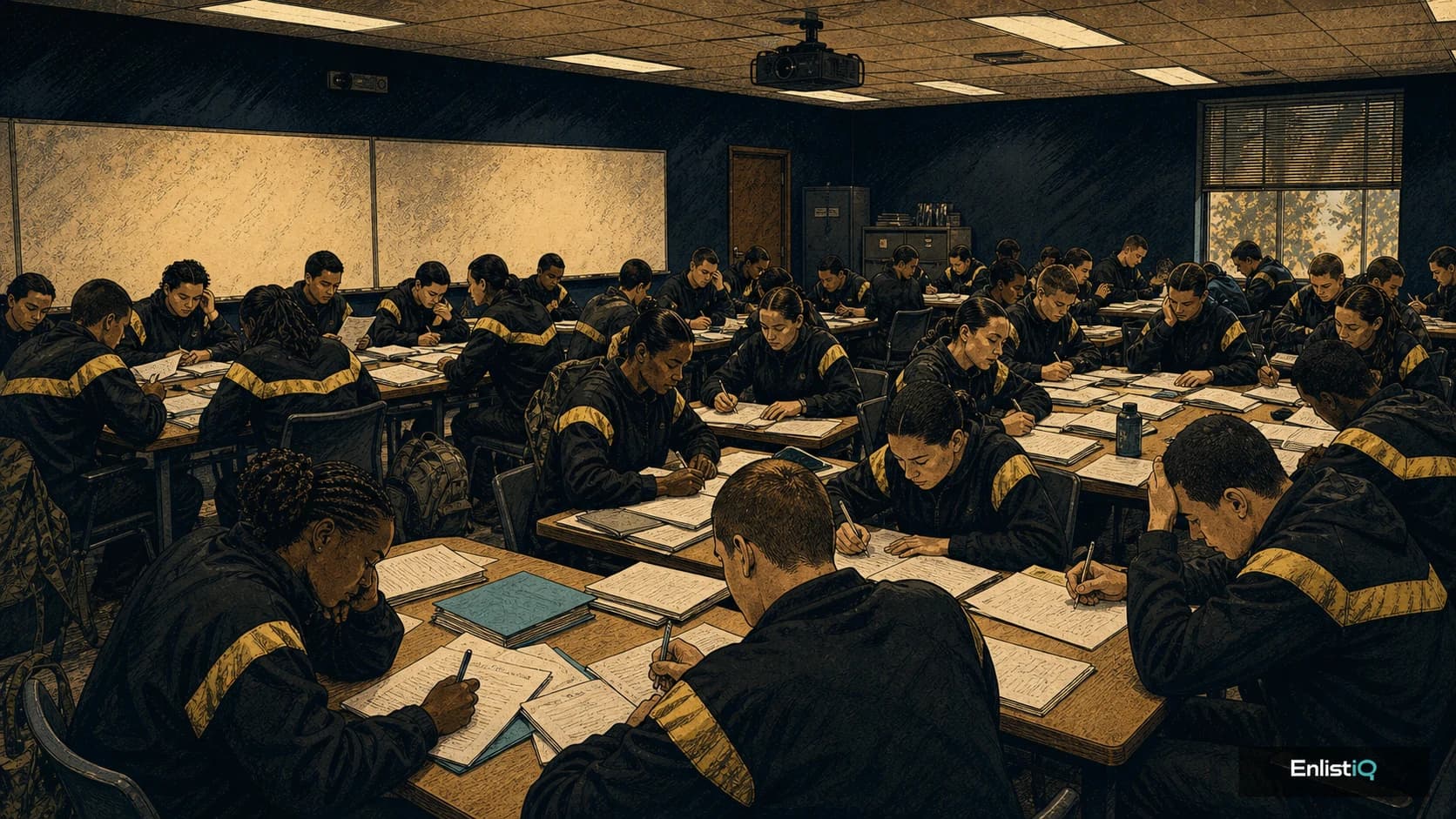
How 09M Academic Preparation Works for a 21–30 AFQT
The Army's official recruiting site says applicants with an AFQT of at least 21 may have access to the academic track of the Future Soldier Preparatory Course.
The course can provide:
- Structured instruction in the subjects tested on the ASVAB
- Practice with math, vocabulary, and reading skills
- Opportunities to retest
- Up to 90 days to meet the required academic standard
- A transition to Basic Combat Training after meeting Army requirements
Army reporting on the program has described retest opportunities at roughly three-week intervals for recruits in the 21–30 band. The exact schedule, location, course label, contract terms, and available MOS choices should be confirmed with your recruiter.
This is a preparation program, not permission to skip the standard. You still need to earn a qualifying score before moving on, and your permanent MOS is handled separately from the temporary 09M identifier.
What If You Score From 31 Through 49?
Applicants in this range already meet the Army's normal AFQT minimum, assuming they satisfy the other enlistment requirements that apply to them.
The Army also advertises a separate 30-day academic option for some recruits in the 31–49 range. That course includes one chance to improve the score. Depending on Army needs and the new results, a higher score may create an opportunity to select a different MOS.
Why volunteer to improve if you already passed?
- More MOS options may become available
- Stronger line scores may unlock technical career fields
- Some incentives depend on qualifications and Army needs
- Better academic preparation can make later classroom training less stressful
Passing at 31 opens the first door. It does not necessarily open every door.
What If Your Score Is Below 21?
Based on the Army's current public guidance, a score below 21 does not meet the academic-track entry floor.
Your practical next move is to prepare and retest:
- Ask for your AFQT and individual subtest scores.
- Identify whether math, verbal skills, or both held you back.
- Build a focused study plan for AR, MK, WK, and PC.
- Confirm the official retest waiting period before choosing a test date.
- Take another full-length practice test only after you have worked on the underlying skills.
Do not schedule repeated attempts with no change in preparation. The ASVAB retest policy uses waiting periods, and your most recent valid score—not automatically your highest score—is generally the one used for processing.
Questions to Ask Your Recruiter
Program rules and available seats can change. Bring a written list so you leave the conversation with specific answers:
- Is my 21–30 result an AFQT score or a practice-test estimate?
- Do I qualify for the 09M delayed-trainee academic route?
- What exact program or course name will appear on my paperwork?
- What other eligibility requirements must I meet first?
- Where would I attend, and how long could I remain in the course?
- How often would I be allowed to retest?
- What happens to my contract if my score improves?
- Is 09M temporary, and when is my permanent MOS selected or renegotiated?
- What happens if I do not reach 31 within the allowed time?
- If body composition is also an issue, is a dual-track option available?
- Which terms are guaranteed in writing?
Treat verbal explanations as the beginning of the conversation. Your enlistment contract is what controls your actual commitment and guarantees.
How to Prepare Before the Academic Track
Do not wait until you arrive to begin studying. The faster you close your skill gaps, the more attention you can give to improving your line scores and MOS options.
1. Focus on the Four AFQT Subtests
Study the material that directly affects your AFQT first:
- Arithmetic Reasoning: ratios, percentages, rates, proportions, and word problems
- Mathematics Knowledge: fractions, algebra, geometry, exponents, and basic equations
- Word Knowledge: roots, prefixes, suffixes, synonyms, and context clues
- Paragraph Comprehension: main idea, supporting detail, inference, and author's purpose
2. Fix Foundations Before Chasing Speed
If fractions or negative numbers are weak, timed practice will mostly train you to make the same mistakes faster. Learn the concept, solve untimed examples, and then add a time limit.
Use an error log with three short notes:
- What type of question was it?
- Why did I miss it?
- What will I do differently next time?
3. Use Short, Consistent Sessions
A reliable 45-minute study block is more useful than one exhausting session every weekend:
- 15 minutes of vocabulary
- 20 minutes of math or arithmetic reasoning
- 10 minutes reviewing previous errors
Add paragraph practice on alternating days and take one timed mixed set each week.
4. Practice Without a Calculator
The ASVAB does not allow a calculator. Rebuild multiplication, division, fractions, percentages, and estimation by hand.
5. Aim Beyond 31
Your goal should not be to scrape across the minimum. A score comfortably above 31 gives you a margin for test-day nerves, and higher line scores may improve the MOS conversation.
Take a free EnlistiQ ASVAB assessment to identify the AFQT subjects that need the most work.
Common Myths About Scoring Below 31
"09M is the Army job I will do after training."
No. 09M identifies a preparatory stage for eligible delayed trainees. It is not a permanent career MOS.
"ARMS and 09M are the same program."
No. 09M is associated with academic preparation. ARMS 2.0 addresses body composition and physical readiness. Some eligible recruits may need both tracks, which is why the names are often mentioned together.
"A recruiter can simply waive my AFQT."
Do not plan around an assumed waiver. Ask about the formal program or policy that applies to your score and get contract terms in writing.
"Once I reach 31, every Army job is available."
No. MOS qualification depends heavily on ASVAB line scores, medical factors, background requirements, openings, and Army needs.
"A 21 means I am bad at everything."
No. The AFQT reflects performance on four academic areas at one point in time. It does not measure discipline, character, physical ability, leadership, or your capacity to improve.
A Below-31 Score Is a Starting Point
A score below 31 is a real barrier, but for some Army applicants it is a barrier with a structured route forward.
If your AFQT is 21–30, ask specifically about the 09M delayed-trainee academic route and the official course name that will appear in your paperwork. If your challenge is body composition, ask about ARMS 2.0 or the fitness track. If both apply, ask whether the dual-track route is currently available.
Then prepare as if your opportunity depends on the next test—because it does. Build the core math and verbal skills, understand every term in your contract, and aim for a score that improves both eligibility and career choice. Treat 09M as the bridge, not the destination.
Official Sources and Related Guides
- U.S. Army: ASVAB Test and Preparation
- U.S. Army: Creation of the Future Soldier Preparatory Course
- U.S. Army: Academic and Fitness Dual-Track Option
- Army ASVAB requirements for 2026
- How to pass the ASVAB
- What your AFQT score means
- How to prepare for Army boot camp
This article is provided by EnlistiQ, an independent ASVAB study resource. EnlistiQ is not affiliated with, endorsed by, or sponsored by the U.S. Department of Defense or any branch of the U.S. Armed Forces. Program availability and accession policies can change. Confirm current eligibility and contract terms with an official Army recruiter.
Share this article