Published February 16, 2026
Last updated August 14, 2026
15 min
ASVAB Math Tips: How to Ace Arithmetic Reasoning & Math Knowledge
Master ASVAB math with proven strategies for Arithmetic Reasoning and Mathematics Knowledge. Formulas, practice techniques, and common mistakes to avoid.
If you're preparing for the ASVAB, the two math subtests deserve deliberate attention. Arithmetic Reasoning (AR) and Mathematics Knowledge (MK) are two of the four standard scores used to compute the AFQT, alongside Word Knowledge (WK) and Paragraph Comprehension (PC). The official ASVAB scoring guide does not describe AR and MK as a simple "50%" of the reported percentile: standard scores are combined and then converted to the 1–99 AFQT percentile.
The useful part of math preparation is that you can identify a specific skill—such as ratios, equations, or geometry—and practice it directly. No responsible prep guide can promise a 10- or 20-point AFQT increase in a set number of weeks, because commercial practice percentages do not reproduce the official scoring and equating process.
This guide covers useful formulas, practical strategies, common pitfalls, and ways to organize your study time. Whether you're starting from scratch or brushing up on concepts you haven't seen since high school, you'll find steps you can apply immediately.
Why ASVAB Math Matters So Much
Before we dive into strategies, let's understand why math is so critical to your military career.
AFQT Score Impact: Your AFQT (Armed Forces Qualification Test) is computed from the standard scores for Word Knowledge, Paragraph Comprehension, Arithmetic Reasoning, and Mathematics Knowledge. Better performance in AR or MK can improve the underlying composite, but there is no valid raw-question-to-percentile shortcut.
Service Composites: Math subtests also appear in many service-specific composites used for job classification. The formulas differ by service and composite; for example, the official table lists Army GT as AR + VE, while other composites use MK and technical subtests in different combinations. Check the official military jobs and composites table and confirm the current requirement for a specific occupation with a recruiter.
If you are targeting a technical field, identify the exact composite and current cutoff used by that service instead of assuming MK alone controls eligibility.
Return on Study Time: Math follows reusable rules, so topic-level review can be efficient. Use comparable practice sets to measure whether a method is helping, without treating short-term practice gains as a guaranteed official score change.
Arithmetic Reasoning (AR): What to Expect
The official program defines Arithmetic Reasoning as the ability to solve basic arithmetic word problems. Its retired AR sample questions include rates, ratios, percentages, and proportional reasoning.
Test Format:
- 15 questions on the CAT-ASVAB
- 55 minutes to complete (CAT-ASVAB adapts difficulty based on your answers)
- Question selection adapts to your estimated ability
Useful AR Practice Areas: The retired samples demonstrate some of these skills, but this is a study checklist rather than an official content blueprint.
- Percentages & Discounts — "A laptop costs $1,200. It's on sale for 15% off. What's the sale price?"
- Ratios & Proportions — "If 3 cups of flour make 24 cookies, how much flour for 40 cookies?"
- Distance, Rate & Time — The classic d = r × t problems
- Work Problems — "If Worker A completes a task in 6 hours and Worker B in 8 hours, how long together?"
- Basic Algebra — Setting up and solving simple equations
- Multi-Step Setup — Combining the relevant quantities before calculating
AR requires both arithmetic and an accurate reading of the scenario. A setup can fail even when the calculation is correct: "How many MORE employees" is different from "How many employees total."
Mathematics Knowledge (MK): What to Expect
The official program defines Mathematics Knowledge as knowledge of high-school mathematics principles. Its retired MK sample questions illustrate algebraic simplification, volume, roots, and ratios.
Test Format:
- 15 questions on the CAT-ASVAB
- 31 minutes to complete
- Difficulty adapts based on your performance
- Mix of computation and conceptual questions
Useful MK Practice Areas: This is a review checklist, not a guarantee about the mix of questions you will receive.
- Algebra — Solving equations, factoring polynomials, exponents, radicals
- Geometry — Area, volume, perimeter, circumference, angles, Pythagorean theorem
- Number Properties — Prime factorization, GCD, LCM, absolute value
- Functions & Equations — Slope, graphing lines, quadratic equations
- Exponents & Radicals — Laws of exponents, simplifying roots
MK presents high-school mathematics tasks more directly than AR word problems. Content and difficulty still vary as the CAT-ASVAB adapts.
Useful Formulas to Review
Build recall for the formulas you use in your review. You cannot use a calculator on the ASVAB, according to the official test-day guidance. The list below is an EnlistiQ review checklist, not an official formula sheet or a claim that it covers a fixed percentage of the test.
Geometry Formulas
| Shape/Concept | Formula | Example |
|---|---|---|
| Rectangle Area | A = length × width | l = 8, w = 5 → A = 40 |
| Rectangle Perimeter | P = 2(l + w) | l = 8, w = 5 → P = 26 |
| Triangle Area | A = ½ × base × height | b = 10, h = 6 → A = 30 |
| Circle Area | A = πr² | r = 4 → A = 16π ≈ 50.3 |
| Circle Circumference | C = 2πr | r = 4 → C = 8π ≈ 25.1 |
| Rectangular Prism Volume | V = l × w × h | l = 3, w = 4, h = 5 → V = 60 |
| Cylinder Volume | V = πr²h | r = 3, h = 7 → V = 63π ≈ 198 |
| Pythagorean Theorem | a² + b² = c² | a = 3, b = 4 → c = 5 |
Algebra Essentials
| Concept | Formula/Rule | Example |
|---|---|---|
| Slope | m = (y₂ - y₁) / (x₂ - x₁) | Points (2,3) and (4,7) → m = 2 |
| Quadratic Formula | x = [-b ± √(b² - 4ac)] / 2a | x² + 5x + 6 = 0 → x = -2 or -3 |
| FOIL (Binomial Multiply) | (a+b)(c+d) = ac + ad + bc + bd | (x+2)(x+3) = x² + 5x + 6 |
| Order of Operations | PEMDAS: Parentheses, Exponents, Multiply/Divide, Add/Subtract | 2 + 3 × 4 = 14, not 20 |
| Difference of Squares | a² - b² = (a+b)(a-b) | x² - 9 = (x+3)(x-3) |
| Perfect Square | (a+b)² = a² + 2ab + b² | (x+3)² = x² + 6x + 9 |
Percentage & Ratio
| Concept | Formula | Example |
|---|---|---|
| Percent | Part = Percent × Whole | 25% of 80 = 0.25 × 80 = 20 |
| Percent Change | Change % = (New - Old) / Old × 100 | Old = 50, New = 60 → 20% increase |
| Ratio & Proportion | a/b = c/d | If 3 cups flour makes 12 cookies, 5 cups makes 20 |
| Markup/Discount | New Price = Original × (1 ± %change) | $100 item, 20% off = $100 × 0.8 = $80 |
Distance, Rate & Time
| Concept | Formula | Example |
|---|---|---|
| Distance Formula | Distance = Rate × Time (d = r × t) | 60 mph × 3 hours = 180 miles |
| Rate | Rate = Distance / Time | 180 miles / 3 hours = 60 mph |
| Time | Time = Distance / Rate | 180 miles / 60 mph = 3 hours |
10 Math Strategies for the ASVAB
Knowing formulas is necessary but not sufficient. You also need smart test-taking strategies that save time and reduce errors.
1. Read Word Problems Twice
The first read: Get the overall scenario. "A train leaves the station..."
The second read: Identify what you're solving for. "How long does it take to reach its destination?" This two-read approach prevents careless misreadings.
2. Translate Words to Equations
Math word problems are puzzles. Your job is to convert English into math notation.
- "Two more than x" → x + 2
- "Three times as many" → 3x
- "Half of the total" → total / 2
- "The difference between" → subtraction
- "Is" or "equals" → =
Practice this translation until it becomes automatic.
3. Estimate Before Calculating
Before you dive into long calculations, estimate what the answer should be in ballpark terms. "This should be around 50, give or take 10." This helps you catch if your calculation is wildly off.
Example: "A shirt costs $34.50. Tax is 8.2%. What's the total?"
- Estimate: $34.50 ≈ $35, 8% of $35 ≈ $2.80, total ≈ $37.80
- Calculate: $34.50 × 1.082 = $37.33
- If you got $100+, you'd know something went wrong immediately.
4. Work Backwards from Answer Choices
On the CAT-ASVAB, answer choices are provided. If you're stuck on the math, try plugging a plausible answer choice back into the problem.
"If x = 3, do I get the correct answer?" Try the next plausible choice if it does not. This is slower than solving directly, but it can be better than guessing blindly. The official program likewise recommends ruling out incorrect choices and making an educated guess from what remains.
5. Draw Diagrams for Geometry
If a geometry problem doesn't include a diagram, draw one. Mark side lengths, angles, known quantities. Visualizing the problem makes it concrete instead of abstract.
6. Memorize Multiplication Tables Through 15
Fluent multiplication can reduce calculation time. If basic products slow you down, add a short multiplication drill to your routine and retest your recall rather than expecting one week of practice to make it permanent.
7. Know Your Perfect Squares and Cubes
Perfect squares: 1, 4, 9, 16, 25, 36, 49, 64, 81, 100, 121, 144, 169, 196, 225
Perfect cubes: 1, 8, 27, 64, 125, 216, 343, 512, 729, 1000
Recognizing "144 = 12²" instantly saves you calculation time and helps with estimation.
8. Use Fraction Rules Instead of Calculator Shortcuts
Because calculators are not allowed, fraction rules are often cleaner than approximate decimals. For example, 3/8 ÷ 5/6 becomes 3/8 × 6/5 = 18/40 = 9/20.
9. Check Units in Word Problems
Unit mismatch is a common trap. "How many minutes are in 2 hours and 45 minutes?" If you forget to convert 2 hours to 120 minutes, you'll get it wrong. Always check: Do my units match the question?
10. Check Whether Your Setup Matches the Question
If a solution becomes unexpectedly complicated, re-read the prompt and verify the quantity and units being requested. Complexity alone does not prove a setup is wrong, but a quick check can catch an unnecessary detour.
Common Mistakes to Avoid
Even strong math students make avoidable mistakes on the ASVAB. Watch out for these:
Misreading "More" vs "Total"
Mistake: "Tom has 5 apples. Sarah has 3 more than Tom. How many total do they have?"
- Wrong approach: Answering 8 (thinking only of Sarah's apples)
- Correct: Tom = 5, Sarah = 8, Total = 13
Lesson: Circle what the question is asking. Re-read once more before you submit your answer.
Forgetting to Convert Units
Mistake: "A car travels 240 miles in 4 hours. How many minutes does it take to travel 60 miles?"
- Wrong approach: Calculating 60/60 = 1 hour, forgetting to convert to minutes
- Correct: 1 hour = 60 minutes
Lesson: Before you finalize any answer, check if the units match the question.
Not Reducing Fractions
Mistake: "Simplify 24/36."
- Wrong: Leaving it as 24/36
- Correct: 24/36 = 2/3
Lesson: Always reduce fractions to lowest terms unless the problem says otherwise.
Sign Errors with Negatives
Mistake: "Solve: -2x = 8"
- Wrong: x = 4 (dropping the negative sign)
- Correct: x = -4
- Common slip: Flipping the sign when you shouldn't, or not flipping when you should
Lesson: Write out each step. Be deliberate with negative signs.
Rushing Through Word Problems
Mistake: Answering the question before you finish reading it.
- Example: "Train A leaves at 60 mph, Train B at 40 mph. If they're 300 miles apart and traveling toward each other, when do they meet?" A student calculates 300/60 = 5 hours, forgetting that Train B is also moving.
- Correct approach: Combined speed = 100 mph, time = 300/100 = 3 hours
Lesson: Finish reading the entire problem before you start calculating.
How to Study ASVAB Math Effectively
Use a repeatable study plan so you can see which methods improve your practice performance.
Start with a Diagnostic
Take a diagnostic test or quiz to identify weak areas. Are you struggling with geometry, percentages, or algebra? Spend more time on weaker areas while occasionally checking stronger ones for retention. The official preparation guide also recommends trying sample questions and reviewing content that needs refreshing.
Focus on One Topic Per Day
One suggested format is to pick one topic, complete a focused set, review every mistake, and revisit that skill later. Use the set length that fits your schedule and attention.
Do 20–30 Practice Problems Daily
Short, regular sessions can be easier to sustain than one long cram session. Twenty to thirty questions is a practical starting range, not an official requirement.
Review Every Mistake — Understand WHY
It's not enough to get a problem wrong and move on. Take 5 minutes to understand exactly where you went wrong. Did you misread the question? Calculate wrong? Forget a formula? If you don't understand the mistake, you'll make it again.
Take Timed Practice Tests Weekly
Once you've studied the core material, take timed practice to test pacing and identify remaining weak areas. The current CAT-ASVAB limits without tryout questions are 55 minutes for 15 scored AR questions and 31 minutes for 15 scored MK questions; tryout questions can add questions and time.
How EnlistiQ Helps With ASVAB Math
The strategies above are powerful, but having guidance matters. That's where EnlistiQ comes in.
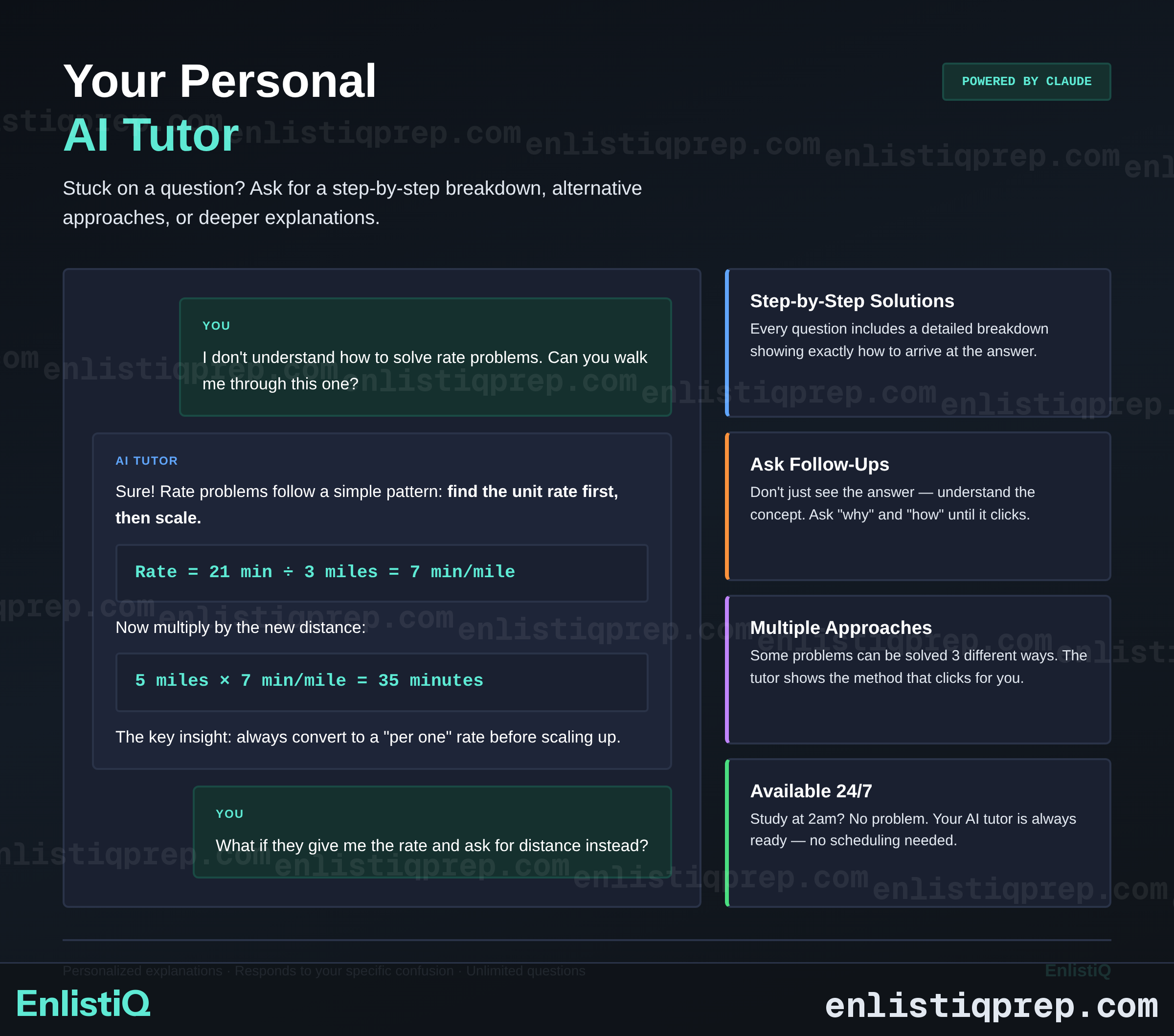
AI Tutor Explanations: Every math problem in EnlistiQ includes a step-by-step AI explanation. Got a question wrong? Don't just see the answer—understand the reasoning behind it. Our AI tutor explains not just the solution, but why each step follows from the last.
Adaptive Drill Sessions: Our adaptive algorithm identifies your weak topics and focuses your practice there. Instead of grinding 100 generic problems, you work on exactly what you need to improve.
Mental Math Trainer: Calculation fluency can leave more time for setup and checking. Our mental math trainer provides daily challenges and competitions for practice.
Practice Question Bank: EnlistiQ provides original practice questions across ASVAB content areas. They are not actual ASVAB test questions; the official ASVAB preparation disclaimer says the program does not provide actual test questions to third-party prep services.
Progress Tracking & Analytics: Review practice trends week to week. Topic-level analytics help you see which areas are stronger and which may need more review.
Ready to ace your ASVAB math sections? Start with a free practice test and start improving your AR and MK scores with EnlistiQ.
Frequently Asked Questions
How much time should I spend on ASVAB math prep?
There is no official prep duration that fits everyone. Start as early as practical, use comparable practice to locate weak areas, and choose a schedule you can sustain. Avoid any promise that a fixed number of weeks guarantees a particular score gain.
What's the difference between AR and MK, and why do both matter?
AR (Arithmetic Reasoning) covers basic arithmetic word problems. MK (Mathematics Knowledge) covers high-school math principles. Both feed the AFQT. For a target technical occupation, check the service composite used for that job rather than assuming MK is always the deciding subtest.
Should I use a calculator on my ASVAB math prep?
No. The official ASVAB program says calculators are not permitted. Practice AR and MK using hand calculations so your routine matches test conditions.
What if I'm really bad at math—can I still pass?
You can build specific skills through review and practice. AR focuses on basic arithmetic word problems, while MK covers high-school math principles. Track improvement with comparable practice sets, but do not rely on a guaranteed timeline or score increase.
How do I know if I'm ready to take the ASVAB?
No commercial practice percentage proves that you are ready or converts directly to an official score. Look for consistent improvement under timed conditions, review remaining error patterns, and discuss current service and job requirements with your recruiter.
Next Steps
Ready to practice ASVAB math? Use these resources:
- Free Four-Area AFQT Diagnostic — 12 or 31 Questions
- ASVAB Practice by Subject — Drill Math Topics
- ASVAB Study Guide — 4-Week Plan to Raise Your AFQT
Keep Learning
Want to dive deeper into ASVAB preparation? Check out our other guides:
- What Is the AFQT Score? — Understand how your math scores feed your overall AFQT
- ASVAB Study Tips — Strategies for the ASVAB subtests
- How to Pass the ASVAB — Complete preparation roadmap
- Understanding the GT Score — Learn which scores matter for your career path
Good luck on your ASVAB. You've got this.
Official References
- Official ASVAB: Preparing for the ASVAB
- Official ASVAB: Sample Questions
- Official ASVAB: What to Expect
- Official ASVAB: Military Jobs and Service Composites
EnlistiQ is an independent ASVAB preparation platform. The official ASVAB program does not endorse EnlistiQ or any paid test-preparation provider.
Share this article