Published March 30, 2026
Last updated August 14, 2026
7 min
7 ASVAB Mistakes That Kill Your Score (And How to Avoid Them)
The most common ASVAB mistakes that cost recruits points. Poor time management, skipping questions, neglecting math — learn what to avoid and how to fix it.
Scoring below your goal on the ASVAB does not mean you lack ability. It may mean that your content review, pacing, or familiarity with the test format needs work. Because official AFQT percentiles come from standardized scores and an official reference population—not a simple practice-test percentage—no prep guide can responsibly promise a particular point increase.
Here are seven avoidable preparation and test-day mistakes, plus a practical response to each one.
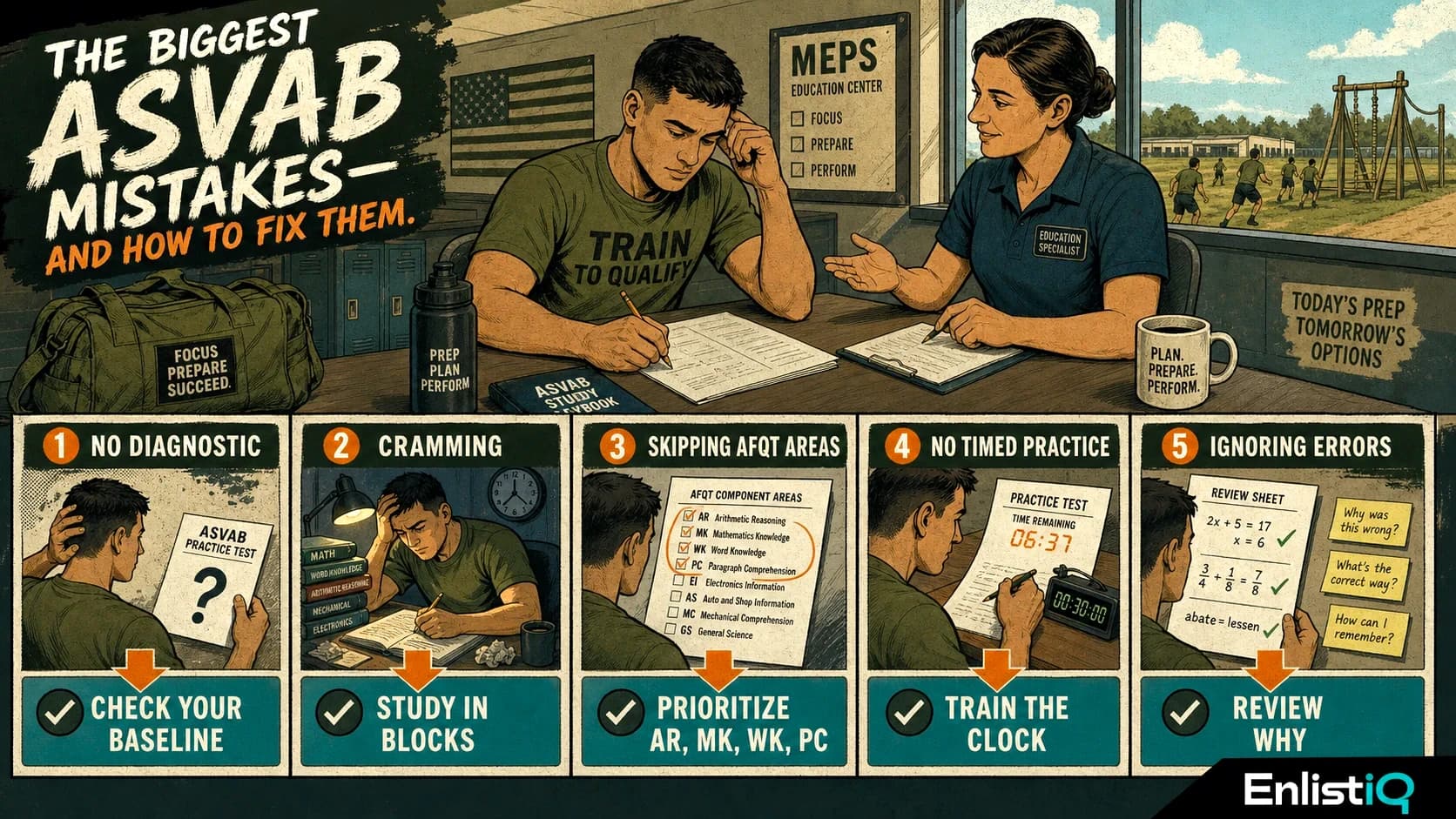
Mistake #1: Not Taking a Practice Test First
This is an easy mistake to spot and correct.
What happens: Applicants arrive with no recent practice and no clear picture of which content areas need refreshing.
Why it matters: The computerized ASVAB administers 10 subtests across verbal, math, science/technical, and spatial domains. The paper administration combines Auto Information and Shop Information into one Auto & Shop subtest. The official program recommends becoming familiar with the content and using official sample questions to find areas that need review.
The fix: Take a timed practice test before you go to MEPS. A free ASVAB practice assessment gives you a section-level baseline for planning review. It is not an official AFQT prediction.
Mistake #2: Studying Everything Equally
What happens: Applicants work through every topic in the same order without connecting the plan to their AFQT goal or target job.
Why it matters: The official scoring guide says the AFQT is computed from four subtest standard scores: Arithmetic Reasoning (AR), Mathematics Knowledge (MK), Word Knowledge (WK), and Paragraph Comprehension (PC). Other subtests can contribute to service-specific composites used for job classification even though they do not enter the AFQT calculation.
If your immediate goal is enlistment eligibility, prioritizing weak areas among the four AFQT subtests can make sense. If you are targeting a specific occupation, also study the subtests used in that service's relevant composite; each service develops its own combinations.
The fix: After your diagnostic test, rank your subtests from weakest to strongest. Spend more prep time on the AFQT sections where your comparable practice is lowest. If WK and PC are stronger than AR and MK, emphasize math while still checking the other inputs. See our ASVAB math tips guide for specific strategies.
Mistake #3: Trying to Skip a CAT-ASVAB Question
What happens: An applicant encounters a difficult CAT-ASVAB question and expects to skip it or return later. The computerized test requires a response before moving forward, and a submitted answer cannot be revisited.
Why it matters: The CAT-ASVAB presents questions one at a time and does not let you return after submitting an answer. The test continues until the subtest is complete or time expires. If time runs out, official scoring treats uncompleted items as though they were answered at random.
On the CAT, a correct response typically leads to a harder next item and an incorrect response typically leads to an easier one. The official program advises answering carefully throughout the subtest and warns against rapid random guesses near the end, which can draw a relatively large penalty.
The fix: Read the question, rule out choices you know are wrong, and make your best supported selection without spending so long that you cannot attempt later items. On a four-choice item, eliminating one option changes a blind guess from one chance in four to one chance in three—but elimination is only useful when you can rule out an option for a real reason.
Important correction: There is no official rule saying the first 5–10 questions receive extra weight. The official CAT-ASVAB description says the next item is selected after each response; treat every item carefully.
Mistake #4: Poor Time Management
What happens: A recruit spends too long on difficult questions early in a section, then rushes through (or doesn't reach) the final questions.
Why it matters: Each proctored ASVAB subtest has a time limit. The table below is for the paper-and-pencil administration, not the CAT-ASVAB:
| Subtest | Questions | Time | Per Question |
|---|---|---|---|
| AR | 30 | 36 min | ~72 sec |
| MK | 25 | 24 min | ~57 sec |
| WK | 35 | 11 min | ~19 sec |
| PC | 15 | 13 min | ~52 sec |
The computerized version uses different question counts and limits, displays the remaining time and questions on screen, and may include unscored tryout questions with additional time. Check the current official CAT table for the format you will take.
The fix: Confirm your test format and practice with its current limits. On the CAT, monitor the on-screen time and question count, but remember that you cannot skip a question and return later. The official advice is to avoid spending so much time on one item that you cannot attempt later ones.
Mistake #5: Neglecting Word Knowledge and Vocabulary
What happens: Recruits focus almost exclusively on math because it feels more "study-able." They ignore WK and PC, assuming reading comprehension is "just common sense."
Why it matters: Word Knowledge and Paragraph Comprehension feed the Verbal Expression (VE) component used in the AFQT, alongside AR and MK. Subtest standard scores—not separate "math percentile" and "verbal percentile" figures—are combined and then converted to the reported AFQT percentile.
WK asks you to identify word meanings, including synonyms and meanings in context. Vocabulary review can help, but the official program does not publish a study-word list or promise which words will appear.
The fix: Begin vocabulary review as early as your schedule allows. Use flashcards and spaced repetition (our Word Knowledge tips guide covers this in detail), and practice extracting meaning from context. Roots, prefixes, and suffixes can provide clues, but verify your interpretation against the full sentence.
Mistake #6: Not Understanding How the AFQT Is Calculated
What happens: Recruits think their AFQT is just a simple average of their subtest scores. They don't understand the formula, so they can't strategize effectively.
Why it matters: The official AFQT score-scale documentation expresses the standard-score composite conceptually as AR + MK + 2(VE), where VE is derived from WK and PC standard scores. The result is converted to a percentile. It is not a sum of raw correct answers or subtest percentiles.
That formula does not mean one extra raw WK or PC question automatically produces twice the AFQT-percentile gain of one AR or MK question. Standardization, the VE conversion, and percentile conversion prevent that kind of point-for-point shortcut.
The fix: Treat all four AFQT inputs as important and spend more time on the areas where your practice shows a genuine weakness. For a full breakdown, read our AFQT score explained guide.
Mistake #7: Taking the Test Before You're Ready
What happens: An applicant schedules the official test before reviewing weak content areas or confirming the score requirements connected to the intended service and job.
Why it matters: Under the official retest policy, you must wait one calendar month after the initial test for the first retest, another calendar month for the second retest, and six calendar months between later retests. Confirmation-testing rules can also apply after a large AFQT gain.
Retesting can therefore affect your timeline. Job availability and qualification involve more than one score, so discuss current requirements and options with your recruiter before making a contract decision.
The fix: Use practice results to identify gaps, but do not treat a commercial practice percentage as an official AFQT prediction. Confirm the current requirements with your recruiter and schedule when you have completed the review plan available to you.
Start with a free practice test to see where you stand, then study until your practice scores consistently hit your target.
The Bottom Line
Each of these mistakes can be addressed with planning, content review, or a clearer understanding of the test format.
ASVAB results can affect enlistment eligibility and military job classification, so prepare carefully and verify current requirements with your recruiter.
Official References
- Official ASVAB: Preparing for the ASVAB
- Official ASVAB: The CAT-ASVAB
- Official ASVAB: Understanding ASVAB Scores
- Official ASVAB: Retest Policy
These official links support the test facts above; they do not imply endorsement of EnlistiQ.
Related Reading
Share this article