Published January 10, 2025
6 min
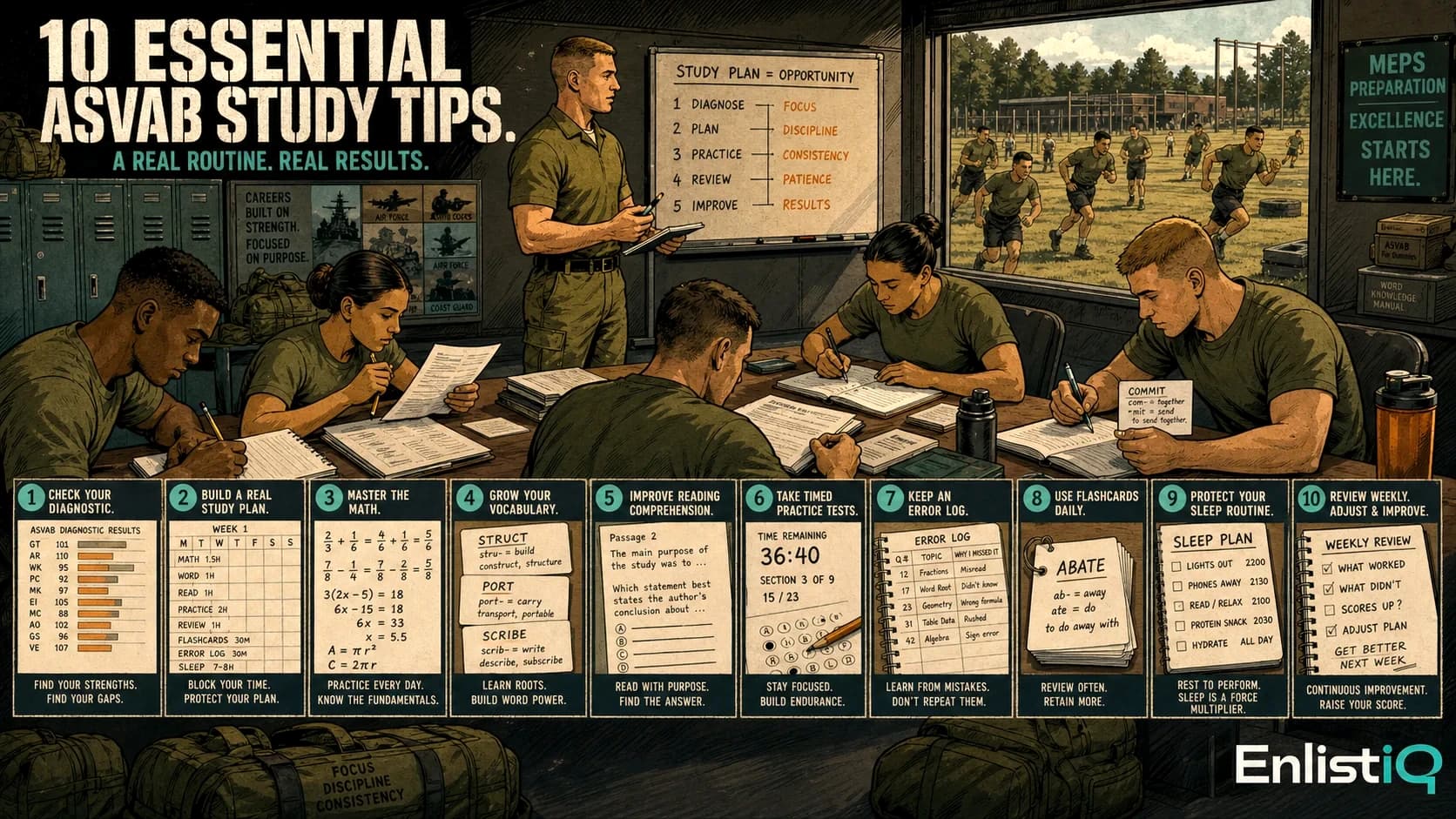
10 Essential ASVAB Study Tips for 2026
Use these ASVAB study tips to build a practical plan, raise your AFQT score, review missed questions, and focus on the sections that matter most for enlistment.
Preparing for the ASVAB (Armed Services Vocational Aptitude Battery) can feel overwhelming, but with the right strategy, you can significantly improve your score. Here are 10 essential tips to help you succeed.
The fastest way to make ASVAB prep feel manageable is to separate two goals: first, qualify to enlist by raising your AFQT score; second, qualify for the jobs you want by improving the right line scores. Those two goals overlap, but they are not identical.
1. Understand the Test Structure
The ASVAB consists of 8 sections that test different skills:
- Arithmetic Reasoning (AR) - Word problems and applied math
- Mathematics Knowledge (MK) - Algebra and geometry
- Word Knowledge (WK) - Vocabulary and synonyms
- Paragraph Comprehension (PC) - Reading comprehension
- General Science (GS) - Life and physical sciences
- Electronics Information (EI) - Electrical concepts
- Auto & Shop Information (AS) - Automotive and shop knowledge
- Mechanical Comprehension (MC) - Mechanical principles
The first four sections (AR, MK, WK, PC) determine your AFQT score, which is your enlistment eligibility score.
If you are just starting, spend most of your first week on those four AFQT sections. Once your practice score is safely above your target branch minimum, add more time for the technical sections tied to your desired MOS, rating, or AFSC.
2. Focus on Your Weak Areas First
Take an assessment to identify where you need the most improvement. Spending extra time on weak subjects will have a bigger impact on your overall score than polishing already-strong areas.
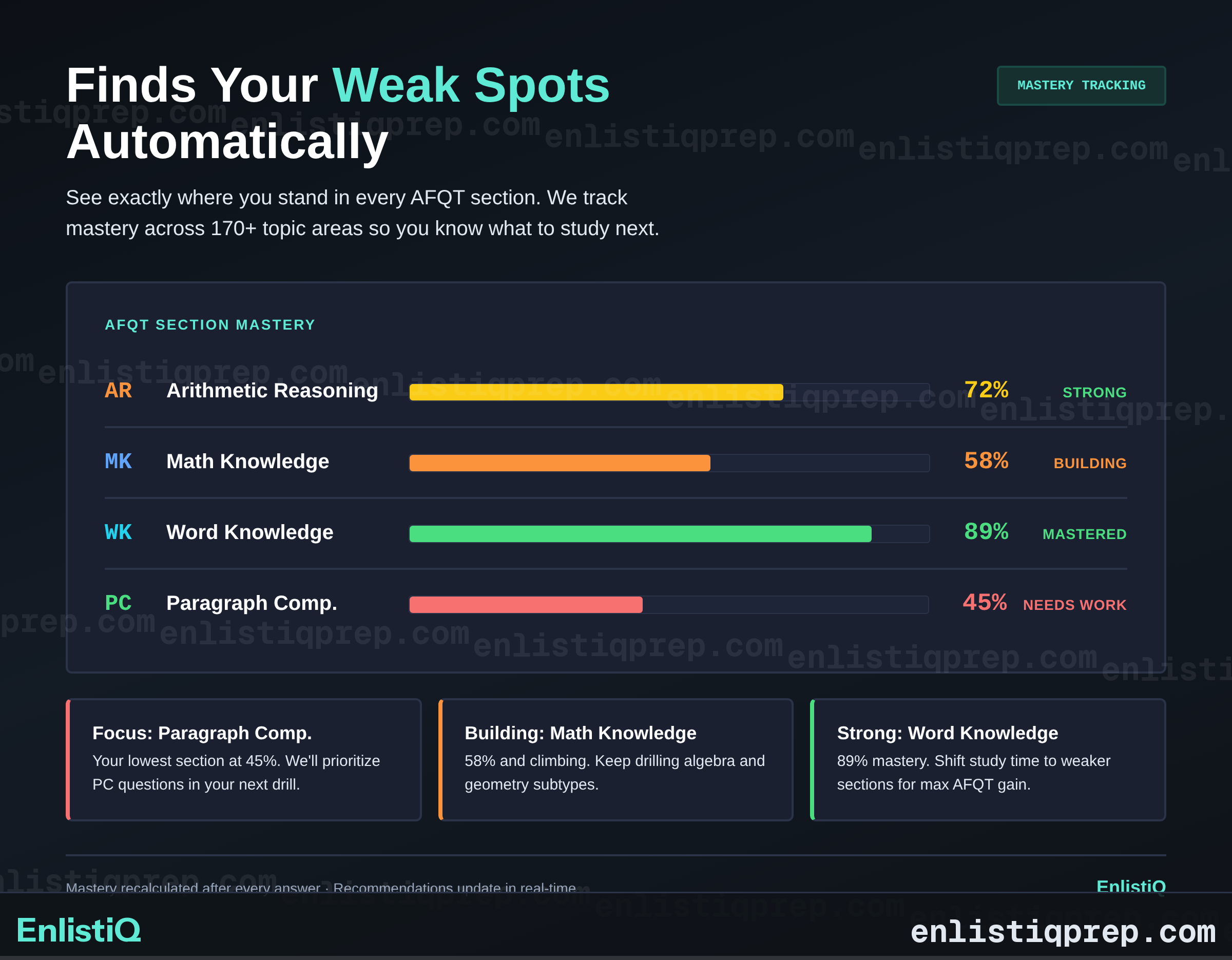
Do not guess your weak areas from how a section feels. A section can feel hard because you are learning, and a section can feel easy because you are moving too fast and missing small details. Use a timed practice test as your baseline, then rank sections by accuracy and pacing.
3. Master the Math Fundamentals
Math accounts for two of the four subtests used in your AFQT score. That is a count of subtests, not a 50% scoring weight. Make sure you're comfortable with:
- Basic arithmetic (fractions, decimals, percentages)
- Algebraic equations
- Geometry formulas
- Word problem strategies
For detailed formulas and strategies, read our ASVAB math tips guide.
4. Build Your Vocabulary
Word Knowledge is one of the faster sections to improve. Try these strategies:
- Learn common prefixes, suffixes, and root words
- Use flashcards daily
- Read military and news articles to encounter new words in context
Our Word Knowledge guide covers the most commonly tested words and root word strategies.
5. Practice Time Management
The ASVAB is timed, so you need to work efficiently:
- Don't spend too long on any single question
- If you're stuck, make an educated guess and move on
- Practice with timed tests to build your pacing
For math, write down the setup before calculating. For reading, read the question stem first so you know whether to look for the main idea, a detail, an inference, or the author's purpose. These small habits prevent time loss without forcing you to rush.
6. Use Elimination Strategies
When you're unsure of an answer:
- Eliminate obviously wrong choices first
- Look for answers that are too extreme
- Trust your first instinct unless you have a clear reason to change
7. Get Enough Sleep
Your brain consolidates learning during sleep. In the weeks leading up to your test:
- Aim for 7-9 hours of sleep per night
- Avoid cramming the night before
- Review lightly the day before, then rest
8. Take Care of Test Day Basics
On test day:
- Eat a good breakfast
- Arrive early to reduce stress
- Bring required identification
- Stay calm and confident
9. Review Your Practice Tests
After each practice test, thoroughly review:
- Questions you got wrong (understand why)
- Questions you guessed on (even if correct)
- Questions that took too long
Use a simple review log with four columns: topic, mistake type, correct method, and next drill. For example: "percent word problem / set up wrong ratio / translate 'of' as multiply / drill 10 percent questions." This turns review into a study plan instead of a vague feeling that you need to "do more math."
10. Stay Consistent
Consistent daily practice beats occasional marathon sessions:
- Study 30-60 minutes daily
- Mix different subjects to keep fresh
- Track your progress to stay motivated
A Simple Weekly ASVAB Study Rhythm
If you have four or more weeks, use this rhythm:
| Day | Focus |
|---|---|
| Monday | Arithmetic Reasoning and missed math review |
| Tuesday | Word Knowledge roots, prefixes, and synonym drills |
| Wednesday | Mathematics Knowledge formulas and algebra |
| Thursday | Paragraph Comprehension timed sets |
| Friday | Weakest AFQT section from the week |
| Saturday | Mixed timed practice test |
| Sunday | Review log, light flashcards, and rest |
If you have less time, keep the same structure but shorten the sessions. The point is not a perfect calendar; it is making sure every high-impact AFQT section gets repeated attention.
Next Steps
Ready to put these tips into practice? Here's where to start:
- ASVAB Study Guide — 4-Week Plan to Raise Your AFQT
- ASVAB Practice Test — Free Timed Test + Instant Score
- ASVAB Practice by Subject — Drill Specific Topics
Start your free ASVAB practice test with EnlistiQ and discover exactly where to focus your study time.
Related guides: How to pass the ASVAB | How long to study | GT score explained | CAT-ASVAB vs. Paper
This article is provided by EnlistiQ, an independent ASVAB study resource. EnlistiQ is not affiliated with, endorsed by, or sponsored by the U.S. Department of Defense or any branch of the U.S. Armed Forces. "ASVAB" is a trademark of the U.S. government. For official information, visit your local recruiter or officialasvab.com.
Share this article