Published February 12, 2026
Last updated August 14, 2026
11 min
CAT-ASVAB vs. Paper ASVAB: Format, Timing & Differences
Compare the CAT-ASVAB (computer adaptive) and P&P-ASVAB (paper). Timing, scoring, format differences, and which one you'll likely take.
If you're preparing for the ASVAB, you've probably heard the acronyms flying around: CAT-ASVAB, P&P-ASVAB, and maybe wondered which one you'll actually take. The truth is, the format you encounter depends on where you test—but the difference goes deeper than just pen and paper versus a screen.
The CAT-ASVAB (Computer Adaptive Test) and P&P-ASVAB (Paper-and-Pencil) are two distinct testing formats with different question progressions, timing, scoring mechanics, and strategic approaches. Both measure the same core skills and produce the same ASVAB score and AFQT percentile, but the path to that score is different. Understanding these differences is crucial because it changes how you should prepare and how you should approach test day.
This guide breaks down the specifics of each format, shows you which one you're likely to take, and gives you strategies to crush whichever version is in your future.
What is the CAT-ASVAB?
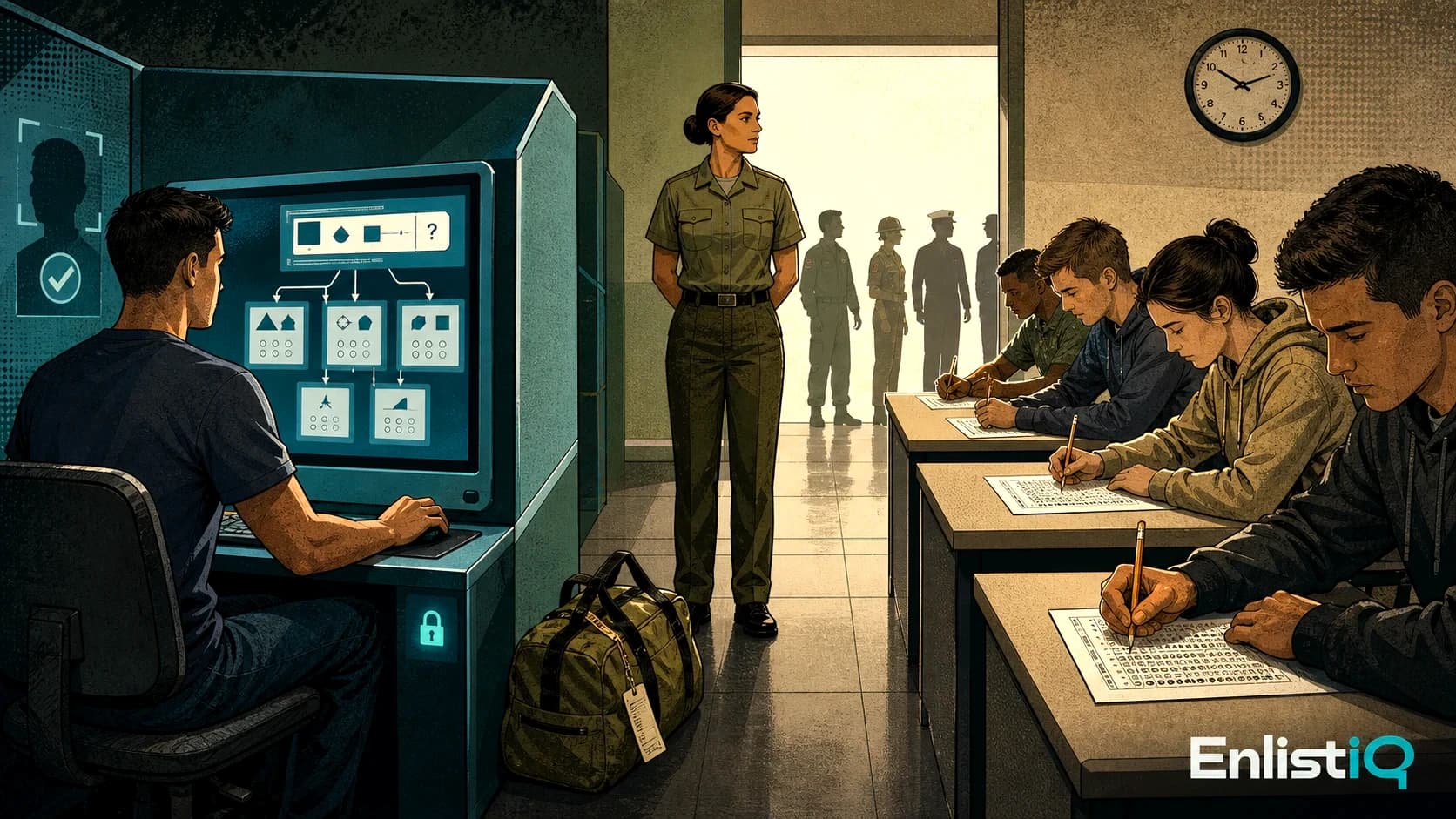
The CAT-ASVAB is administered exclusively at Military Entrance Processing Stations (MEPS) during the official enlistment process. It's a computerized test that adapts to your performance in real-time.
Here's how it works: You start with a question of medium difficulty. Answer it correctly? The next question gets harder. Miss it? The next one is easier. This continues throughout the section. The computer adjusts the difficulty dynamically, and your final score in that section is based on both the difficulty level of the questions you answered correctly and your overall accuracy.
This is the key difference from paper-and-pencil testing. You're not moving through a predetermined set of questions—you're moving through a test that actively responds to you.
Important limitations: Once you submit an answer on the CAT-ASVAB, it's gone. You cannot return to previous questions or change your answer. The test moves forward only. This creates psychological pressure that some test-takers find challenging.
The benefit? The CAT-ASVAB is generally shorter in terms of total questions and can be more precise in measuring your ability level.
What is the P&P-ASVAB?
The P&P-ASVAB is the traditional paper-and-pencil format, administered at Military Entrance Test (MET) sites, high schools, and military academies. It's a fixed-form test, meaning every test-taker receives the same set of questions in the same order.
With paper-and-pencil, you work through the test at your own pace within each section's time limit. You can skip questions, mark them for later review, and come back to change your answers—all within the same section. If you have 5 minutes left in a section and haven't answered question 12, you can flip back and fill it in.
The test is scored based on the number of correct answers and the difficulty level of those questions (questions have different point values), but there's no adaptive element. You and every other test-taker are answering the same questions.
Side-by-Side Comparison
| Feature | CAT-ASVAB | P&P-ASVAB |
|---|---|---|
| Location | MEPS only | High schools, MET sites, military academies |
| Format | Computer-adaptive | Paper-and-pencil (fixed form) |
| Number of Questions | 135 scored questions across 10 subtests | 225 questions across 9 subtests |
| Total Test Time (Section Limits) | 197 minutes | 149 minutes |
| Questions Adapt? | Yes—difficulty adjusts to your answers | No—fixed question set |
| Can You Go Back? | No—one-way progression | Yes—within each section |
| Can You Change Answers? | No | Yes |
| Scoring Method | Difficulty-based + accuracy | Accuracy + question weighting |
| Guessing Penalty? | Official guidance notes a guessing penalty | No penalty for guessing; answer every question |
| Score Range | 1-99 AFQT percentile | 1-99 AFQT percentile |
| Where You'll Likely Take It | Official enlistment process | Pre-enlistment practice, schools, confirmation tests |
How CAT-ASVAB Scoring Works
Understanding the scoring logic of the CAT-ASVAB is essential because it changes your strategy on test day.
The algorithm works like this:
- You start in the middle. The first question in each section is typically medium difficulty.
- Correct answer = harder question. If you get it right, the next question is more difficult. Harder questions are worth more points.
- Incorrect answer = easier question. If you get it wrong, the next question is easier. Easier questions are worth fewer points.
- Your score reflects difficulty + accuracy. The computer calculates your final score based on the difficulty level of the questions you answered correctly and your overall accuracy rate.
This has a critical implication: Your early answers carry more weight. Why? Because each correct answer determines the ceiling of your remaining questions. If you miss one of the first three questions, you may have already capped your maximum possible score in that section.
Conversely, if you nail the first few questions, the test ramps up in difficulty—but you've set a higher baseline for your remaining attempts.
What this means for strategy: Take your time on the first 3-5 questions in each section. Get those right, and you unlock the harder (higher-value) questions. Rush through them, and you'll spend the rest of the section answering lower-value questions.
Section-by-Section Breakdown
CAT-ASVAB reports 10 scored subtests (including separate AI and SI). P&P-ASVAB uses 9 subtests (Auto & Shop combined as AS):
| Section | CAT Questions | CAT Time | P&P Questions | P&P Time |
|---|---|---|---|---|
| General Science (GS) | 15 | 12 min | 25 | 11 min |
| Arithmetic Reasoning (AR) | 15 | 55 min | 30 | 36 min |
| Word Knowledge (WK) | 15 | 9 min | 35 | 11 min |
| Paragraph Comprehension (PC) | 10 | 27 min | 15 | 13 min |
| Mathematics Knowledge (MK) | 15 | 31 min | 25 | 24 min |
| Electronics Information (EI) | 15 | 10 min | 20 | 9 min |
| Auto Information (AI) | 10 | 7 min | — | — |
| Shop Information (SI) | 10 | 6 min | — | — |
| Auto & Shop Information (AS) | — | — | 25 | 11 min |
| Mechanical Comprehension (MC) | 15 | 22 min | 25 | 19 min |
| Assembling Objects (AO) | 15 | 18 min | 25 | 15 min |
CAT-ASVAB uses fewer scored questions (135), while P&P uses more items (225) with shorter section limits overall.
Which Format Will You Take?
If you're enlisting: You will almost certainly take the CAT-ASVAB at MEPS. This is the official military test used in the enlistment process. There are rare exceptions (technical issues, accessibility needs), but expect CAT.
If you're testing at school (ASVAB CEP): You'll take the P&P-ASVAB. High school career exams and student recruitment tests use the paper format. This is great—it lets you practice in the lower-pressure environment and get comfortable before your official MEPS test.
If you're taking a confirmation test: After enlisting, if your MEPS score is disputed or you're trying to qualify for a different job, you'll take the CAT-ASVAB again at MEPS.
Strategies for the CAT-ASVAB
1. Dominate the First Questions
The first 3-5 questions in each section set your score ceiling. Invest time here. Read carefully. Double-check your reasoning. These questions disproportionately impact your final score.
2. You Can't Go Back—Commit
Once you submit an answer, it's locked. There's no second-guessing. This means you need to be decisive and confident. If you're torn between two answers, eliminate the obviously wrong options and choose your best guess—then move on.
3. Never Leave a Question Blank
On CAT-ASVAB, unanswered items can hurt your result. If you're running out of time, make an educated guess and move on.
4. Guess Strategically
If you genuinely don't know, eliminate any clearly wrong options and pick your best guess from the remaining choices. A 50/50 guess has a better expected value than leaving it blank.
5. Focus on Accuracy Over Speed
The CAT-ASVAB gives you more time per question than the P&P format (relative to question count). Use it. Accuracy matters more than speed because your early answers determine your difficulty trajectory.
Strategies for the P&P-ASVAB
1. Skip Hard Questions and Come Back
You have the luxury of movement. If you hit a tough problem, mark it and move on. Answer the easy ones first, bank those points, then return to the harder ones.
2. Mark Questions to Review
Use your test booklet to mark questions you want to revisit. Don't waste time deciding between two answers on your first pass—mark it, move on, come back later.
3. Manage Your Time Per Section
Each section has a specific time limit. Pace yourself. Mentally divide the time by the number of questions to know how many seconds per question you can afford. Don't get stuck on one problem and blow your time budget.
4. Answer Every Question
Just like the CAT, you want to answer every question. Blank = wrong. If you're running low on time, even a random guess is better than nothing.
5. Use Your Second Pass Wisely
Once you've answered all questions you're confident about, use remaining time to revisit the marked ones. Try a different approach or angle. Sometimes a fresh look helps.
Does It Matter Which One You Take?
Both formats produce a valid ASVAB score and AFQT percentile. Both are recognized by all branches of the military. A 90 is a 90 whether you earned it on CAT or P&P.
That said, there are subtle differences in how scores are perceived:
- CAT scores are slightly more precise. The adaptive algorithm fine-tunes your ability estimate with fewer questions, so there's less variance.
- MEPS recruiting coordinators are most familiar with CAT scores. Since that's the official enlistment test, they naturally see more CAT results.
- Scores are not directly comparable between formats. A question that's "easy" on P&P might be worth fewer points than an "easy" question on CAT. But the military has equating tables, so your percentile score is standardized regardless.
The bottom line: Take whichever format you're assigned. Focus on preparation and test-day strategy, not on whether the format is "easier."
How EnlistiQ Prepares You for Both Formats
Whether you're taking the CAT-ASVAB or P&P-ASVAB, EnlistiQ can help you practice the underlying skills and work within a timer. Its original questions and interface do not reproduce either official test.
Adaptive drills can focus practice on weaker topics, while timed sets help you observe your own pacing. Review behavior differs by official format, so use the current test-day instructions from the ASVAB program for the version you are assigned.
Our analytics track your progress section by section, showing you exactly where you need to improve. And our AI tutor can explain any question, concept, or strategy in real time.
Ready to start your personalized study plan? Sign up for EnlistiQ today and get matched with a practice path based on your current score level and target job.
FAQ
Q: Can I take the P&P-ASVAB and then the CAT-ASVAB at MEPS? A: Yes, that pathway exists in many cases. Final score-use policy depends on current branch processing rules, so confirm with your recruiter.
Q: Is one format easier than the other? A: Not inherently. Both are equally challenging for the average test-taker. The CAT-ASVAB's adaptive nature can feel harder because you're constantly working at your edge, while P&P allows you to accumulate confidence by answering easier questions first. Choose the strategy that plays to your strengths.
Q: How long do I have to complete the ASVAB? A: Official section time limits are 197 minutes for CAT-ASVAB and 149 minutes for P&P-ASVAB. Many CAT test-takers finish earlier than the full limits.
Q: What if I fail the CAT-ASVAB at MEPS? Can I retake it? A: Yes. The standard schedule is one calendar month after your first test, one calendar month after your first retest, then six calendar months between later retests.
Q: Do the military branches care which format I took? A: No. Your AFQT percentile is the same whether you achieved it on CAT or P&P. All branches use the same scoring scales.
Next Steps
Ready to prepare for your ASVAB format? Here are the best resources:
- ASVAB Test Format Explained — CAT vs. Paper
- Free Four-Area AFQT Diagnostic — 12 or 31 Questions
- ASVAB Scores & Percentiles — Understanding Your Score
Additional Resources
Ready to start studying? Check out these related articles:
- How to Pass the ASVAB: Complete Study Guide
- Top 10 ASVAB Study Tips for Fast Learners
- Master ASVAB Math: Arithmetic Reasoning & Math Knowledge
Disclaimer: This article is for informational purposes only and reflects the ASVAB testing policies as of February 2026. Testing formats, question counts, and time limits may be subject to change by the Department of Defense. For the most current official information, visit officialasvab.com or consult your recruiter. EnlistiQ is an independent test preparation platform and is not affiliated with or endorsed by the U.S. Department of Defense or any military branch.
Share this article