Published March 7, 2026
Last updated September 8, 2026
9 min
PiCAT vs ASVAB: Difficulty, Timing & Verification
Is PiCAT easier than ASVAB? Compare both formats, understand the 45-day verification window, and choose your next step with a clear testing timeline.
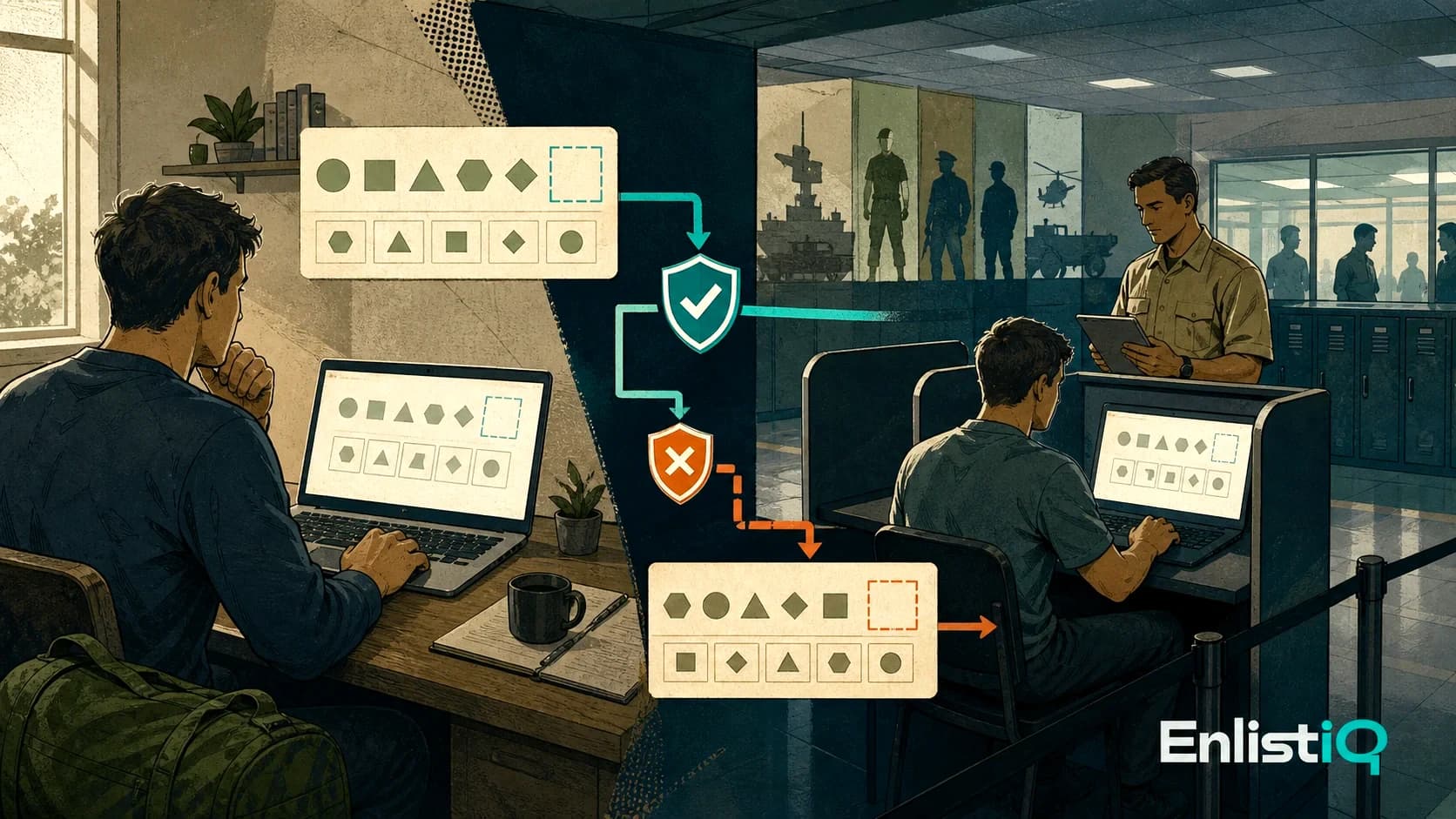
The PiCAT—short for Pending Internet Computerized Adaptive Test—is the unproctored version of the CAT-ASVAB. It can be convenient because you take it on your own computer, but the result is provisional until a proctored Verification Test confirms it. The current official ASVAB PiCAT guide should be your source of truth if a recruiter offers this option.
The most important correction to older PiCAT advice is the deadline: the Verification Test must now be taken within 45 days of the PiCAT, not 30 days.
Is PiCAT Easier or Harder than the ASVAB?
PiCAT changes the setting and timing; it is not a guaranteed easier score. It is the unproctored version of CAT-ASVAB, with no time limit on each individual subtest. You still need to demonstrate your ability under supervision during verification. Your best choice depends on whether you can work independently in a suitable environment and complete the required follow-up.
| Your situation | What to discuss with your recruiter |
|---|---|
| You have never taken the ASVAB and have a quiet place to test | Whether PiCAT and a verification appointment fit your schedule |
| You prefer supervision and set section time limits | Scheduling a proctored CAT-ASVAB |
| You have already taken the ASVAB | The applicable ASVAB testing or retest process; PiCAT is for first-time applicants |
| Your main concern is readiness | Practice the subjects first; changing formats will not replace missing knowledge |
Check your starting point: Take the free ASVAB diagnostic to identify weak AFQT subjects before your recruiter schedules an official test. EnlistiQ practice is not PiCAT registration or an official Verification Test.
PiCAT Rules at a Glance
According to the official PiCAT guide:
- A military recruiter must register you and issue an access code; the code expires 30 days after issuance.
- Once you begin, you must complete the PiCAT within 48 hours.
- The test generally takes 2 to 3 hours, with no time limit on each individual subtest.
- PiCAT is available only to applicants who have never taken the ASVAB and can be taken only once.
- If your result suggests you may be eligible for service, you must take a proctored Verification Test at a MEPS or Military Entrance Test (MET) site.
- The Verification Test must occur within 45 days and generally takes 25 to 30 minutes.
- You do not receive a separate Verification Test score. A successful verification makes the PiCAT result your official ASVAB score of record.
Your recruiter sees the PiCAT result; you do not receive it directly from the testing system.
PiCAT Timeline: Three Different Clocks
The official PiCAT guide sets separate windows for access, completion, and verification. Do not use the code-expiration deadline as the verification deadline.
| Stage | When the clock starts | Published window |
|---|---|---|
| Access code | Recruiter issues the code | Code expires after 30 days |
| PiCAT completion | You begin the test | Finish within 48 hours; allow about 2–3 hours of testing |
| Verification | PiCAT is taken | Complete the required proctored verification within 45 days |
Arrange the verification appointment with your recruiter early enough to meet the deadline. The Verification Test generally takes 25–30 minutes; that is a typical duration, not a promise that your full MEPS visit will be finished in half an hour.
After successful verification, the PiCAT result becomes the official ASVAB score of record. If it is not validated, ask the testing staff which follow-on testing is required and which result will apply. Do not treat a provisional home result as a final score.
What Makes PiCAT Different?
PiCAT uses the computerized adaptive ASVAB format without a proctor at your location. It measures the same aptitude areas and reports scores in the same format as the ASVAB, but it has no tryout items and no per-subtest time limits. The official applicant testing guide explains the current format, supported browsers, and testing-site rules.
That flexibility is not permission to use outside help. The official program specifically says to take PiCAT without a calculator, internet lookups, posted questions, or another person's assistance. Your result should reflect what you can reproduce in a controlled setting.
How the Verification Test Works
The Verification Test is designed to check the consistency of your performance between the unproctored and proctored sessions. It validates or does not validate the PiCAT result; it is not another reported score.
The ASVAB Testing Program does not publish an applicant-facing point margin or a rule such as “within 10 points.” It also does not provide a public question-by-question blueprint for the Verification Test. Treat websites that claim to know an exact passing gap with caution.
If your PiCAT is not validated, do not assume the provisional result remains usable. Ask your recruiter before test day what follow-on testing will be required and which result would become your score of record. That process is administered by the testing program and MEPS, not by a prep site.
Side-by-Side Comparison
| Feature | PiCAT | Proctored CAT-ASVAB |
|---|---|---|
| Where you take it | A suitable location with a computer and internet | MEPS or most MET sites |
| Proctor present | No | Yes |
| Typical testing time | About 2–3 hours | About 2 hours on average |
| Timing | No limit on each individual subtest; finish within 48 hours after starting | Time limits apply to each subtest |
| Verification required | Yes, within 45 days if directed | No separate PiCAT Verification Test |
| Who can take it | First-time ASVAB applicants; once only | Applicants scheduled under current testing rules |
| When it becomes official | After successful verification | After the proctored test is scored |
Once you have an official ASVAB score, the official applicant FAQ says it may be used for enlistment for up to two years from the test date, provided it can be verified as yours.
Which Should You Choose?
Choose PiCAT if…
You have a quiet place, stable internet, a suitable device, and enough uninterrupted time to finish. You are comfortable producing the same level of performance later under proctored conditions, and you understand that the Verification Test is required before the result becomes official.
Choose the proctored CAT-ASVAB if…
You prefer a controlled testing environment and want to complete the official test in one proctored session. This can also be the practical route if you have already taken the ASVAB, cannot meet PiCAT eligibility rules, or do not have a reliable place to test at home.
Neither option is inherently a shortcut. Choose the setting in which you can follow the rules and show your actual ability.
Score Validity and Retesting
PiCAT can be taken only once and only before any ASVAB attempt. Do not label an unsuccessful Verification Test as a normal voluntary “first retake”; ask the recruiter or test administrator how it affects your testing record.
For standard ASVAB retesting, the official retest policy requires one calendar month after the initial test, another calendar month before the second retest, and six calendar months before additional retests. Special confirmation-testing and invalidation rules can apply, so the testing staff—not a prep article—should determine your next eligible date.
How to Prepare for Each Option
If You Choose PiCAT
- Study as if the result must be reproduced—because it does. Review all subtests before you begin.
- Use a quiet, interruption-free location with stable internet. These are recommendations from the official PiCAT guide.
- Set aside enough time. You have 48 hours after starting, but the official guidance recommends trying to finish without stopping.
- Use only permitted materials. Scratch paper and a pen or pencil are allowed; assistance, calculators, and internet lookups are not.
- Keep preparing for verification. Do not stop reviewing once the home session is over.
If You Choose the Proctored CAT-ASVAB
- Practice the computer-adaptive workflow. You cannot return to a question after answering it on CAT-ASVAB.
- Work with realistic section timing. The official test applies time limits to each subtest.
- Read each question carefully and keep moving. The official ASVAB preparation page recommends ruling out incorrect choices and avoiding random guesses at the end of a CAT-ASVAB subtest.
- Follow your recruiter's arrival and identification instructions. Late arrivals may have to reschedule.
Frequently Asked Questions
How long do I have to take the Verification Test?
The current official deadline is 45 days from the PiCAT date.
What score difference causes verification to fail?
The testing program does not publish an applicant-facing numeric threshold. Claims about an exact allowable point gap are not official guidance.
Can I use a calculator or look up answers on PiCAT?
No. The official PiCAT guidance expressly says to take it without any assistance, including a calculator or internet help.
Is the Verification Test harder than PiCAT?
The official program describes its purpose as checking consistency, not as producing a second score or deliberately being harder. Prepare to demonstrate the same knowledge under proctored conditions.
Is the PiCAT Verification Test Timed?
It is a supervised testing appointment, and the official guide says it generally takes 25–30 minutes. That duration should not be interpreted as an unlimited home session or as a published time allowance for each question. Follow the test administrator's timing instructions.
Can I take PiCAT after taking the ASVAB?
No. The official program limits PiCAT to applicants who have never taken the ASVAB.
Key Takeaways
- PiCAT is convenient but conditional. The result is provisional until verified.
- The current verification window is 45 days. Older 30-day advice is stale.
- The Verification Test generally takes 25 to 30 minutes and provides no separate score.
- No exact verification margin is publicly stated. Ignore unofficial “10-point” rules.
- PiCAT is for first-time ASVAB applicants and can be taken only once.
- Prepare honestly for either format. The goal is an accurate score that reflects your own work.
Official References
- Official ASVAB: Unproctored Administration of the ASVAB—PiCAT
- Official ASVAB: What to Expect When You Take the ASVAB
- Official ASVAB: Applicant FAQs
Related Reading
Share this article