Published March 4, 2026
Last updated August 14, 2026
9 min
ASVAB Test Explained: Format, Timing & What to Expect
Complete guide to the ASVAB test including format, all 10 subtests, scoring, CAT-ASVAB vs paper-and-pencil, MEPS experience, test day rules, and retake policy.
Understanding the ASVAB format, scoring, and test-day rules removes avoidable surprises. This guide separates current official facts from study suggestions so you know what to confirm before your appointment.
What Is the ASVAB Test?
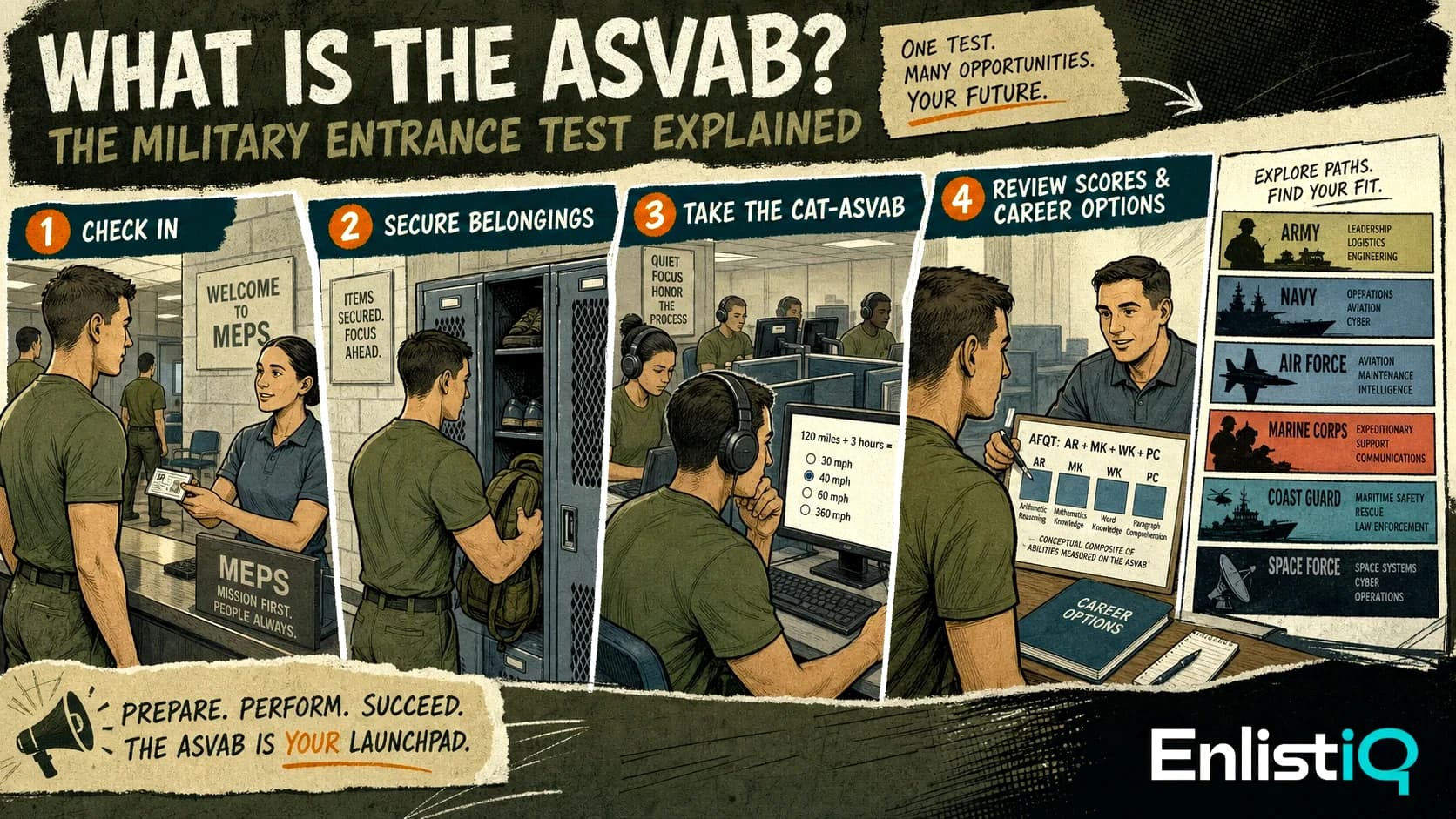
The Armed Services Vocational Aptitude Battery (ASVAB) is the Department of Defense enlistment test used to help determine military eligibility and classify applicants into occupations. Its subtests measure aptitudes across verbal, math, science/technical, and spatial domains. The official program explains that AFQT scores support enlistment decisions while service composite scores support military job classification.
The ASVAB is not a guarantee of a particular job. Services use their own composites and current standards, and other qualifications and job availability also matter.
ASVAB Test Format: CAT-ASVAB vs Paper-and-Pencil
Most enlistment testing is computerized at a Military Entrance Processing Station (MEPS) or Military Entrance Test (MET) site. The paper-and-pencil version is now used at only a handful of MET sites. The official What to Expect guide provides the current administration details.
CAT-ASVAB (Computerized Adaptive Test)
- Format: Computer-adaptive; the next question is selected using the response to the previous question
- Location: MEPS and most MET sites for proctored enlistment testing
- Scored questions: 135 across 10 subtests
- Published limits without tryout questions: 197 minutes when all subtest limits are added together
- Typical completion: About two hours on average
- Results: Available immediately after the proctored session at MEPS or a MET site
Some examinees receive unscored tryout questions in two to four subtests. Those questions are mixed into the selected subtests, and additional time is provided. Once you submit an answer on the CAT-ASVAB, you cannot return to change it.
Paper-and-Pencil ASVAB
- Format: Fixed items on paper
- Location: A limited number of MET sites in the Enlistment Testing Program
- Questions: 225
- Published subtest limits: 149 minutes total
- Full session: About three to four hours including instructions and administrative tasks
- Results: Usually available after answer sheets are scanned and verified, which the official program says generally takes a few days
Within the current paper subtest, you may review answers before time is called. You cannot return to an earlier subtest or move ahead until instructed.
All 10 Computerized ASVAB Subtests
The table below lists the scored CAT-ASVAB questions and limits without tryout questions. The official CAT-ASVAB table also lists the possible tryout counts and expanded limits.
| Code | Subtest | Scored Questions | Limit Without Tryouts | AFQT Input | Officially Described Aptitude |
|---|---|---|---|---|---|
| GS | General Science | 15 | 12 min | — | Knowledge of physical and biological sciences |
| AR | Arithmetic Reasoning | 15 | 55 min | Yes | Ability to solve arithmetic word problems |
| WK | Word Knowledge | 15 | 9 min | Yes | Word meaning in context and synonyms |
| PC | Paragraph Comprehension | 10 | 27 min | Yes | Ability to obtain information from written passages |
| MK | Mathematics Knowledge | 15 | 31 min | Yes | Knowledge of high-school mathematics principles |
| EI | Electronics Information | 15 | 10 min | — | Knowledge of electricity and electronics |
| AI | Auto Information | 10 | 7 min | — | Knowledge of automobile technology |
| SI | Shop Information | 10 | 6 min | — | Knowledge of tools, shop terminology, and practices |
| MC | Mechanical Comprehension | 15 | 22 min | — | Knowledge of mechanical and physical principles |
| AO | Assembling Objects | 15 | 18 min | — | Ability to determine how an object will look when assembled |
The paper administration combines AI and SI into a single Auto & Shop Information (AS) subtest, so its published table has nine test sections rather than 10.
How ASVAB Scoring Works
Standard Scores and the AFQT
Individual ASVAB subtests are reported as Standard Scores relative to the official reference population. The AFQT uses the standard scores from four subtests:
- Arithmetic Reasoning (AR)
- Mathematics Knowledge (MK)
- Word Knowledge (WK)
- Paragraph Comprehension (PC)
The official technical documentation expresses the standard-score composite conceptually as:
AFQT composite = AR + MK + (2 × VE)
VE is derived from WK and PC standard scores; it is not a simple sum of raw correct answers. The composite is then converted to the reported 1–99 percentile. See the official AFQT score-scale technical report for the methodology.
An AFQT percentile indicates the percentage of the official reference group that scored at or below that result. It is not the percentage of questions answered correctly.
Official AFQT Categories
| Category | AFQT Percentile Range |
|---|---|
| I | 93–99 |
| II | 65–92 |
| IIIA | 50–64 |
| IIIB | 31–49 |
| IVA | 21–30 |
| IVB | 16–20 |
| IVC | 10–15 |
| V | 1–9 |
These are reporting categories, not a branch-eligibility table. Standard high-school AFQT floors are Army 31, Marines 31, Navy 31, Air Force 31, Space Force 36, and Coast Guard 32. Standard GED floors are Army 31, Marines 50, Navy 50, Air Force 50, Space Force 50, and Coast Guard 47; limited exception pathways may differ.
Service Composite Scores
Beyond the AFQT, each service develops and validates composite scores from different combinations of ASVAB subtests. Those composites help determine the occupations for which an applicant is best suited. Use the official service-composite table for current formulas, then confirm the current cutoff for a specific occupation with your recruiter.
Do not add raw practice-test totals to estimate an official AFQT or service composite. Commercial practice is useful for spotting weak areas, but it does not reproduce military scoring and equating.
What to Expect on Test Day
Your recruiter screens you and schedules testing at a MEPS or MET site. A physical exam may also be conducted during the entrance-processing timeline, but the order and schedule can vary. For the ASVAB testing session itself, the official program says:
- Bring valid identification required for admission to the testing room.
- Arrive on time; late applicants may be turned away and rescheduled.
- Your recruiter is not permitted inside the testing room.
- Calculators are not allowed.
- Questions are controlled testing material; do not seek, share, record, or reproduce live test content.
Ask your recruiter for the exact document list, arrival time, transportation details, and local rules for electronics or personal items. Do not rely on a generic online checklist for a specific MEPS appointment.
Practical Test-Day Preparation
The official preparation guide recommends preparing in advance, knowing the format, reviewing sample questions, and getting plenty of rest. During the test:
- Read the directions and each question carefully.
- Watch the remaining time without sacrificing accuracy.
- Rule out choices you know are incorrect, then make an educated selection.
- On the CAT-ASVAB, verify the selected answer before submitting because you cannot return.
- If CAT time is running short, continue making legitimate attempts rather than rapidly entering random guesses near the end.
Who Takes the ASVAB?
- Military applicants: A recruiter schedules enlistment testing at a MEPS or MET site.
- Students: Schools may offer the ASVAB through the Career Exploration Program for career planning.
- Current service members: In-service testing may be available for reclassification; members should contact their base education office.
The official testing-locations page explains these routes.
ASVAB Retest Policy
The official policy uses calendar-month waits:
| Test Sequence | Minimum Wait |
|---|---|
| Initial test to first retest | One calendar month |
| First retest to second retest | One additional calendar month |
| After the second retest | Six calendar months between later retests |
A gain of 20 or more AFQT points within six months may trigger a confirmation test under separate rules. Read the official ASVAB retest policy and coordinate the date with your recruiter.
Official ASVAB scores may be used for enlistment for up to two years from the test date, according to the program's applicant FAQ.
Frequently Asked Questions
How long does the CAT-ASVAB take?
The official program says the proctored CAT-ASVAB takes about two hours on average. The 10 published limits without tryout questions add to 197 minutes, but most examinees finish individual subtests before each limit. Tryout questions can add questions and time in selected subtests.
Can I skip a CAT-ASVAB question and return later?
No. You answer one item at a time and cannot change an answer after moving forward.
Can I use a calculator?
No. The official program states that calculators are not allowed on the ASVAB.
Which subtests determine the AFQT?
AR, MK, WK, and PC standard scores are used. VE is derived from WK and PC, and the resulting composite is converted to the AFQT percentile.
Do the other subtests matter?
Yes. Although they do not enter the AFQT, they can feed service-specific composites used for job classification.
Next Steps: Start Your ASVAB Prep
Start with a diagnostic to identify content gaps, then review the four AFQT subtests and any additional subtests used in the service composite for your target occupation. Treat EnlistiQ results as practice feedback, not official score predictions.
Related Reading:
- How to Pass the ASVAB: Complete 2026 Guide
- What is the AFQT Score? (Complete Breakdown)
- ASVAB Study Tips
- Understanding the GT Score
Official References
- Official ASVAB: What to Expect
- Official ASVAB: The CAT-ASVAB
- Official ASVAB: Understanding ASVAB Scores
- Official ASVAB: Preparing for the ASVAB
- Official ASVAB: Retest Policy
EnlistiQ is an independent ASVAB preparation platform and is not affiliated with, endorsed by, or sponsored by the U.S. Department of Defense, any branch of the U.S. Armed Forces, or the official ASVAB program.
Share this article