Published March 2, 2026
Last updated August 14, 2026
5 min
5 CAT-ASVAB Test Strategies Most Recruiters Won't Tell You
Prepare for the CAT-ASVAB with practical adaptive-test strategies, section pacing guidance, guessing rules, and ways to avoid late-test penalties.
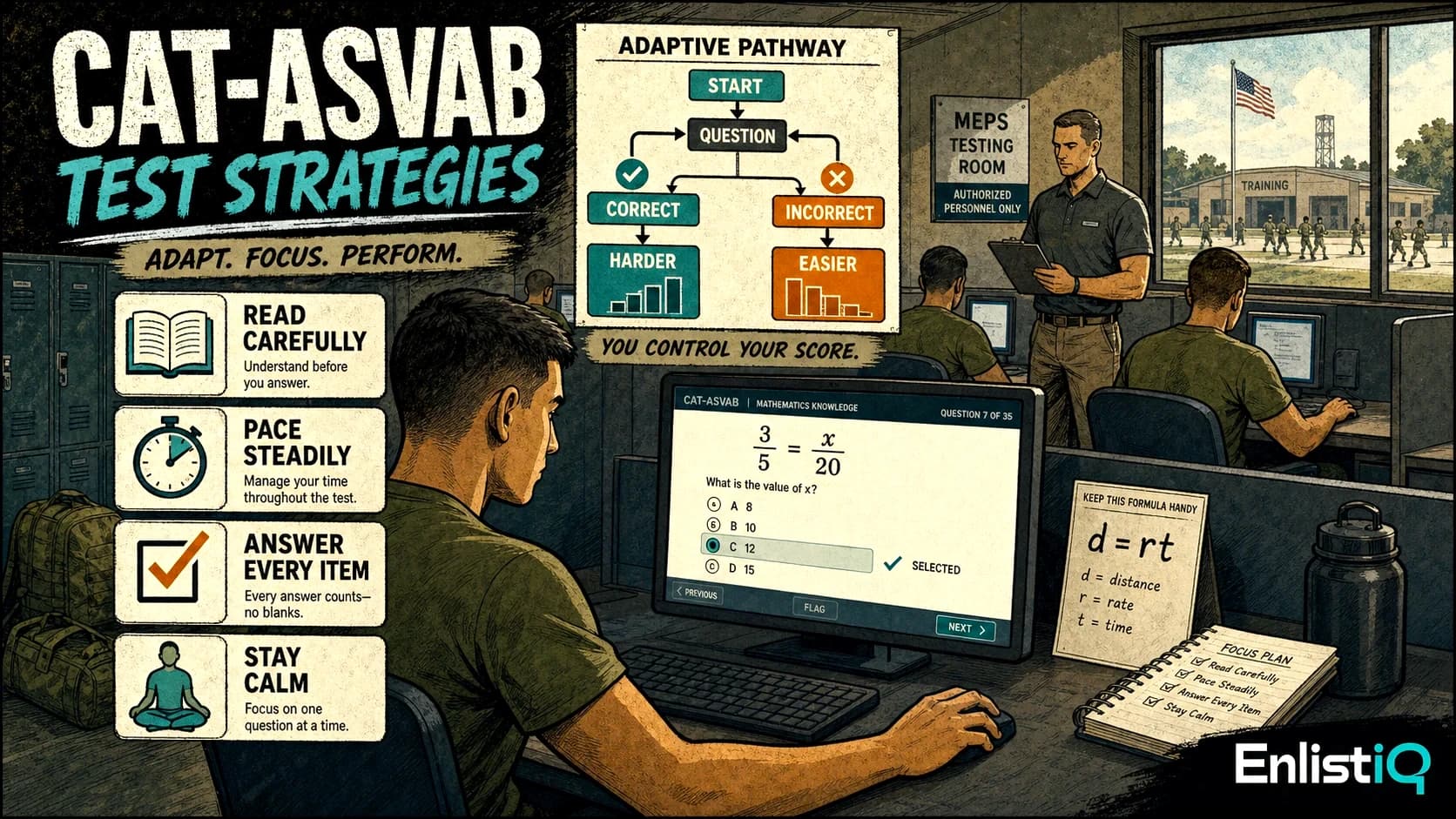
Studying content is only part of preparing for the CAT-ASVAB (Computerized Adaptive Test). It also helps to understand the format. On the official test, each response updates the estimate of your ability and helps select the next question; final scoring accounts for both correctness and question difficulty. The official CAT-ASVAB explanation is the best source for the current process.
Here are five strategies that can sharpen your approach.
1. Treat Every Question Seriously — There Is No Official "Early Bonus"
The CAT-ASVAB selects a question after evaluating the response that came before it. The official program does not say that the first 5–10 questions receive extra weight, so do not treat an early item as if it is worth double.
What this means: Work carefully from the first question through the last. Once you submit an answer, you cannot return to change it. If time is running short, keep trying to answer legitimately instead of rapidly filling in random guesses; the official preparation guidance warns that several wrong answers near the end of a CAT subtest can bring a relatively large penalty.
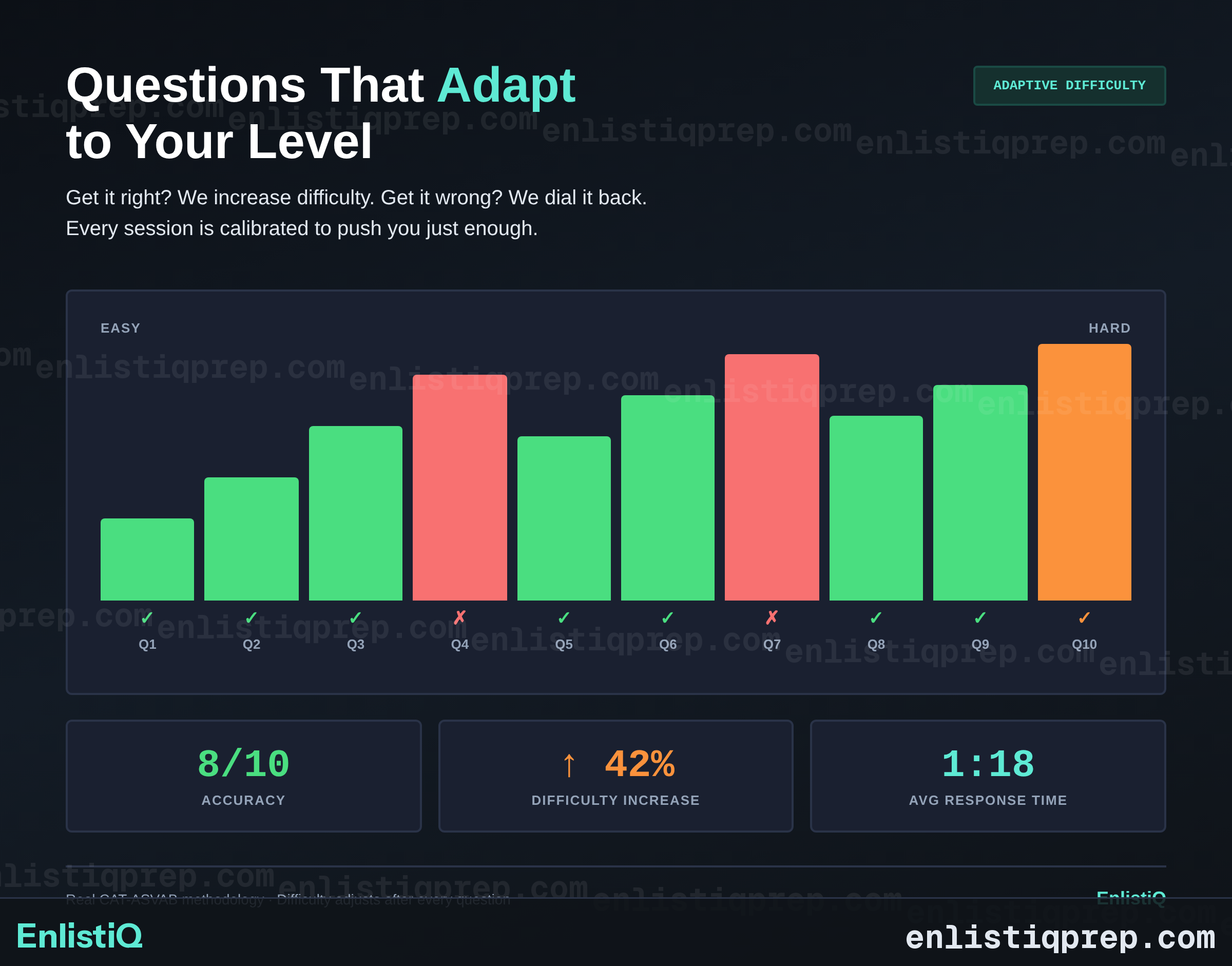
The adaptive format does move toward harder questions after correct responses and easier questions after incorrect responses. That is how the test targets questions to your estimated ability—not evidence of a special scoring multiplier for the first third.
2. Elimination Beats Memorization
When you are unsure of the right answer, eliminate choices you can show are wrong. On a four-choice question, removing two options for valid reasons leaves a 50/50 choice.
Practice this method:
- Cover the answer choices mentally
- Read the question and think about what the answer should look like
- Then look at the options and cross off what doesn't fit
- Choose from what's left
This can work well on verbal questions and on math questions where you can estimate a reasonable range before calculating. It also matches the official ASVAB test-taking advice: rule out as many incorrect choices as possible, then make an educated guess from what remains.
Process of elimination does not replace content knowledge, but it is better than a blind guess when you are genuinely unsure.
3. The AFQT Uses Four Subtests — Focus There First
Your AFQT is the ASVAB-based measure used for enlistment eligibility. It is computed from standard scores on four subtests:
- Arithmetic Reasoning (AR) — word problems and applied math
- Mathematics Knowledge (MK) — high-school mathematics principles
- Word Knowledge (WK) — vocabulary and synonyms
- Paragraph Comprehension (PC) — reading comprehension
The other six computerized subtests do not enter the AFQT calculation, but they can feed the service-specific composites used for military job classification. Each service builds and validates its own composite formulas, as shown in the official program's military jobs and composites guide. Enlistment cutoffs and exceptions can change, so confirm the current requirement for your education and applicant category with your recruiter instead of relying on a static branch-minimum list.
If enlistment eligibility is your immediate goal, start with weak areas among AR, MK, WK, and PC. Also review any technical subtests used in the service composite for your target occupation.
4. Don't Study What You Already Know
Drilling your strong areas can feel productive because you get more questions right. A diagnostic can reveal lower-performing practice areas that deserve more review.
Here's why: If one comparable practice set is consistently much weaker than another, extra work in the weaker area may close a larger content gap. Those practice percentages are diagnostic signals, not official AFQT percentiles or promises of a particular increase.
Start with a diagnostic, compare section-level practice, and devote a larger share of study time to your bottom two or three areas while continuing to check stronger skills.
One suggested approach is to spend most of your study time on your lowest practice areas while periodically retesting stronger areas. Tools like EnlistiQ's free diagnostic assessment break down your practice performance by section so you can choose where to focus. EnlistiQ practice results are not official ASVAB scores.
5. Rehearse Timed Test Conditions Before MEPS
Studying untimed with notes open is fine for learning. Add at least one or two timed rehearsals under controlled conditions:
- No phone
- Follow the per-subtest limits you plan to practice
- No looking anything up
- Use the current official CAT-ASVAB limits, recognizing that tryout questions can add questions and time to selected subtests
This gives you a realistic rehearsal for pacing and sustained attention. The official program says the proctored CAT-ASVAB takes about two hours on average, although the exact experience varies.
Bonus tip: Take your practice tests at the same time of day as your MEPS appointment. If your test is at 0600, don't practice at 2pm when you're fully awake. Train your brain for the exact conditions it'll face.
TL;DR — The 5 Strategies
- Treat every item carefully — there is no official early-question scoring bonus, and submitted answers cannot be changed
- Eliminate wrong answers instead of guessing blindly — even removing 2 options doubles your odds
- Prioritize AFQT sections (AR, MK, WK, PC) — their standard scores feed the AFQT eligibility measure
- Study your weaknesses deliberately — use diagnostics to locate the largest practice gaps
- Rehearse under timed conditions before MEPS — practice current subtest limits and sustained focus
What's Your Next Move?
If you don't know where your weak spots are, start with a diagnostic. EnlistiQ's free AFQT practice assessment breaks down your practice performance by section. It is not an official ASVAB score report.
Already know your weak areas? Start a practice drill and put these strategies to work.
Official References
- Official ASVAB: The CAT-ASVAB
- Official ASVAB: Preparing for the ASVAB
- Official ASVAB: Understanding ASVAB Scores
EnlistiQ is an independent ASVAB preparation platform. The official ASVAB program does not endorse EnlistiQ or any paid test-preparation provider.
Share this article