Published February 8, 2026
Last updated August 14, 2026
16 min
ASVAB Word Knowledge Tips: How to Build Vocabulary Fast
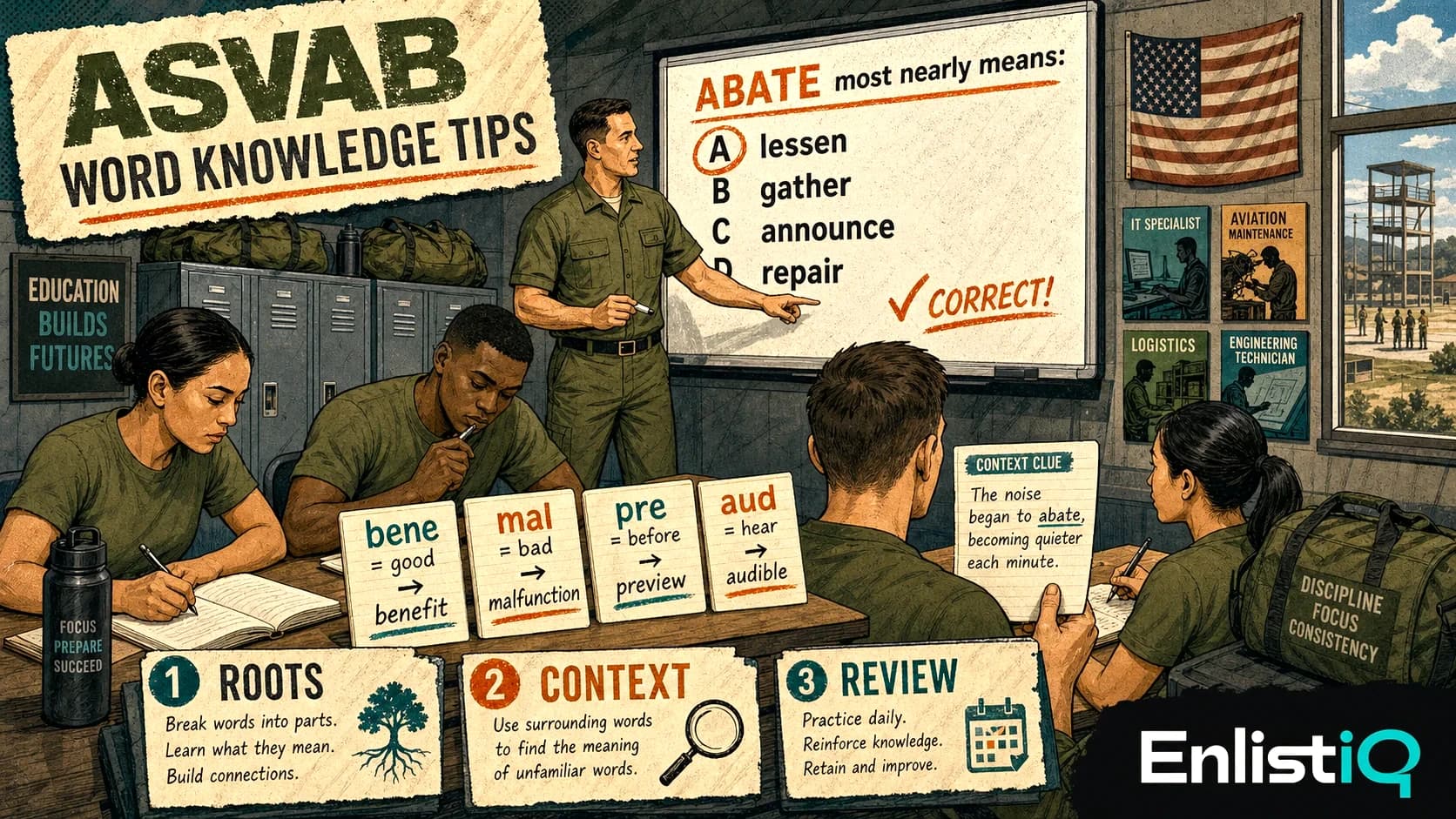
Boost your ASVAB Word Knowledge score with proven vocabulary strategies. Root words, context clues, study techniques, and original vocabulary examples.
If you're preparing for the ASVAB, you already know that Word Knowledge is crucial. It's one of the four sections that make up your AFQT score, and it directly feeds into your Verbal Expression (VE) score—which impacts not just your AFQT, but also your GT score. In other words, mastering vocabulary on the ASVAB isn't just about passing one section. It's about unlocking better scores across the board.
Word Knowledge is a section you can practice systematically. Building vocabulary, recognizing word parts, and using context clues can make unfamiliar items more approachable, but individual score changes vary. This guide gives you a practical study method for test day.
Why Word Knowledge Matters
Your Word Knowledge (WK) score isn't isolated. Here's how it connects to your overall performance:
Feeds into Verbal Expression (VE): Word Knowledge is combined with Paragraph Comprehension to calculate your VE score. VE is one of the most important metrics on the ASVAB.
VE Impacts AFQT: Your VE score is a core component of the AFQT calculation, which determines your military eligibility and branch qualification. A higher VE directly raises your AFQT.
VE Impacts GT Score: The GT score—used for technical and specialized roles—also incorporates VE. This means strong vocabulary skills open doors to more career fields.
Speed Matters: On the CAT-ASVAB (Computer Adaptive Test), Word Knowledge has 15 scored questions and 9 minutes of section time when no tryout questions are included. That pace makes quick recognition and careful elimination important; it does not create a predictable score gain on a fixed timeline.
What the Word Knowledge Section Tests
Before you start studying, it helps to understand exactly what you're up against.
Question Types
Definition Format ("X most nearly means:"): You're given a single word in isolation, and you choose the answer that best matches its meaning.
Example:
Resilient most nearly means:
A) Fragile
B) Flexible
C) Stubborn
D) Indifferent
Context Format (Word in a sentence): You're given a word used in a sentence, and you choose the meaning that fits the context.
Example:
The general issued a terse command before the mission.
A) Urgent
B) Loud
C) Brief and blunt
D) Confidential
Both formats test the same skill—knowing word meanings—but the context version gives you a clue. Smart test-takers use that clue.
Vocabulary Level
ASVAB vocabulary sits roughly at the SAT level, with some military and technical terms sprinkled in. You won't see obscure, PhD-level words. The test is designed to measure practical communication ability, not esoteric knowledge. That said, words appear across a range of difficulty:
- Common words with tricky definitions: Words you know, but not all their meanings (e.g., "bear" as a verb, not an animal)
- Moderately difficult words: SAT-level vocabulary that a typical high school student should recognize (e.g., "audacious," "pragmatic")
- Military/technical terms: Words common in military contexts or technical fields (e.g., "ordnance," "caliber," "deployment")
The Power of Root Words, Prefixes & Suffixes
Here's a secret: you don't need to memorize thousands of words to dominate Word Knowledge. Instead, learn the building blocks. Understanding roots, prefixes, and suffixes allows you to decode words you've never seen before.
Think of it this way: English has roughly 170,000 words in current use. But they're all built from a few thousand roots and combining forms. Master the building blocks, and you can infer the meaning of hundreds of words.
Common Prefixes
| Prefix | Meaning | Example |
|---|---|---|
| un- | not, opposite | unhappy, undo |
| re- | again, back | rebuild, rewrite |
| pre- | before | preview, prepare |
| mis- | wrongly, badly | mislead, misbehave |
| anti- | against, opposite | antibody, antipathy |
| sub- | under, below | submarine, subtext |
| inter- | between, among | interact, international |
| trans- | across, beyond | transfer, translate |
| dis- | not, opposite, away | disagree, dismantle |
| over- | above, too much | overlap, overthink |
| under- | below, not enough | underneath, underestimate |
| semi- | half, partly | semicircle, semifinal |
Common Suffixes
| Suffix | Meaning | Example |
|---|---|---|
| -tion/-sion | act, state, result | creation, decision |
| -ment | state, action, result | movement, enjoyment |
| -able/-ible | capable of, worthy of | comfortable, possible |
| -ous | full of, characterized by | dangerous, joyous |
| -ful | full of | beautiful, helpful |
| -less | without | homeless, careless |
| -ive | tending to, relating to | creative, productive |
| -ity/-ty | state, quality, condition | clarity, purity |
| -ness | state, condition, quality | happiness, kindness |
| -er/-or | one who | teacher, actor |
| -ly | in a manner, like | quickly, slowly |
| -age | collection, action, state | baggage, courage |
Common Root Words
| Root | Meaning | Example Words |
|---|---|---|
| bene | good, well | benefit, benevolent, beneficial |
| mal | bad, evil | malicious, malfunction, malpractice |
| port | carry, bear | transport, import, support |
| scrib/script | write | describe, prescribe, manuscript |
| aud | hear, listen | audio, audience, audible |
| vis/vid | see, look | vision, video, visible |
| dict | speak, say | predict, dictionary, dictate |
| ject | throw, cast | reject, inject, trajectory |
| tract | pull, draw | attract, contract, distract |
| struct | build | structure, construct, instruct |
| pel/pul | push, drive | propel, repel, impulse |
| mort | death | mortal, immortal, mortify |
| chron | time | chronology, chronic, synchronize |
| graph | write, draw | graph, paragraph, biography |
| phon | sound, voice | telephone, phonetic, symphony |
| path | feeling, suffering | sympathy, pathetic, apathy |
| spect | look, see | inspect, respect, perspective |
Practice this: Take a word like "malevolent." Break it down: mal (bad) + vol (wish/will) + ent (state/quality). Literally: "the state of wishing bad things." Boom. You've decoded it without memorizing the definition.
8 Strategies for ASVAB Word Knowledge
1. Learn Root Words (Most Efficient)
Root words are the master key. A single root unlocks dozens of related words. Spend 15 minutes a day learning roots, and you'll see payoff within a week.
How: Use flashcards or apps focused on roots, not random vocabulary lists. Study 5-7 roots per day, then review previous days' roots. In two weeks, you'll know 70+ roots and can infer meaning for hundreds of words.
2. Read 20 Minutes a Day
The ASVAB tests words that actually exist in English media. Reading exposes you to vocabulary in context, which is how you learn language naturally.
What to read: News articles, magazines, blogs, or even military-themed content. Avoid fiction with archaic language (like 19th-century novels)—stick to modern, accessible material. When you encounter a word you don't know, write it down and look it up.
3. Use Flashcards with Spaced Repetition
Flashcards work because repetition cements vocabulary into long-term memory. Spaced repetition—reviewing cards just as you're about to forget them—is the gold standard.
How: Create flashcards with the word on one side and definition + context on the other. Review difficult cards more often, easier cards less often. Aim for 10-15 minutes daily.
4. Study Words in Context, Not Isolation
A word without context is just a string of letters. Context is where meaning lives.
How: Always learn words with example sentences. When you see a word on the test, the context clues in the sentence are your allies. Practice identifying context clues: "but," "however," "similarly," "in contrast," etc.
5. Use Elimination on Test Day
On the test, you won't always know every word. Elimination is your second-best friend (first is root words).
How: Even if you don't know the word's meaning, eliminate answers that don't make sense in context. If a word is "opulent," you can eliminate "cheap" or "minimal" based on the sound and structure. Is it positive or negative? That alone eliminates half the options.
6. Look for Word Parts You Recognize
On test day, if you encounter a word you've never seen, dissect it. Look for prefixes, suffixes, and roots you know.
Example: You see "preemptive." You don't need to know its exact definition. You recognize "pre-" (before). That's enough to eliminate answers about things that happen after, or that aren't anticipatory.
7. Learn Common Military and Technical Vocabulary
Some words appear frequently in military contexts. These are worth memorizing directly.
Common military/technical words:
- Ordnance (ammunition, military equipment)
- Caliber (skill level, quality; also gun measurement)
- Deployment (assignment to a location or duty)
- Protocol (official procedure, rules)
- Logistics (movement and supply of forces)
- Tactical (related to immediate military action)
- Strategic (related to long-term military planning)
- Commendation (official praise)
- Discipline (orderliness; also punishment)
- Reconnaissance (military observation)
8. Practice With Timed Drills
Speed matters. You have 9 minutes for 15 questions—about 36 seconds per question.
How: Use practice tests and time yourself. Focus on maintaining accuracy while building speed. Once you can answer 15 questions correctly in 9 minutes, you're ready.
Common ASVAB Vocabulary Words
Below are 30 original study words organized by difficulty level. This is a practice list, not a list of secure ASVAB questions or verified test-word frequencies. These aren't the only words you need to know, but mastering them gives you a strong foundation.
Foundational Level
- Abrasive — Rough, harsh, or irritating
- Abundant — Plentiful, present in large quantities
- Concise — Brief, short and clear
- Diligent — Hard-working, careful and thorough
- Equivalent — Equal in value, amount, or meaning
- Fragile — Delicate, easily broken
- Genuine — Authentic, real and not fake
- Hospitable — Friendly and welcoming to guests
- Idle — Not working, lazy or inactive
- Juvenile — Relating to young people or childish behavior
Intermediate Level
- Ambiguous — Having more than one possible meaning, unclear
- Benign — Harmless, not causing harm or damage
- Candid — Honest and direct in speech
- Defunct — No longer existing or functioning
- Eloquent — Fluent and persuasive in speech
- Frivolous — Not serious, trivial
- Gregarious — Fond of being with others, social
- Homogeneous — Of the same kind throughout
- Indigenous — Native to a particular region
- Jocular — Characterized by joking and good humor
Advanced Level
- Acrimonious — Bitter, angry, or harsh in tone
- Belligerent — Aggressive and eager to fight
- Cogent — Compelling, clear and persuasive
- Diatribe — A forceful and bitter verbal attack
- Esoteric — Intended for or likely to be understood by only a small number of people
- Fortuitous — Happening by chance or accident in a lucky way
- Gesticulation — Excited or emphatic gesturing without words
- Harbinger — A person or thing that announces or signals the approach of another
- Imbue — To permeate or inspire with a feeling or quality
- Judicious — Having, showing, or done with good judgment or wisdom
How to Use Context Clues
The Word Knowledge section often provides context clues embedded in the sentence. Learning to spot and use these clues dramatically improves your accuracy—even on words you don't know.
Types of Context Clues
Synonym context: The sentence contains a word or phrase with a similar meaning.
- Example: "The ancient artifact was a relic from thousands of years ago."
- Clue: "artifact" and "thousands of years ago" suggest "relic" means something old and valuable.
Antonym context: The sentence contains a word or phrase with an opposite meaning (often signaled by "but," "however," "unlike").
- Example: "Unlike his verbose colleague, the manager was terse in meetings."
- Clue: "Unlike" signals that "terse" is opposite of "verbose," so it means brief or concise.
Definition context: The sentence directly defines the word.
- Example: "The curriculum—the set of courses offered at the school—was updated last year."
- Clue: The dash provides a definition.
Example context: The sentence provides examples that suggest meaning.
- Example: "She displayed aptitude in various skills, mastering math, languages, and music."
- Clue: "aptitude" is paired with examples of skills and mastery, suggesting ability or talent.
Test-Taking Strategy with Context Clues
- Read the sentence carefully without looking at the answer choices yet.
- Identify the context clues — Look for synonyms, antonyms, definitions, or examples in the surrounding words.
- Predict the meaning before looking at the options.
- Eliminate obviously wrong answers — If you know the word is negative, eliminate positive answers.
- Substitute each answer choice into the sentence and see which feels most natural.
- Choose the best fit, not just a word that matches one definition.
Example Walkthrough
Question: "The coach's acerbic criticism was particularly demoralizing to the young athletes."
Step 1: Read carefully. The word is "acerbic," and it's paired with "criticism" and "demoralizing."
Step 2: Identify context clues. The phrase "demoralizing to the young athletes" tells you that "acerbic criticism" has a negative effect.
Step 3: Predict meaning. Something negative, harsh, or biting.
Step 4: Look at answers:
- A) Constructive (positive—eliminate)
- B) Sharp, bitter, or harsh (matches your prediction)
- C) Generous (positive—eliminate)
- D) Detailed (neutral—doesn't match context)
Answer: B. Even if you didn't know "acerbic" before, context clues narrowed it down.
Study Plan for Word Knowledge
Here's a realistic, high-impact study plan. You can adjust the timeline based on your needs.
Week 1: Root Words and Prefixes
- Daily commitment: 15 minutes
- Focus: Learn 5-7 root words per day (bene, mal, port, scrib, aud, vis, dict)
- Method: Flashcards with roots on one side, examples on the other
- Review: Spend first 5 minutes reviewing previous days' roots, then learn new ones
- Goal: Recognize and decode words with common roots
Week 2: Suffixes and Reading
- Daily commitment: 20 minutes (10 min flashcards, 10 min reading)
- Focus: Flashcard drills on suffixes; read articles and flag new words
- Method: Continue root review, add suffix cards, read news/blogs
- Add: Create a personal vocabulary list from your reading
- Goal: See roots and suffixes activate automatically when you encounter new words
Week 3: Practice Questions and Context Clues
- Daily commitment: 20 minutes
- Focus: Timed Word Knowledge practice questions; context clue strategies
- Method: Use flashcards + practice questions; focus on eliminating wrong answers
- Analyze: On questions you miss, identify whether it's a root/suffix you didn't know, or a context clue you misinterpreted
- Goal: Score 80%+ on practice quizzes
Week 4: Timed Practice Tests
- Daily commitment: 15 minutes
- Focus: Full-speed, timed practice (15 questions in 9 minutes)
- Method: Take practice tests and review mistakes immediately
- Refine: Practice only the strategies that work for you
- Goal: Speed + accuracy; build test-day confidence
How EnlistiQ Helps With Vocabulary
EnlistiQ's platform is designed specifically for ASVAB success, and Word Knowledge is a key area we've invested in.
Spaced Repetition Flashcards: Instead of studying the same words over and over, our system uses proven spaced repetition to review words just as you're about to forget them. This maximizes retention with minimal time investment.
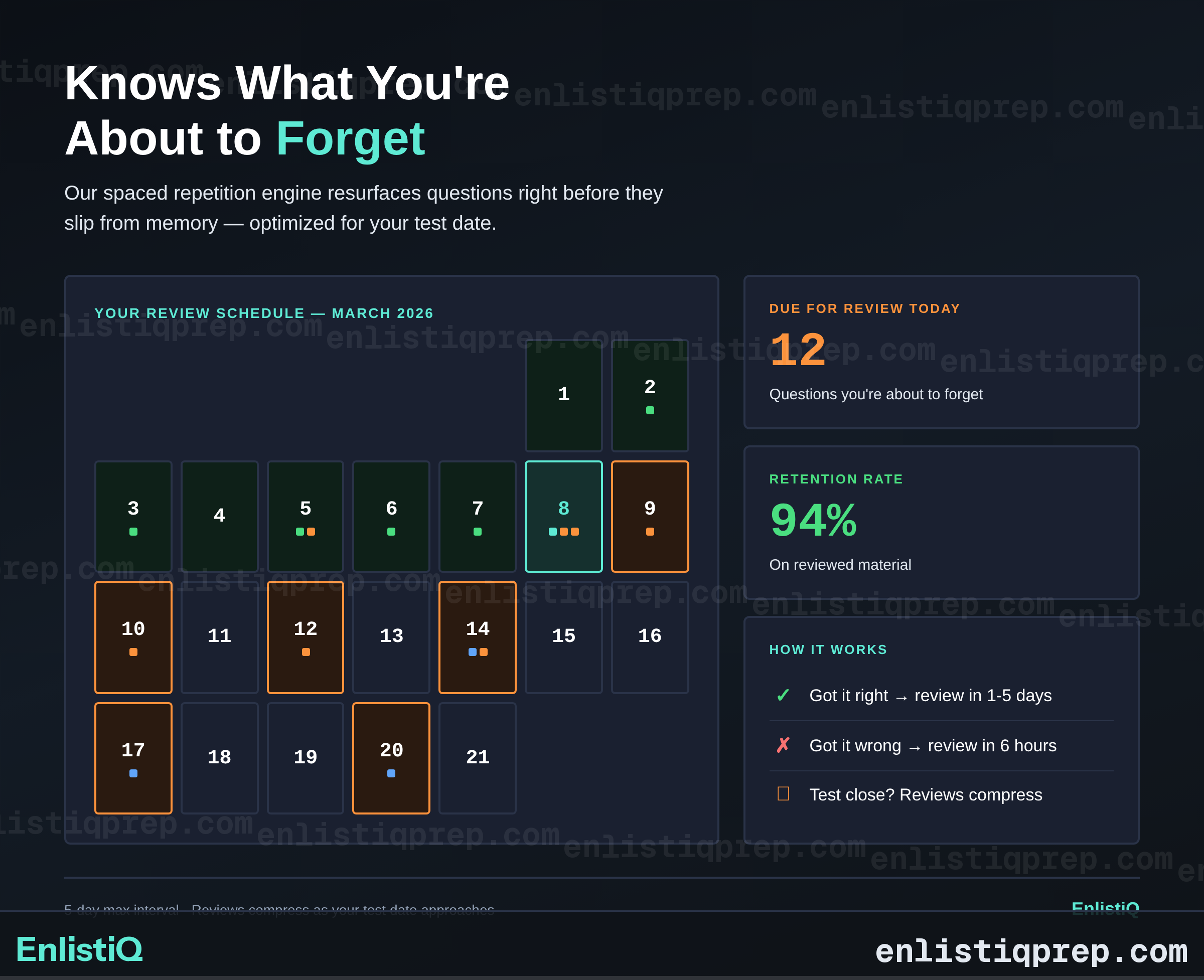
AI Tutor: Get stuck on a word? Our AI tutor explains definitions, shows you examples, and helps you understand the roots and context. It's like having a personalized vocabulary coach available 24/7.
Adaptive Practice: Our practice questions adapt to your skill level. You'll focus on the words and concepts that will give you the biggest score boost, not waste time on words you already know.
Progress Tracking: See your vocabulary growth in real time. Watch your Word Knowledge score climb week over week.
Ready to boost your vocabulary? Sign up for EnlistiQ today and access adaptive drills, AI-powered tutoring, and proven study plans designed for ASVAB success.
FAQ
Q: How many vocabulary words do I need to memorize? A: You do not need to memorize one enormous list. Combine a manageable vocabulary deck with roots, prefixes, context practice, and regular review. Use your own accuracy data to decide which method is helping.
Q: How long does it take to improve my Word Knowledge score? A: There is no responsible universal timeline or point estimate. Start with a baseline, practice consistently, and compare accuracy and pacing over time. An unofficial practice trend does not guarantee the same change on the official ASVAB.
Q: Should I use a dictionary during study? A: Yes. Write down new words you encounter while reading, look them up, and add them to your flashcard deck. This makes learning organic and meaningful. However, on test day, you won't have access to a dictionary, so rely on context clues and word parts.
Q: What's the difference between Word Knowledge and Paragraph Comprehension? A: Word Knowledge tests individual words and their meanings (in isolation or simple sentences). Paragraph Comprehension tests your ability to understand longer passages and answer questions about what you've read. Both feed into your Verbal Expression score, so both matter.
Q: Can I study Word Knowledge alongside other ASVAB sections? A: Absolutely. In fact, vocabulary study is quick and flexible—15 minutes a day is enough. You can do flashcards on the bus, between classes, or while waiting. Pair Word Knowledge study with longer study blocks for other sections like general math fundamentals or reading comprehension.
Next Steps
Ready to build vocabulary and boost your score? Here's where to start:
- Free Four-Area AFQT Diagnostic — 12 or 31 Questions
- ASVAB Practice by Subject — Drill Word Knowledge
- ASVAB Study Guide — 4-Week Plan to Raise Your AFQT
Related Reading
- What is the AFQT Score and Why Does It Matter?
- GT Score Explained: Why It Matters for Your Military Career
- How to Pass the ASVAB: A Comprehensive Guide
- ASVAB Study Tips: The Complete Preparation Strategy
Disclaimer
This guide is for educational purposes and reflects the general format and content of the ASVAB based on publicly available test specifications. Word choices and specific test items may vary. For official ASVAB information, visit officialasvab.com. Always consult with your recruiting office or military guidance counselor for the most current testing information and score requirements for your branch of service.
Share this article