Published July 6, 2026
Last updated August 14, 2026
5 min
Paragraph Comprehension Practice Test Tips for the ASVAB
Improve ASVAB Paragraph Comprehension with a practical reading strategy for main idea, detail, inference, and vocabulary-in-context questions.
Paragraph Comprehension looks simple until the answer choices start sounding almost the same. The official ASVAB subtest description says PC measures your ability to obtain information from written passages. In practice, that means finding evidence efficiently and refusing to add information that is not there.
That skill matters because Paragraph Comprehension is one of the four subtests used to calculate the Armed Forces Qualification Test (AFQT) score, along with Arithmetic Reasoning, Mathematics Knowledge, and Word Knowledge.
If PC is a weak spot, start with focused Paragraph Comprehension practice instead of only taking full mixed tests.
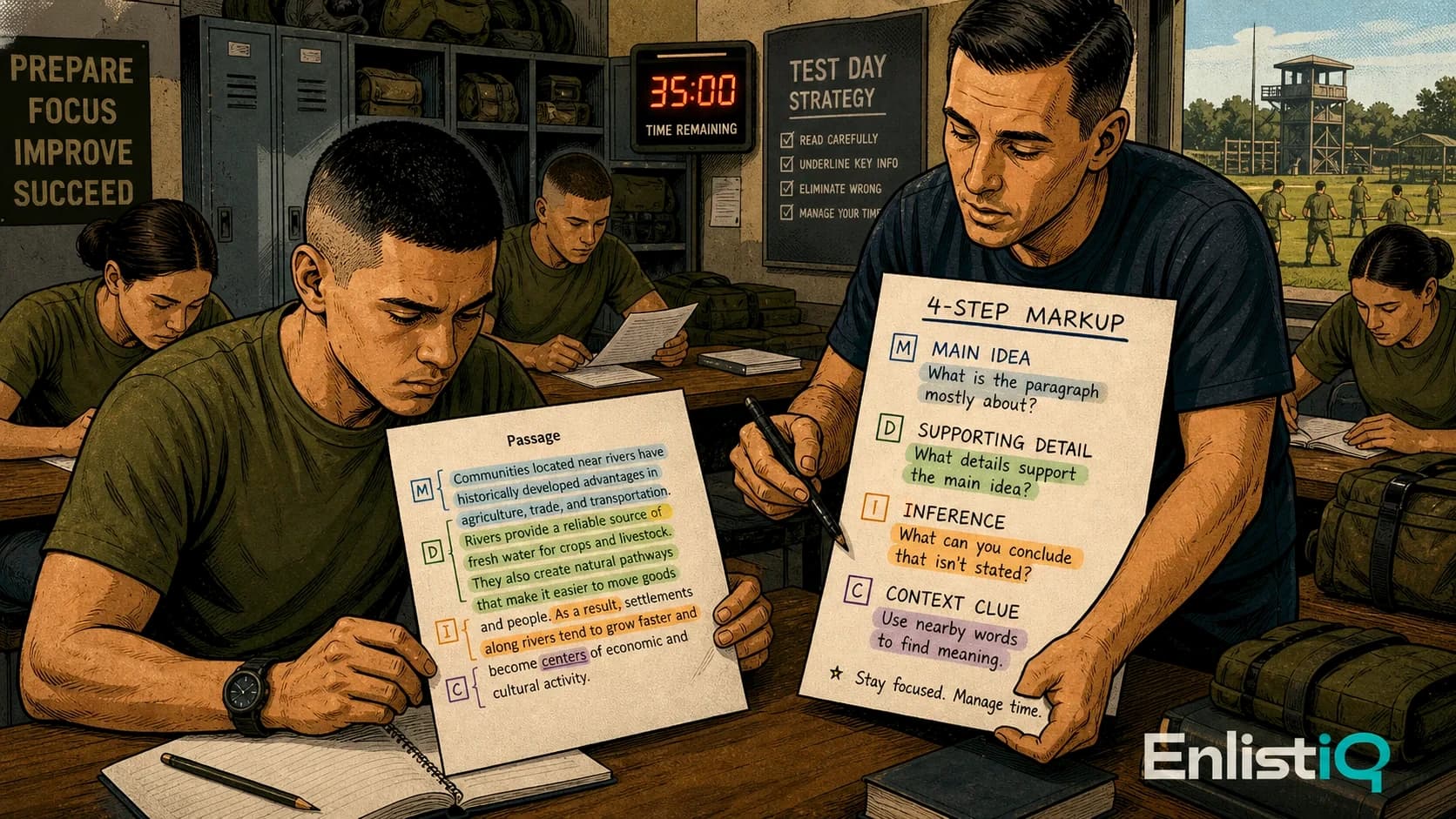
The Four Question Types
For review purposes, it helps to sort Paragraph Comprehension questions into four practical buckets. These are study labels, not categories published by the ASVAB Testing Program.
1. Main Idea
Main idea questions ask what the passage is mostly about.
Wrong answers often include:
- A detail from the passage
- A statement that is too broad
- A statement that is true but not central
- An outside idea that sounds related
The best answer should cover the whole passage, not just one sentence.
2. Detail
Detail questions ask for something stated directly.
For these, do not rely on memory. Go back to the sentence. The correct answer usually uses different wording than the passage, but the meaning should match.
3. Inference
Inference questions ask what can reasonably be concluded.
The key word is reasonably. The answer must follow from the passage. If you need outside knowledge to make the answer work, it is probably wrong.
4. Vocabulary in Context
Vocabulary-in-context questions ask what a word means inside the passage.
Do not choose a definition just because you know the word. Use nearby clues. The passage controls the meaning.
Read the Question First
One strategy worth testing during practice is:
- Read the question.
- Identify the task: main idea, detail, inference, or vocabulary.
- Read the passage with that task in mind.
- Choose the answer supported by the text.
This prevents wandering. You are not reading for everything. You are reading for the answer.
Use the Evidence Test
Before picking an answer, ask:
"Where is the evidence?"
If the answer is correct, you should be able to point to a sentence or phrase that supports it. If you cannot, the answer may be a trap.
Common traps:
- Too broad: bigger than what the passage says
- Too narrow: only one detail, not the main point
- Reversed: says the opposite of the text
- Outside info: may be true in real life, but not supported by the passage
- Extreme wording: uses words like always, never, only, or completely when the passage is more careful
Practice With Short Sets
Short sets make it easier to review each decision carefully instead of rushing through a long session.
Try this routine:
- Do 5 PC questions.
- Label each question type.
- For every miss, write the sentence that supported the correct answer.
- Label the trap that pulled you away.
That last step is where the improvement happens. You are training your brain to recognize the wrong-answer pattern before it catches you again.
A Sample PC Walkthrough
Passage:
Military supply teams track food, fuel, and repair parts so units can operate without interruption. When supply records are inaccurate, field operations may slow down or stop.
Question:
What is the main point of the passage?
Choices:
A. Food is the most important military supply. B. Accurate supply tracking supports field operations. C. Repair parts are difficult to track. D. Field units should reduce fuel use.
Correct answer: B. Accurate supply tracking supports field operations.
Why: The passage is not only about food, repair parts, or fuel. It is about supply tracking keeping operations moving.
What to Do If You Read Slowly
Slow reading is not always the problem. Slow decision-making is.
If you read slowly, practice this:
- Read the first and last sentence carefully.
- Notice contrast words like however, although, but, and therefore.
- Do not reread the whole passage unless the question requires it.
- Eliminate answers that are unsupported or too extreme.
The goal is not speed for its own sake. The goal is accurate evidence selection.
The Bottom Line
Paragraph Comprehension is not about guessing what the author "probably meant." It is about matching the answer to evidence in the passage.
Use the Paragraph Comprehension practice test to drill main idea, detail, inference, and context questions until the traps start to look obvious.
Official References
- The ASVAB Testing Program publishes retired sample questions for Paragraph Comprehension so you can see the official question style.
- Its ASVAB preparation guidance recommends reading each question carefully, watching the time, and ruling out incorrect choices before making an educated guess.
Next steps:
- Take a free AFQT practice test
- Read the ASVAB Paragraph Comprehension guide
- Start a free ASVAB practice test with score
EnlistiQ is an independent ASVAB preparation platform and is not affiliated with, endorsed by, or sponsored by the U.S. Department of Defense, any branch of the U.S. Armed Forces, or the official ASVAB program.
Share this article