Published July 6, 2026
Last updated August 14, 2026
5 min
Mechanical Comprehension Practice Test Guide for the ASVAB
Learn how to study ASVAB Mechanical Comprehension with a practical guide to levers, pulleys, gears, hydraulics, pressure, force, and diagrams.
Mechanical Comprehension feels intimidating if you have never worked on engines, tools, or machines. The good news is that the ASVAB is not asking you to rebuild a transmission. It is testing whether you understand basic mechanical principles.
That means you can improve with the right practice.
Start with a focused Mechanical Comprehension practice test, then study the concepts behind every missed question.
What Mechanical Comprehension Tests
The official ASVAB program defines Mechanical Comprehension as knowledge of mechanical and physical principles. Its test description and timing table also shows why you should confirm which format you will take: the proctored CAT-ASVAB currently has 15 scored MC questions and may include tryout questions, while the paper-and-pencil form has a different count and time limit.
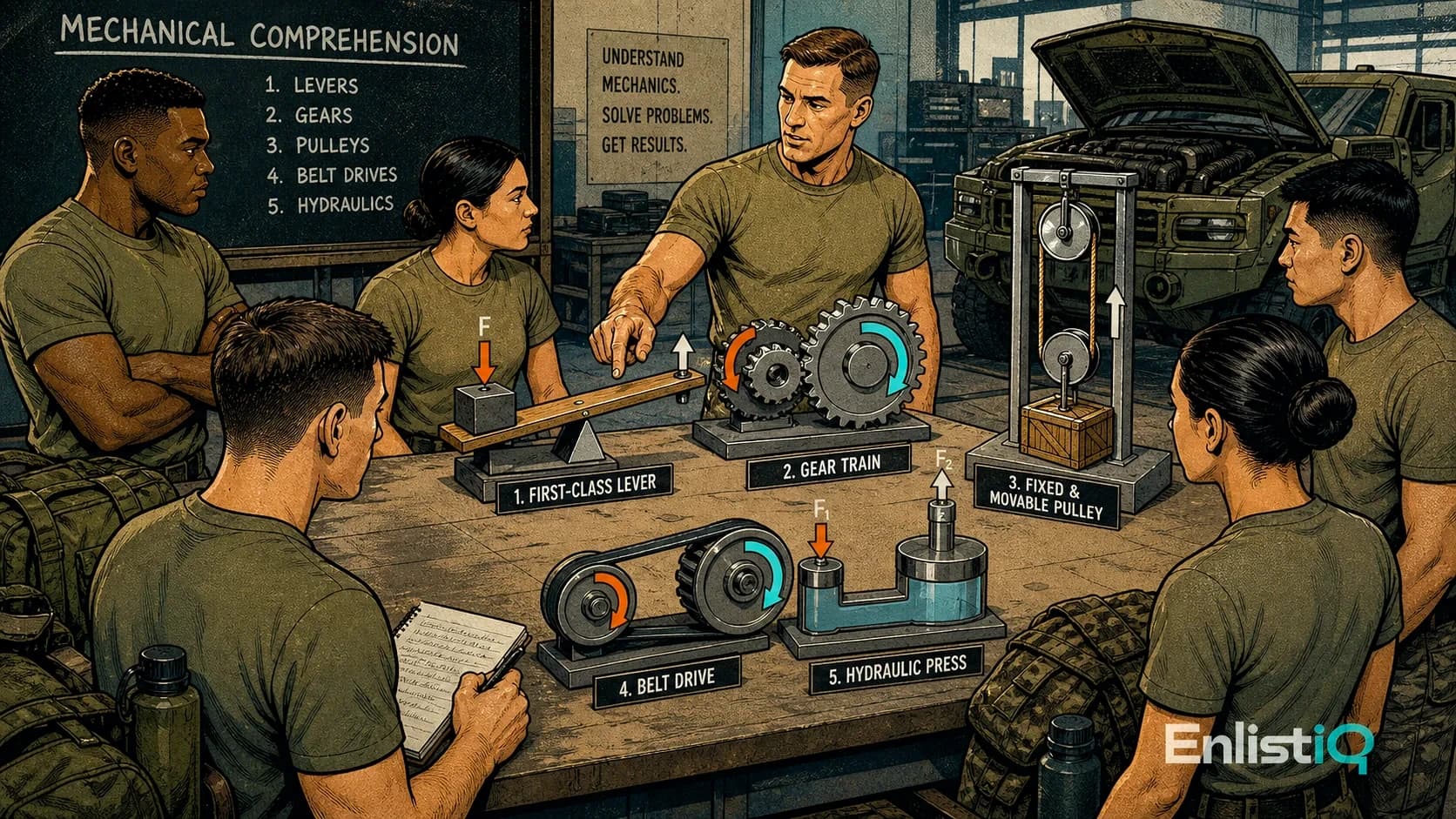
Mechanical Comprehension practice commonly applies that domain to ideas like:
- Levers and fulcrums
- Pulleys and rope systems
- Gears and rotation direction
- Wheels and axles
- Inclined planes, wedges, and screws
- Torque and mechanical advantage
- Work, force, and energy
- Pressure, hydraulics, and pneumatics
- Buoyancy and fluids
- Heat, friction, and simple motion
You do not need to rebuild an engine. You need a working grasp of cause and effect: if this part moves this way, what happens next? Before relying on any commercial question bank, compare its scope with the official retired ASVAB sample questions.
The Big Idea: Tradeoffs
Most simple machines involve a tradeoff.
You can:
- Use less force but move farther
- Gain speed but lose torque
- Change direction of force
- Spread force over a larger area
- Increase pressure by reducing area
When a question feels confusing, ask what the machine is trading.
Example:
A longer wrench makes it easier to loosen a bolt.
Why? The longer handle increases torque because the force is applied farther from the pivot point.
Learn These First
Levers
Every lever has:
- A fulcrum
- A load
- An effort force
If the effort arm is longer than the load arm, you need less force. If the load arm is longer, you need more force but may move the load farther or faster.
Pulleys
A fixed pulley changes direction. A movable pulley can reduce the effort force by sharing the load across rope segments.
Count the rope segments supporting the load. That often reveals the mechanical advantage.
Gears
When two gears touch, they rotate in opposite directions.
Small gear driving large gear:
- Large gear turns slower
- Large gear has more torque
Large gear driving small gear:
- Small gear turns faster
- Small gear has less torque
Hydraulics
Hydraulics use liquids to transmit pressure. A small force on a small piston can create a larger force on a larger piston, because pressure transfers through the fluid.
The key relationship is:
Pressure = force / area
How to Review Mechanical Questions
When you miss a Mechanical Comprehension question, do this:
- Identify the concept: lever, gear, pulley, pressure, force, motion, or energy.
- Draw the direction of force or movement.
- Ask what is being traded: speed, force, distance, or direction.
- Write one sentence explaining the correct answer.
Do not memorize the exact question. Memorize the principle.
A Sample Mechanical Walkthrough
Question:
A small gear turns a larger gear. Compared with the small gear, what will the larger gear do?
Correct answer:
Turn more slowly with greater torque.
Why:
Gear size creates a speed and torque tradeoff. A larger driven gear rotates fewer times for each turn of the small gear, but it gains turning force.
That one idea appears in many forms.
A 10-Day Mechanical Practice Plan
Use this if Mechanical Comprehension is new to you.
Day 1: Take a short diagnostic. Label every miss by concept.
Day 2: Study levers and torque.
Day 3: Study pulleys and mechanical advantage.
Day 4: Study gears and rotation direction.
Day 5: Study work, force, friction, and energy.
Day 6: Study pressure, hydraulics, and pneumatics.
Day 7: Study wheels, axles, inclined planes, wedges, and screws.
Day 8: Run a mixed untimed practice set.
Day 9: Run a mixed timed practice set.
Day 10: Review every miss and retake a diagnostic.
Does Mechanical Comprehension Affect AFQT?
Mechanical Comprehension does not determine your AFQT eligibility score. AFQT comes from Arithmetic Reasoning, Mathematics Knowledge, Word Knowledge, and Paragraph Comprehension.
That four-subtest definition comes from the official program's AFQT score explanation.
MC can still contribute to service-specific job composites. The exact combination depends on the service and occupation, so ask your recruiter for the current qualification formula for the job code you want. If you are targeting a hands-on technical role, do not ignore MC just because it is not part of AFQT.
The Bottom Line
Mechanical Comprehension is learnable. Focus on principles, not memorized trivia. Once you understand force, direction, motion, and tradeoffs, the diagrams start making sense.
Start with the Mechanical Comprehension practice test, then review misses by concept until the machine logic feels predictable.
Next steps:
- Practice Mechanical Comprehension
- Read the ASVAB Mechanical Comprehension guide
- Take a free ASVAB diagnostic with score
Official references: ASVAB test content and timing, retired official sample questions, and AFQT scoring.
EnlistiQ is an independent ASVAB preparation platform and is not affiliated with, endorsed by, or sponsored by the U.S. Department of Defense, any branch of the U.S. Armed Forces, or the official ASVAB program.
Share this article