Technical Subtest

ASVAB Mechanical Comprehension (MC)

MC tests your understanding of mechanical principles — gears, levers, pulleys, and basic physics. Key for combat, engineering, and maintenance jobs.

Score use
Used for job qualification
Focus areas
5
Examples in this guide
5
Section overview

What MC measures

Understanding of mechanical principles: leverage, gears, pulleys, inclined planes, hydraulics, and structural support. Often includes diagram-based questions.

What appears on the test

  • Simple MachinesLevers, pulleys, gears, wedges, inclined planes
  • Mechanical AdvantageForce multiplication and trade-offs
  • Fluid MechanicsHydraulics, pressure, buoyancy
  • Structural SupportLoad distribution, center of gravity
  • Motion & ForcesFriction, momentum, acceleration
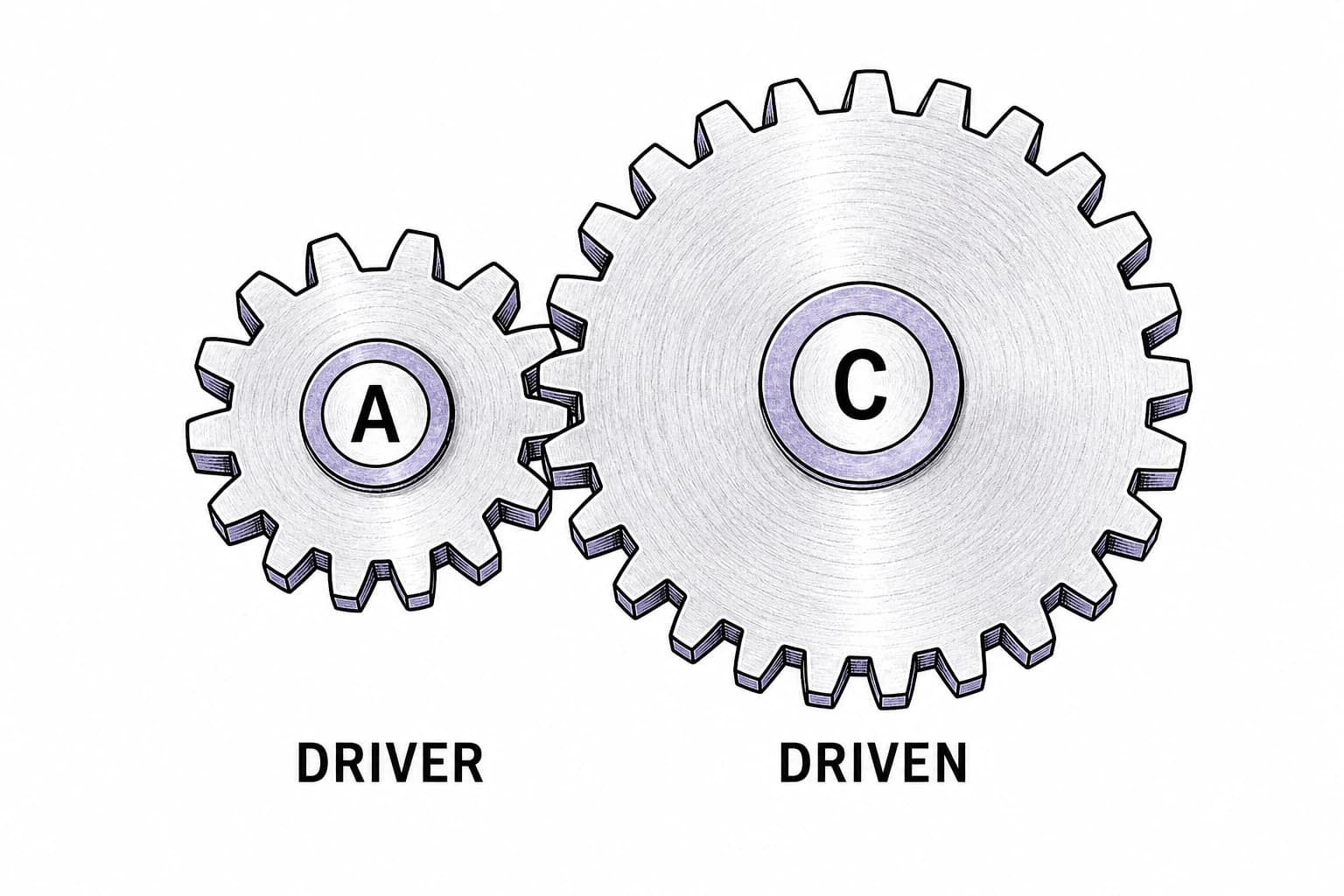
Concept visual

Compare gear size, speed, and direction

A small driving gear A meshed with a larger driven gear C
Meshed gears turn in opposite directions. The larger driven gear turns more slowly but produces more torque.

What to study for MC

Mechanical Comprehension tests cause and effect. Instead of memorizing a picture, identify the forces, motion, pivot, pressure, or energy transfer and predict what must change when one part of the system changes.

01

Force, motion, and friction

Connect net force to acceleration and recognize how mass, inertia, momentum, and friction affect motion.

View key facts
  • Balanced forces produce no acceleration; an unbalanced net force changes velocity.
  • Friction opposes relative motion between contacting surfaces.
  • Momentum increases with both mass and velocity.
02

Levers and torque

Locate the fulcrum, effort, and load, then compare their distances from the pivot.

View key facts
  • Torque = force × perpendicular distance from the pivot.
  • A longer effort arm can produce the same torque with less force.
  • Lever class depends on which element lies between the other two.
03

Gears, belts, and pulleys

Track direction, speed, torque, and supporting rope segments.

View key facts
  • Meshed gears rotate in opposite directions; gears on the same shaft rotate together.
  • A larger driven gear turns slower and produces more torque than a smaller driver.
  • Ideal pulley mechanical advantage equals the number of rope segments supporting the moving load.
04

Fluids and pressure

Apply pressure relationships to liquids, gases, hydraulics, buoyancy, and flow.

View key facts
  • Pressure = force ÷ area.
  • In a confined fluid, applied pressure is transmitted throughout the fluid.
  • Fluid pressure increases with depth.
05

Energy, work, and simple machines

Recognize how machines exchange force for distance while conserving energy in an ideal system.

View key facts
  • Work = force × distance in the direction of the force.
  • Simple machines reduce required force by increasing the distance over which it acts.
  • Lowering a center of gravity generally improves stability.
5 ASVAB-style practice questions

Open a question to review the choices, correct answer, and a short explanation.

Q1A 12-tooth external gear directly meshes with a 36-tooth external gear on fixed parallel shafts. Viewed from the same side, the driven gear turns:View question and answer
  1. Three times as fast in the same direction
  2. At the same speed in the opposite direction
  3. One-third as fast in the opposite direction
  4. One-third as fast in the same direction
Correct answerC. One-third as fast in the opposite direction

Why: The driven gear has three times as many teeth, so it turns at one-third the driving speed. Two directly meshed external gears on fixed parallel shafts rotate in opposite directions when viewed from the same side.

Q2A force of 200 pounds is applied over an area of 4 square inches. What pressure is produced?View question and answer
  1. 25 psi
  2. 800 psi
  3. 100 psi
  4. 50 psi
Correct answerD. 50 psi

Why: Pressure = force ÷ area = 200 ÷ 4 = 50 pounds per square inch.

Q3An ideal single fixed pulley mainly:View question and answer
  1. Changes the direction of the applied force
  2. Doubles the lifting force
  3. Cuts the load weight in half
  4. Stores elastic energy
Correct answerA. Changes the direction of the applied force

Why: A fixed pulley has an ideal mechanical advantage of 1; its primary benefit is changing the direction of pull.

Q4Why does a longer wrench make it easier to loosen a tight bolt?View question and answer
  1. It reduces the bolt diameter
  2. It increases the torque for the same force
  3. It eliminates friction in the threads
  4. It increases the bolt mass
Correct answerB. It increases the torque for the same force

Why: Torque equals force times perpendicular distance from the pivot. A longer handle increases that distance.

Q5Which change generally makes an object harder to tip over?View question and answer
  1. Raise its center of gravity
  2. Narrow its base
  3. Lower its center of gravity
  4. Move its weight outside its base
Correct answerC. Lower its center of gravity

Why: A lower center of gravity allows more tilt before the line of action of the weight moves outside the support base.

MC study strategy

  1. Draw arrows for forces and motion before choosing an answer.
  2. For rotation, identify the pivot and compare distances from it.
  3. Trace gear and belt direction one connection at a time.
  4. Remember the core trade-off: less input force usually requires more input distance.
  5. Use units to separate force, pressure, work, power, and speed.
Optional 7-day study planUse this only if you want a day-by-day way to organize the same core topics.Open the full plan
  1. Day 1

    Forces and motion: Review inertia, acceleration, friction, momentum, and balanced forces.

  2. Day 2

    Levers and torque: Classify levers and solve qualitative torque comparisons.

  3. Day 3

    Gears and belts: Practice rotation direction, tooth ratios, speed, and torque.

  4. Day 4

    Pulleys and planes: Count supporting ropes and study mechanical-advantage trade-offs.

  5. Day 5

    Fluids: Review pressure, hydraulics, buoyancy, and pressure with depth.

  6. Day 6

    Energy and structures: Study work, power, springs, center of gravity, and load support.

  7. Day 7

    Timed set: Complete 15 diagram-heavy questions in 22 minutes and redraw every miss.

Ready to practice MC?

Start a free trial to practice Mechanical Comprehension and review misses by topic.

Start MC practiceTry the free AFQT test

Free ASVAB study cheat sheet

Key formulas, composite scores, and score benchmarks in one printable PDF.

Related pages

Guides to all ten ASVAB subtests