Technical Subtest

ASVAB General Science (GS)

GS covers biology, chemistry, physics, and earth science. It contributes to line scores for technical and medical jobs.

Score use
Used for job qualification
Focus areas
4
Examples in this guide
5
Section overview

What GS measures

Broad science literacy across biology (cells, genetics, anatomy), chemistry (elements, reactions), physics (motion, energy), and earth science (weather, geology, astronomy).

What appears on the test

  • Life ScienceCells, body systems, genetics, ecology
  • Physical ScienceElements, states of matter, forces, energy
  • Earth & SpaceWeather, geology, planets, the atmosphere
  • Scientific MethodHypothesis, experiment design, variables
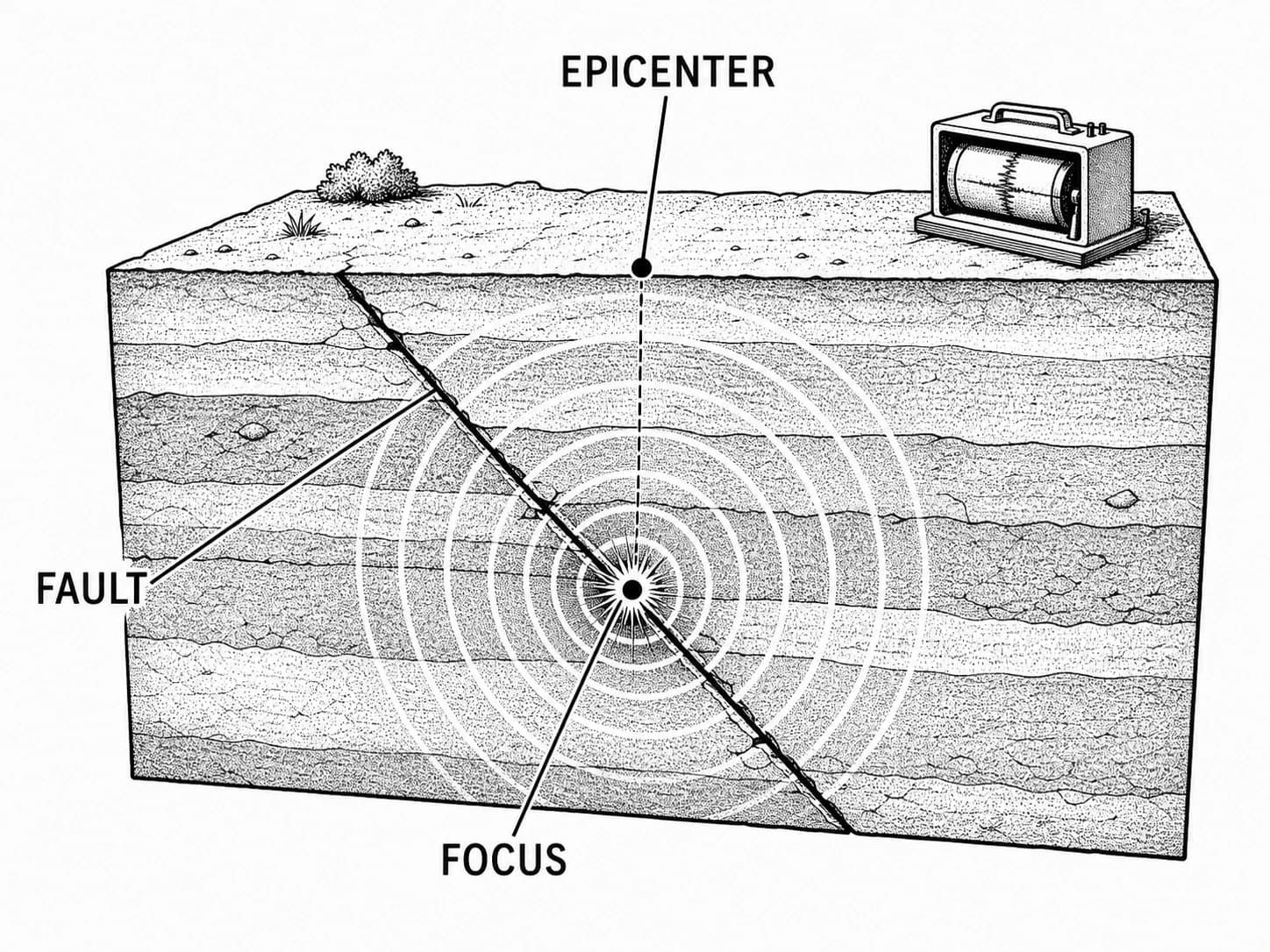
Concept visual

Distinguish focus from epicenter

Earthquake cross-section labeling a fault, underground focus, and surface epicenter
The focus is where the rupture starts underground; the epicenter is the point directly above it on Earth’s surface.

What to study for GS

General Science samples a broad high-school science foundation. Build a clear core in biology, human anatomy, chemistry, physics, and earth and space science, then practice distinguishing closely related terms.

01

Cells, genetics, and life processes

Know cell structures, photosynthesis, respiration, reproduction, and basic inheritance.

View key facts
  • The nucleus stores DNA; mitochondria release usable energy; ribosomes build proteins.
  • Plants perform photosynthesis in chloroplasts and cellular respiration in mitochondria.
  • Genes are DNA segments, and alleles are alternative versions of a gene.
02

Human body systems

Connect each organ and system to its main function and interactions with other systems.

View key facts
  • Red blood cells carry oxygen; white blood cells help defend against infection.
  • The small intestine absorbs most nutrients; kidneys filter blood and regulate water balance.
  • The nervous system uses electrical signals; the endocrine system uses hormones.
03

Chemistry and matter

Review atoms, the periodic table, bonding, reactions, states of matter, acids, and bases.

View key facts
  • Atomic number equals the number of protons.
  • A pH below 7 is acidic, 7 is neutral, and above 7 is basic.
  • Chemical changes form new substances; physical changes do not change chemical identity.
04

Physics and energy

Understand motion, forces, energy transfer, waves, electricity, and heat.

View key facts
  • A net force causes acceleration; balanced forces do not change motion.
  • Kinetic energy is energy of motion; potential energy is stored by position or condition.
  • Heat flows naturally from higher temperature to lower temperature.
05

Earth, weather, and space

Study rocks, plate tectonics, the water cycle, atmosphere, seasons, and the solar system.

View key facts
  • Earthquakes and many volcanoes cluster near tectonic plate boundaries.
  • Weather occurs mainly in the troposphere.
  • Seasons result from Earth's axial tilt, not large changes in distance from the Sun.
5 ASVAB-style practice questions

Open a question to review the choices, correct answer, and a short explanation.

Q1In plant cells, photosynthesis occurs mainly in the:View question and answer
  1. Chloroplasts
  2. Nucleus
  3. Ribosomes
  4. Cell membrane
Correct answerA. Chloroplasts

Why: Chloroplasts contain chlorophyll and are the main site of photosynthesis in plant cells.

Q2Which blood cells carry most of the oxygen in the body?View question and answer
  1. Platelets
  2. Red blood cells
  3. White blood cells
  4. Nerve cells
Correct answerB. Red blood cells

Why: Hemoglobin in red blood cells binds oxygen and transports it from the lungs to tissues.

Q3A solution with a pH of 2 is:View question and answer
  1. Neutral
  2. Slightly basic
  3. Strongly acidic
  4. Strongly basic
Correct answerC. Strongly acidic

Why: The pH scale runs from acidic below 7 to basic above 7; pH 2 is strongly acidic.

Q4Most earthquakes occur near:View question and answer
  1. The centers of continents only
  2. Ocean surfaces
  3. The equator only
  4. Tectonic plate boundaries
Correct answerD. Tectonic plate boundaries

Why: Stress builds where tectonic plates meet and is released as earthquakes along faults.

Q5If an unbalanced force acts on an object, the object will:View question and answer
  1. Accelerate
  2. Slow down without changing direction
  3. Continue at constant velocity
  4. Remain at rest regardless of the force
Correct answerA. Accelerate

Why: A nonzero net force produces acceleration, meaning a change in speed, direction, or both.

GS study strategy

  1. Study relationships and functions instead of isolated lists.
  2. Compare commonly confused terms side by side.
  3. Use diagrams for body systems, cells, cycles, and plate boundaries.
  4. Review the periodic table at the level of protons, groups, and common elements.
  5. Keep broad coverage—do not spend the entire week on one science branch.
Optional 7-day study planUse this only if you want a day-by-day way to organize the same core topics.Open the full plan
  1. Day 1

    Cells and genetics: Review organelles, cell division, DNA, heredity, photosynthesis, and respiration.

  2. Day 2

    Human biology: Map organs to the circulatory, respiratory, digestive, nervous, and excretory systems.

  3. Day 3

    Chemistry: Study atomic structure, periodic trends, bonding, reactions, matter, acids, and bases.

  4. Day 4

    Physics: Review motion, force, energy, waves, heat, and basic electricity.

  5. Day 5

    Earth science: Study rocks, plate tectonics, weather, atmosphere, and the water cycle.

  6. Day 6

    Space and ecology: Review the solar system, seasons, food webs, populations, and ecosystems.

  7. Day 7

    Timed set: Complete 15 mixed questions in 12 minutes and revisit weak science branches.

Ready to practice GS?

Start a free trial to practice General Science and review misses by topic.

Start GS practiceTry the free AFQT test

Free ASVAB study cheat sheet

Key formulas, composite scores, and score benchmarks in one printable PDF.

Related pages

Guides to all ten ASVAB subtests