AFQT Subtest

ASVAB Mathematics Knowledge (MK)

MK tests pure math: algebra, geometry, and number properties. It feeds directly into your AFQT score.

Score use
Counts toward AFQT
Focus areas
5
Examples in this guide
5
Section overview

What MK measures

Knowledge of algebraic equations, geometric properties, number theory, and mathematical operations typically covered through Algebra I and basic Geometry.

What appears on the test

  • AlgebraSolve equations, inequalities, and expressions
  • GeometryAngles, triangles, circles, area, volume
  • Number PropertiesFactors, multiples, primes, exponents
  • Fractions & DecimalsOperations with fractions, decimals, percents
  • Order of OperationsPEMDAS applied to multi-step expressions
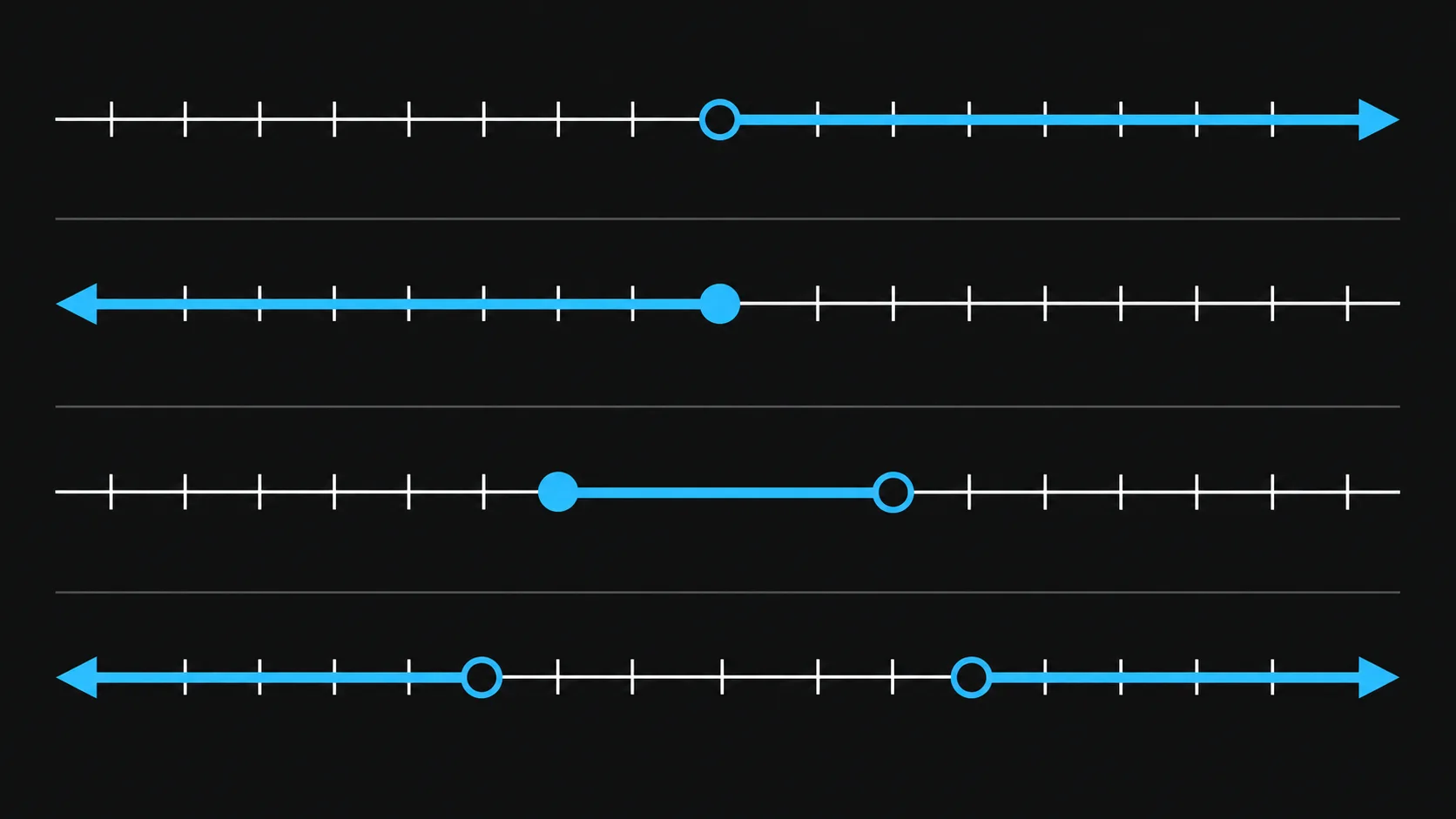
Concept visual

Read endpoints and shaded solution sets

Four number-line examples showing open points, closed points, intervals, and compound inequalities
An open point excludes an endpoint, a closed point includes it, and arrows show the direction of the solution set.

What to study for MK

Mathematics Knowledge questions are direct: you are given an expression, equation, figure, or set of values and must apply the correct rule. Accuracy comes from recognizing the form of the problem and executing a short sequence cleanly.

01

Equations and inequalities

Isolate the variable with inverse operations and preserve equality at every step.

View key facts
  • Perform the same operation on both sides of an equation.
  • Reverse an inequality sign when multiplying or dividing by a negative number.
  • Distribute before combining like terms when parentheses are present.
02

Exponents, roots, and scientific notation

Use exponent laws to simplify products, quotients, powers, and radicals.

View key facts
  • When multiplying like bases, add exponents; when dividing, subtract them.
  • A negative exponent represents a reciprocal, not a negative value.
  • The square root of a number is the nonnegative value whose square equals that number.
03

Polynomials and factoring

Combine like terms, multiply expressions, and reverse multiplication through factoring.

View key facts
  • Only terms with identical variable parts can be combined.
  • Difference of squares: a² − b² = (a − b)(a + b).
  • Check a factorization by multiplying the factors back together.
04

Geometry

Memorize core formulas and connect given dimensions to the right property.

View key facts
  • Triangle area = 1/2 bh; circle circumference = 2πr; circle area = πr².
  • For a right triangle, a² + b² = c², where c is the hypotenuse.
  • Angles in a triangle sum to 180 degrees.
05

Numbers, statistics, and probability

Review fractions, divisibility, averages, and the probability of simple events.

View key facts
  • Mean is the sum divided by the count; median is the middle ordered value.
  • Probability = favorable outcomes ÷ total equally likely outcomes.
  • Use a common denominator before adding or subtracting fractions.
5 ASVAB-style practice questions

Open a question to review the choices, correct answer, and a short explanation.

Q1Solve for x: 2(x − 3) = 14View question and answer
  1. 4
  2. 10
  3. 7
  4. 17
Correct answerB. 10

Why: Divide by 2 to get x − 3 = 7, then add 3. Therefore x = 10.

Q2What is √144 + 3²?View question and answer
  1. 15
  2. 18
  3. 21
  4. 27
Correct answerC. 21

Why: √144 = 12 and 3² = 9, so the sum is 21.

Q3Which expression is equivalent to x² − 9?View question and answer
  1. (x − 9)(x + 1)
  2. (x − 9)²
  3. (x − 3)²
  4. (x − 3)(x + 3)
Correct answerD. (x − 3)(x + 3)

Why: This is a difference of squares: x² − 3² = (x − 3)(x + 3).

Q4A right triangle has legs of length 5 and 12. What is the hypotenuse?View question and answer
  1. 13
  2. 15
  3. 17
  4. 25
Correct answerA. 13

Why: c² = 5² + 12² = 25 + 144 = 169, so c = 13.

Q5What is the mean of 8, 10, 12, and 14?View question and answer
  1. 10
  2. 11
  3. 12
  4. 44
Correct answerB. 11

Why: The sum is 44 and there are 4 values, so the mean is 44 ÷ 4 = 11.

MK study strategy

  1. Write one algebra step per line to reduce sign mistakes.
  2. Memorize the small set of geometry formulas most often tested.
  3. Substitute your answer back into the original equation when time permits.
  4. Draw and label a figure when geometry is described only in words.
  5. Practice without a calculator so fraction and exponent operations become automatic.
Optional 7-day study planUse this only if you want a day-by-day way to organize the same core topics.Open the full plan
  1. Day 1

    Number operations: Review fractions, decimals, percents, factors, multiples, and order of operations.

  2. Day 2

    Linear algebra: Solve equations and inequalities, including distribution and negative coefficients.

  3. Day 3

    Exponents and roots: Practice exponent laws, radicals, and scientific notation.

  4. Day 4

    Polynomials: Combine terms, multiply binomials, and factor common patterns.

  5. Day 5

    Geometry: Review angle rules, triangles, circles, area, perimeter, and volume.

  6. Day 6

    Statistics and probability: Practice mean, median, range, ratios, and simple probability.

  7. Day 7

    Timed review: Complete 15 mixed problems in 31 minutes and redo every miss from a blank page.

Ready to practice MK?

Try Mathematics Knowledge questions in the free AFQT practice test and review every explanation.

Practice MK freeCreate free account

Free ASVAB study cheat sheet

Key formulas, composite scores, and score benchmarks in one printable PDF.

Related pages

Guides to all ten ASVAB subtests