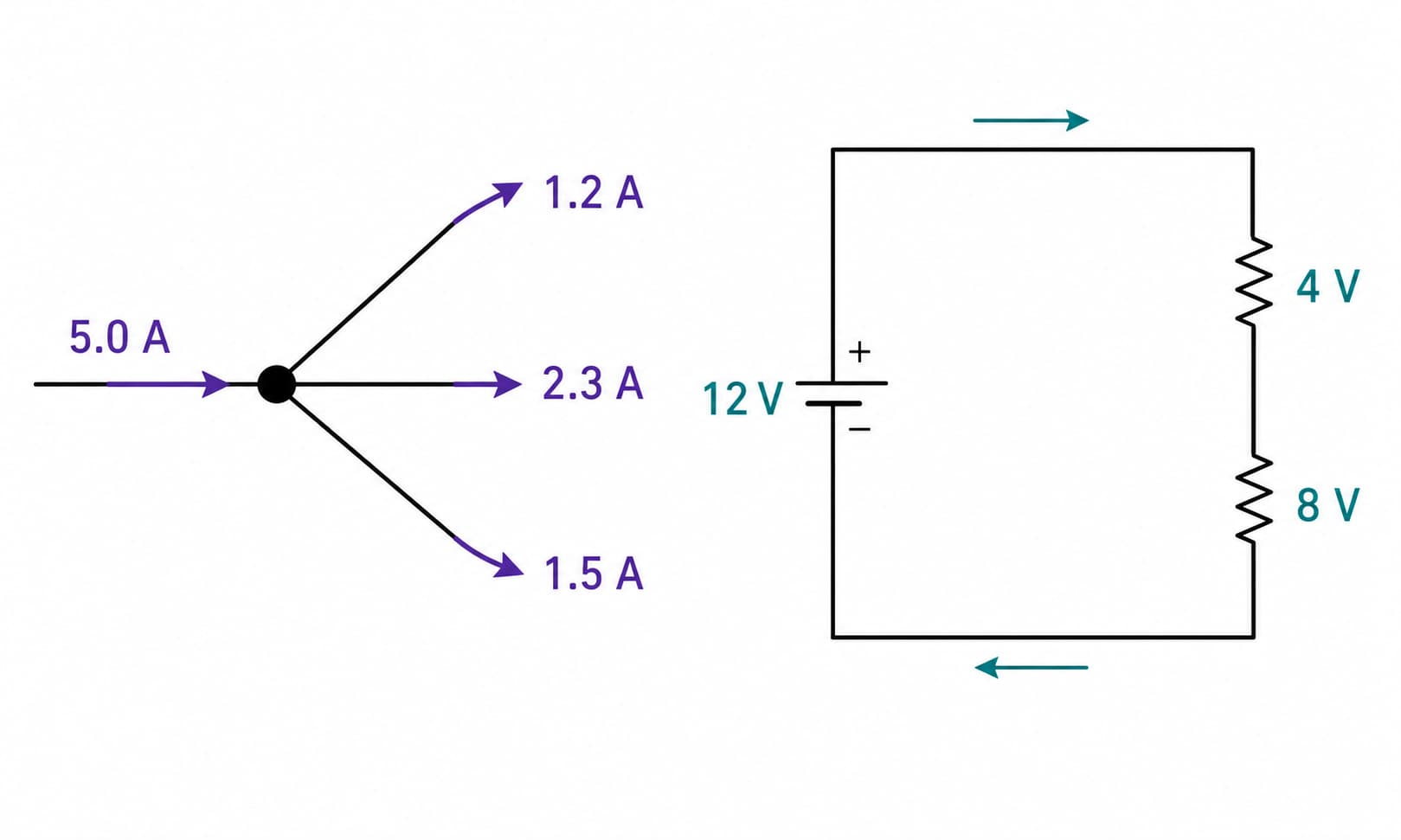
Electronics Information becomes manageable when you separate quantities, circuit layouts, and component functions. Trace current paths, label known values with units, and use a small set of laws rather than guessing from a diagram.
01
Voltage, current, and resistance
Understand what each electrical quantity represents and relate them with Ohm's law.
View key facts
- Voltage is electrical potential difference, current is charge flow, and resistance opposes current.
- Ohm's law is V = IR.
- Electrical power can be calculated with P = VI.
02
Series and parallel circuits
Identify which quantities stay the same and which combine in each circuit arrangement.
View key facts
- Series components share the same current and their resistances add.
- Parallel branches share the same voltage.
- Adding a parallel branch lowers equivalent resistance and increases total current for a fixed voltage.
03
Components and semiconductors
Know the basic purpose of resistors, capacitors, inductors, diodes, and transistors.
View key facts
- A capacitor stores energy in an electric field; an inductor stores energy in a magnetic field.
- A diode primarily allows current in one direction.
- A transistor can act as a switch or amplifier.
04
AC, magnetism, and transformers
Connect changing current and magnetic fields to motors, generators, and transformers.
View key facts
- Direct current flows in one direction; alternating current reverses periodically.
- A transformer requires changing magnetic flux and therefore operates with AC or varying current.
- A step-up transformer increases voltage while ideally decreasing current.
05
Meters and electrical safety
Match the measurement to correct meter placement and recognize basic circuit protection.
View key facts
- An ammeter goes in series; a voltmeter goes in parallel.
- Measure resistance only on a de-energized circuit.
- Fuses and circuit breakers open a circuit when current becomes unsafe.