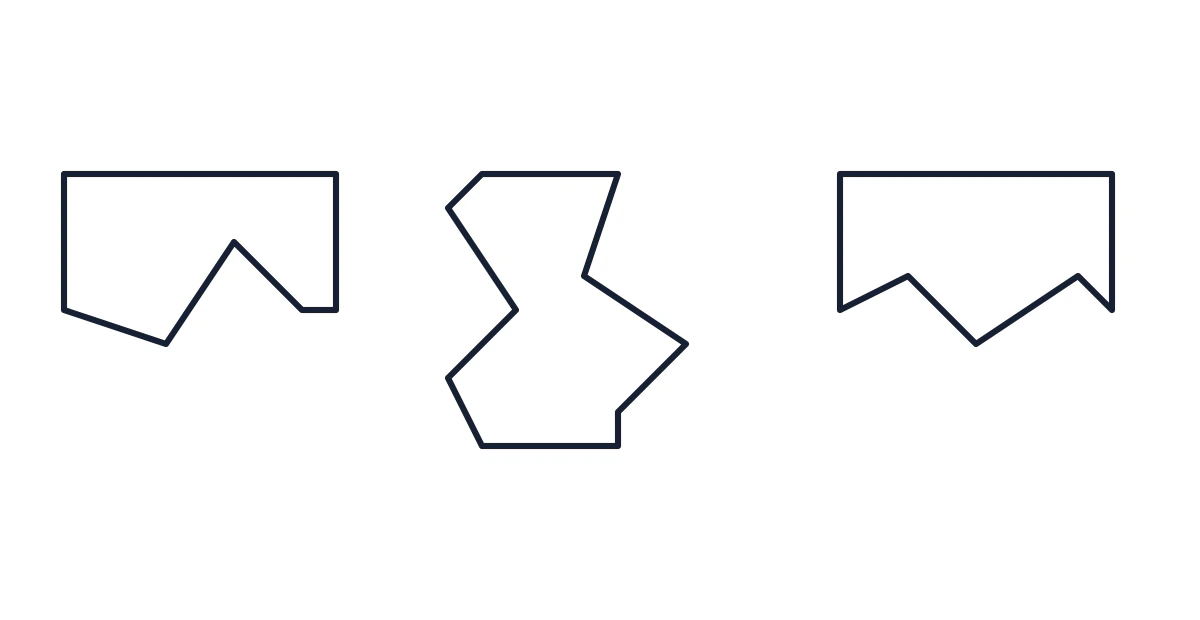
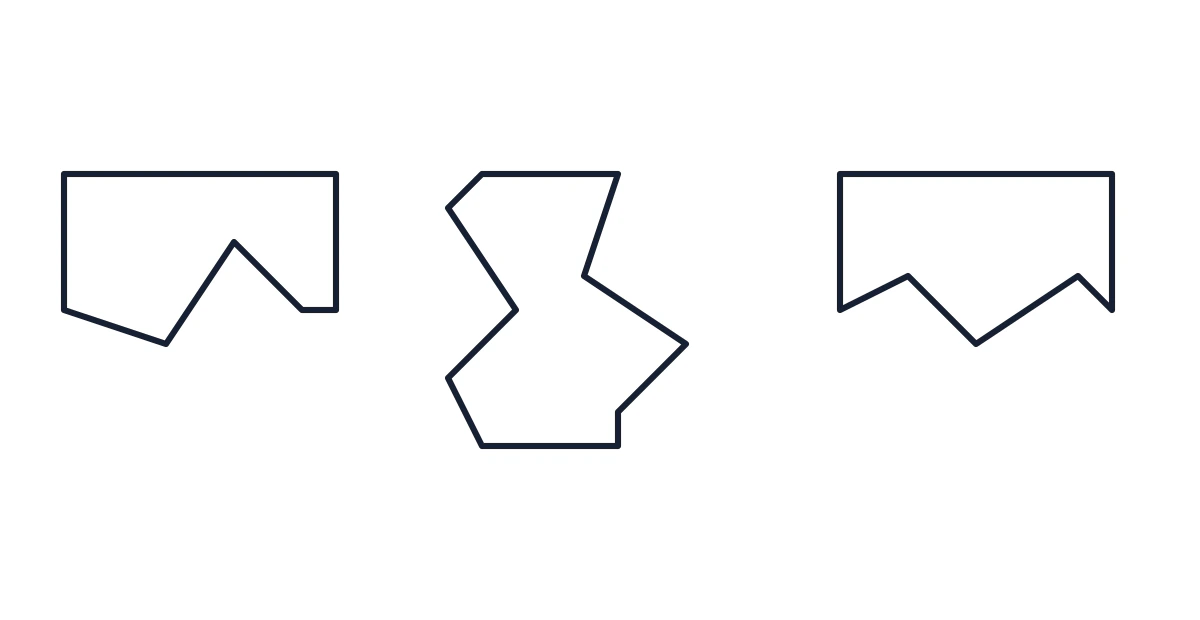
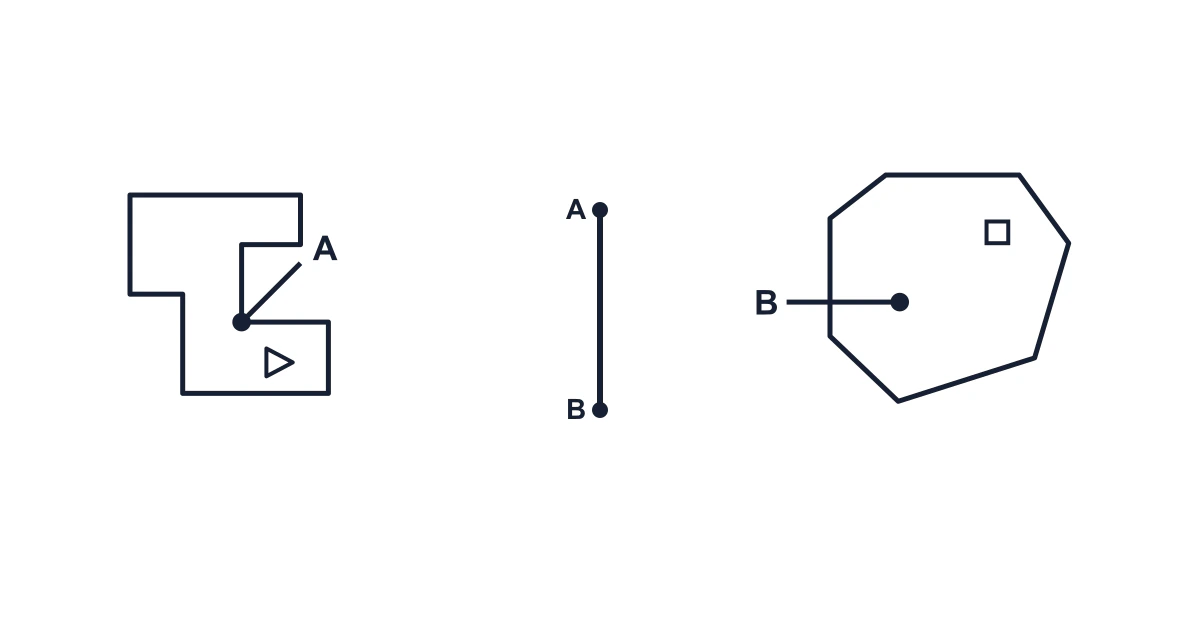
AO cannot be studied as vocabulary alone; it must be practiced visually. Use rigid transformations only: pieces may move and rotate, but they may not stretch, overlap, or mirror-flip unless the prompt explicitly allows it.
01
Piece inventory
Before assembling anything, count pieces and identify each piece's longest edge, sharpest corner, notches, and other asymmetric landmarks.
View key facts
- Every source piece must appear exactly once in the finished assembly.
- Edge lengths and corner angles remain unchanged during rotation.
- Unique notches and protrusions are faster anchors than overall silhouette.
02
Rotation versus reflection
A rotation preserves the clockwise order of features; a mirror reflection reverses that order.
View key facts
- Track an asymmetric feature around the piece to test its handedness.
- Turning a page or rotating a piece never changes left-right feature order around its boundary.
- Eliminate mirrored options even when their outer silhouette looks plausible.
03
Connector-point tracking
Treat labeled connection points as permanent marks fixed to the same local edge, corner, or interior feature.
View key facts
- The two required points must occupy the same location in the assembly.
- A point cannot slide to a nearby corner or another place on the same edge.
- Use a short ray or nearby landmark to preserve the point's local direction after rotation.
04
Boundary and seam checks
Verify both the outside boundary and the internal seams created where pieces meet.
View key facts
- Matching internal edges must be equal in length and complementary in shape.
- The correct result has no gaps, overlaps, or unused edges inside the assembly.
- A wrong interior seam can expose an incorrect option even when the outside boundary looks right.
05
Fast elimination
Use invariant features to reject options before attempting a complete mental assembly.
View key facts
- Count distinctive corners and notches in each answer.
- Reject any option that changes a piece's handedness or connection-point location.
- Compare one high-information landmark at a time rather than rotating the whole image continuously.