Published March 1, 2026
Last updated August 14, 2026
9 min
ASVAB Scores Breakdown: How Subtests Build Your AFQT Score
Learn how the 10 ASVAB subtests produce standard scores, how four subtests shape AFQT eligibility, and how service composites affect job qualification.
Your ASVAB results include individual subtest standard scores, an AFQT percentile used for enlistment eligibility, and service-specific composite scores used in military job classification. Understanding that structure helps you study without trying to turn a raw practice-test total into an official score.
How ASVAB Scores Break Down
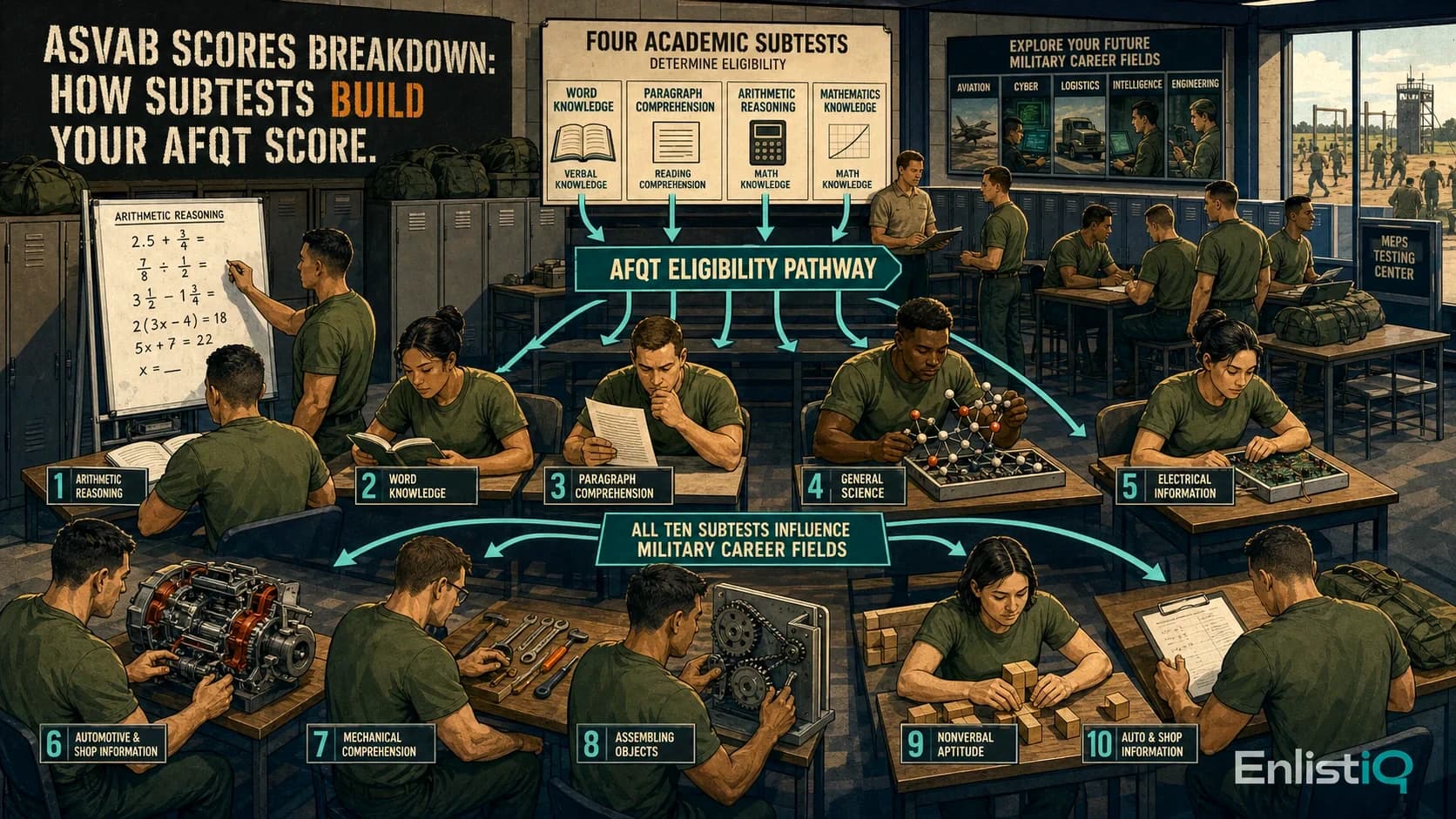
The computerized enlistment ASVAB administers 10 subtests. In the paper-and-pencil version, Auto Information and Shop Information are combined into one Auto & Shop subtest. Those scores feed two types of decisions:
4 AFQT Subtests
Arithmetic Reasoning, Mathematics Knowledge, Word Knowledge, and Paragraph Comprehension standard scores are used to compute your AFQT. The official scoring guide explains that the AFQT is reported as a percentile from 1 to 99 against the official reference population. Each service sets current eligibility standards and may apply additional rules.
6 Additional Subtests
General Science, Electronics Information, Auto Information, Shop Information, Mechanical Comprehension, and Assembling Objects do not enter the AFQT calculation. They can contribute to service-specific composite scores used to help classify applicants into military occupations.
The 10 Subtests and What They Measure
Each ASVAB subtest measures a specific aptitude area. The counts and limits below are for scored questions on the proctored CAT-ASVAB without tryout questions. The official test may add unscored tryout questions and corresponding time in selected subtests; see the current official CAT-ASVAB table before testing.
AR — Arithmetic Reasoning
- Questions: 15 | Time Limit: 55 min
- What It Measures: Ability to solve word problems using mathematical reasoning
- Example Topics: Distance, work rate, and percentage problems
- AFQT Input: Yes
MK — Mathematics Knowledge
- Questions: 15 | Time Limit: 31 min
- What It Measures: Knowledge of mathematical concepts, formulas, and operations
- Example Topics: Algebra, geometry, exponents, fractions
- AFQT Input: Yes
WK — Word Knowledge
- Questions: 15 | Time Limit: 9 min
- What It Measures: Vocabulary and word meanings through synonyms and context
- Example Topics: Definitions, synonyms, and word usage in sentences
- AFQT Input: Yes, through Verbal Expression (VE)
PC — Paragraph Comprehension
- Questions: 10 | Time Limit: 27 min
- What It Measures: Reading comprehension and main idea identification
- Example Topics: Understanding passages and answering comprehension questions
- AFQT Input: Yes, through Verbal Expression (VE)
GS — General Science
- Questions: 15 | Time Limit: 12 min
- What It Measures: Knowledge of basic science including biology, chemistry, physics
- Example Topics: Life science, earth science, and physical science concepts
- AFQT Input: No; may be used in service composites
EI — Electronics Information
- Questions: 15 | Time Limit: 10 min
- What It Measures: Understanding of electrical and electronic concepts
- Example Topics: Circuits, voltage, current, and electronic components
- AFQT Input: No; may be used in service composites
AI — Auto Information
- Questions: 10 | Time Limit: 7 min
- What It Measures: Knowledge of automotive maintenance and repair
- Example Topics: Engine parts, maintenance, and automotive systems
- AFQT Input: No; may be used in service composites
SI — Shop Information
- Questions: 10 | Time Limit: 6 min
- What It Measures: Knowledge of shop practices, tools, and mechanical processes
- Example Topics: Tool usage, shop safety, and wood/metal working
- AFQT Input: No; may be used in service composites
MC — Mechanical Comprehension
- Questions: 15 | Time Limit: 22 min
- What It Measures: Understanding of mechanical principles and physics concepts
- Example Topics: Levers, pulleys, gears, pressure, and mechanical advantage
- AFQT Input: No; may be used in service composites
AO — Assembling Objects
- Questions: 15 | Time Limit: 18 min
- What It Measures: Spatial relations and visualization ability
- Example Topics: Identifying how shapes fit together in 3D space
- AFQT Input: No; may be used in service composites
From Subtests to AFQT
The AFQT uses standard scores from four subtests: Arithmetic Reasoning, Mathematics Knowledge, Word Knowledge, and Paragraph Comprehension. It does not use the raw number of questions you answered correctly.
The official ASVAB technical documentation expresses the standard-score composite conceptually as:
AFQT = AR + MK + (2 × VE)
VE is a verbal composite derived from WK and PC standard scores. It is not calculated by simply adding raw WK and PC totals. The resulting AFQT standard-score composite is then converted to the familiar percentile from 1–99. For the underlying methodology, see the official program's AFQT score-scale technical report.
This distinction matters: a practice-test total cannot be converted reliably into an official AFQT percentile without the military's scoring and equating process. Use practice scores to track direction and weak areas, not as an exact reconstruction of an official score report.
Why Verbal Expression Matters
VE is doubled in the conceptual AFQT formula, so Word Knowledge and Paragraph Comprehension deserve deliberate practice. Arithmetic Reasoning and Mathematics Knowledge remain equally essential inputs. The safest study strategy is to improve all four AFQT subtests rather than trying to reverse-engineer a percentile from raw totals.
Line Score Composites: How Branches Use ASVAB Scores Breakdown
Separate from the AFQT calculation, services combine selected ASVAB subtest standard scores into composites used to help classify applicants for occupations. A composite may use AFQT subtests, additional subtests, or both.
The services calculate composites differently. The official program publishes a current overview of service composites and formulas and explains that each service develops and validates its own combinations based on their relationship to job performance.
Do not add practice-test raw totals to estimate an official line score. Use the composites printed on your official score sheet, then confirm the current cutoff for a specific job with a recruiter. Formulas and job standards can change.
Which Subtests Should You Prioritize?
There is no accurate raw-point shortcut such as "+1 WK equals +2 AFQT percentile points." Official scoring uses standardized subtest scores, a VE conversion, and a percentile conversion. The best priority depends on your goal:
- For enlistment eligibility: review your weakest areas among AR, MK, WK, and PC, because all four feed the AFQT.
- For a target military occupation: also review the subtests used in the relevant service composite and confirm the current job standard with a recruiter.
- For practice tracking: compare like-for-like practice sets over time, but do not present a commercial raw percentage as an official AFQT or line score.
Frequently Asked Questions
Q: How do ASVAB scores break down into the AFQT?
A: Four ASVAB standard scores feed the AFQT: AR + MK + (2 × VE), with VE derived from WK and PC. The remaining six computerized subtests do not enter the AFQT, but they can contribute to service composite scores used for job classification.
Q: Why is Verbal Expression (VE) double-weighted in the ASVAB scores breakdown?
A: The official standard-score formula includes 2 × VE. That does not make WK and PC raw questions "worth double" or exactly 50% of the reported percentile; standardization and score conversions make that interpretation inaccurate.
Q: What is the difference between AFQT and line scores?
A: Your AFQT score is the ASVAB-based measure used for overall military eligibility. Service composites combine subtest scores to help classify applicants into military occupations. Other entrance requirements, occupation standards, and job availability also apply.
Q: How do line score composites change by military branch?
A: Each service uses different combinations of ASVAB subtest scores. The official composite table lists the current labels and formulas; confirm a specific occupation's current cutoff with a recruiter because job standards can change.
Q: Which subtests impact my ASVAB scores breakdown the most?
A: AR, MK, WK, and PC all feed the AFQT, so prioritize whichever of those four is weakest in comparable practice. The other six computerized subtests can matter for the service composites associated with particular occupations.
Q: Can I see my ASVAB scores breakdown by subtest?
A: Your official results report ASVAB standard scores and the AFQT percentile, along with applicable service composites. EnlistiQ's dashboard can show practice performance by section, but it does not reproduce the military's official scoring and equating process.
Key Takeaways
- ASVAB results include AFQT and service composites — AFQT is the enlistment-eligibility measure derived from ASVAB scores; service composites help with job classification
- The conceptual standard-score formula is AR + MK + (2 × VE) — It is not a raw-correct formula or a direct percentile calculator
- All four AFQT inputs matter — Study your weakest areas across AR, MK, WK, and PC
- Line scores vary by branch — Each military branch calculates line scores differently to match job requirements
- Study strategically by goal — Build AFQT readiness first, then emphasize the composites connected to your target occupation
- Practice scores are directional — They cannot be converted reliably into official AFQT or service-composite results
Next Steps
Ready to improve your ASVAB scores breakdown? Use these resources:
- Free Four-Area AFQT Diagnostic — 12 or 31 Questions — Review AR, MK, WK, and PC with an unofficial planning estimate
- ASVAB Study Guide — 4-Week Plan to Raise Your AFQT — Get a structured study plan based on your weak areas
- How to Pass the ASVAB: Complete Guide for 2026 — Comprehensive strategies for every subtest
Ready to start? Sign up for EnlistiQ today and take your diagnostic test to see exactly how your subtest scores break down and which areas need the most attention.
Official References
- Official ASVAB: Understanding ASVAB Scores
- Official ASVAB: Military Jobs and Service Composites
- Official ASVAB: CAT-ASVAB Counts and Time Limits
These official links support the test facts above; they do not imply endorsement of EnlistiQ.
Related Reading
Share this article