Technical Subtest

ASVAB Auto Information (AI)

AI tests knowledge of engines, drivetrains, brakes, cooling, lubrication, and automotive electrical systems. On the CAT-ASVAB, Auto and Shop are separate subtests but contribute to a combined AS score.

Score use
Used for job qualification
Focus areas
6
Examples in this guide
5
Section overview

What AI measures

Practical knowledge of automobile technology: how engine, fuel, cooling, lubrication, electrical, brake, suspension, steering, and drivetrain systems work. The CAT-ASVAB administers Auto and Shop separately, while the paper-and-pencil ASVAB combines them into one AS subtest.

What appears on the test

  • Engine OperationFour-stroke cycle, valves, pistons, camshaft, crankshaft
  • Fuel, Ignition & ExhaustFuel delivery, spark plugs, diesel ignition, emissions components
  • Cooling & LubricationRadiator, thermostat, water pump, oil pump, filters
  • Starting & ChargingBattery, starter motor, alternator, fuses
  • Brakes, Steering & SuspensionDisc and drum brakes, hydraulics, springs, shocks
  • DrivetrainClutch, transmission, differential, axles, drive shafts
Concept visual

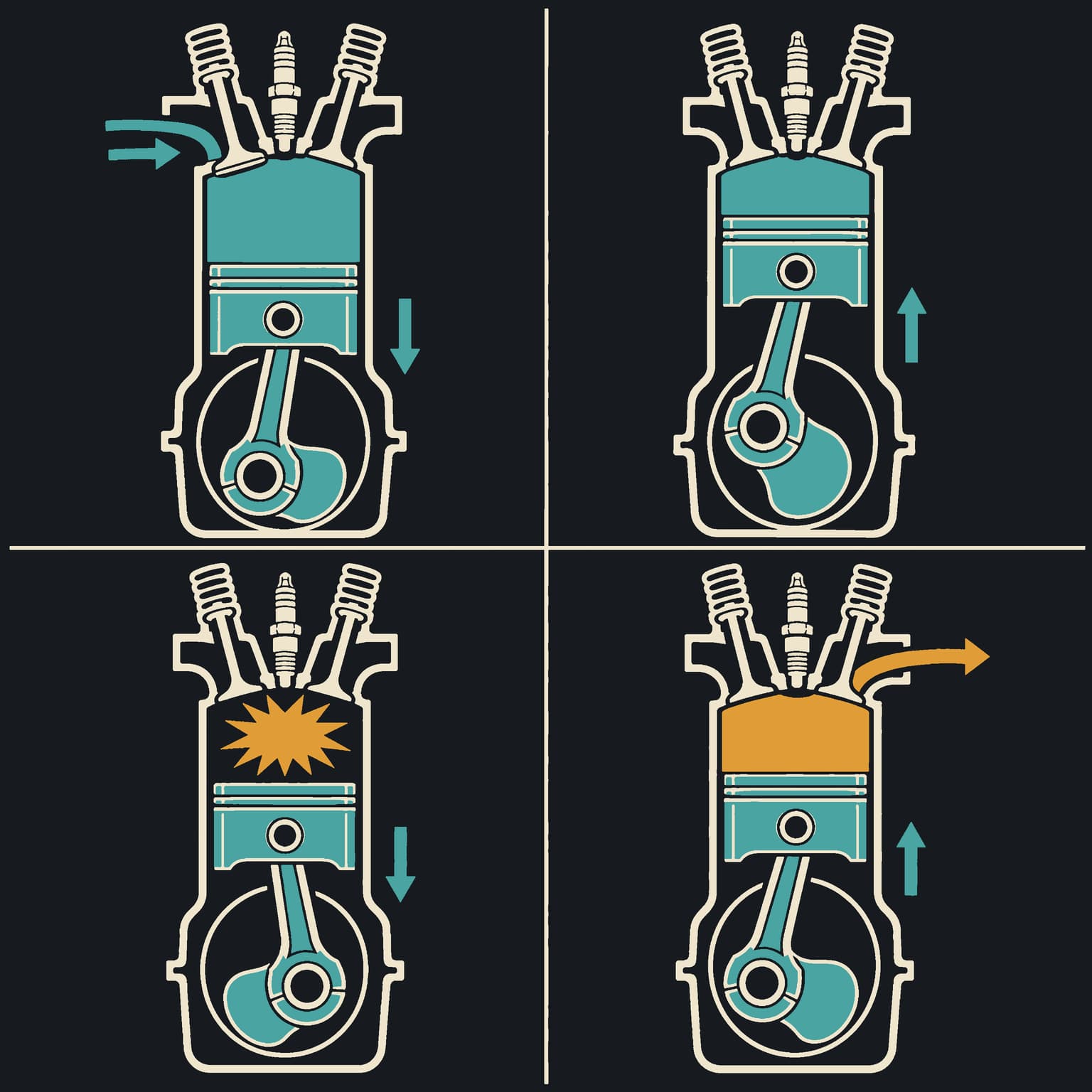
Follow the four-stroke engine cycle

Four engine-cylinder diagrams showing intake, compression, power, and exhaust strokes
Read the panels left to right, top row then bottom row: intake, compression, power, and exhaust.

What to study for AI

Study systems as connected chains: identify what enters a component, what the component changes, and where the output goes next. AI questions usually test a part's function, the order of an operating cycle, or the likely system involved in a basic symptom.

01

Engine cycle and internal parts

Know the four-stroke gasoline-engine cycle and how the main moving parts turn combustion into rotation.

View key facts
  • The sequence is intake, compression, power, exhaust.
  • The camshaft opens and closes valves; the crankshaft converts piston motion into rotary motion.
  • Piston rings help seal the combustion chamber and control oil on the cylinder wall.
02

Fuel, ignition, and exhaust

Trace the path from clean air and fuel to ignition, exhaust flow, and emissions control.

View key facts
  • A gasoline engine uses a spark plug; a diesel engine ignites fuel with heat from compression.
  • Fuel injectors meter fuel, while the air filter keeps dirt out of the engine.
  • The catalytic converter reduces harmful exhaust pollutants; the muffler reduces exhaust noise.
03

Cooling and lubrication

Separate the cooling system, which carries away heat, from the lubrication system, which reduces friction and wear.

View key facts
  • The water pump circulates coolant and the radiator releases coolant heat to outside air.
  • The thermostat controls coolant flow according to engine temperature.
  • The oil pump circulates oil; the oil filter traps contaminants before oil returns to engine parts.
04

Starting, charging, and circuits

Learn which electrical component acts before startup and which one supplies power after the engine is running.

View key facts
  • The battery supplies power to the starter motor, which cranks the engine.
  • The alternator powers electrical loads and recharges the battery while the engine runs.
  • A fuse opens an overloaded circuit to protect wiring and components.
05

Brakes, steering, and suspension

Focus on the parts that create friction, transfer hydraulic pressure, support weight, and control unwanted motion.

View key facts
  • Disc brakes squeeze pads against a rotor; drum brakes press shoes against a drum.
  • The master cylinder converts pedal force into hydraulic pressure.
  • Springs support vehicle weight; shock absorbers damp repeated spring movement.
06

Transmission and drivetrain

Follow engine torque through the transmission to the drive wheels and know why gear ratios change.

View key facts
  • A clutch disconnects a manual transmission from the engine during shifting.
  • Lower gears provide more torque at lower vehicle speed; higher gears favor speed and efficiency.
  • A differential lets the left and right drive wheels rotate at different speeds while turning.
5 ASVAB-style practice questions

Open a question to review the choices, correct answer, and a short explanation.

Q1What is the main function of an engine oil pump?View question and answer
  1. Create voltage for the spark plugs
  2. Mix fuel with incoming air
  3. Force coolant through the heater core
  4. Circulate lubricant to moving engine parts
Correct answerD. Circulate lubricant to moving engine parts

Why: The oil pump moves pressurized oil through passages to bearings and other moving parts, reducing friction and carrying away some heat.

Q2In a gasoline engine, which component ignites the compressed air-fuel mixture?View question and answer
  1. Spark plug
  2. Fuel injector
  3. Piston ring
  4. Muffler
Correct answerA. Spark plug

Why: The spark plug produces an electrical spark near the end of the compression stroke to begin combustion.

Q3A shock absorber primarily helps to:View question and answer
  1. Support all vehicle weight without springs
  2. Dampen repeated spring movement
  3. Increase tire air pressure
  4. Transfer engine torque to the axle
Correct answerB. Dampen repeated spring movement

Why: Springs support the vehicle and absorb bumps; shock absorbers control the springs' repeated bouncing.

Q4Which exhaust-system component is designed mainly to reduce harmful pollutants?View question and answer
  1. Muffler
  2. Tailpipe
  3. Catalytic converter
  4. Exhaust manifold
Correct answerC. Catalytic converter

Why: The catalytic converter promotes chemical reactions that convert several harmful exhaust gases into less harmful substances. The muffler mainly reduces noise.

Q5In a manual-transmission vehicle, pressing the clutch pedal allows the driver to:View question and answer
  1. Open the engine thermostat
  2. Lock both front wheels together
  3. Increase brake-fluid pressure
  4. Disconnect the engine from the transmission for shifting
Correct answerD. Disconnect the engine from the transmission for shifting

Why: The clutch temporarily interrupts torque flow between the engine and transmission so gears can be selected smoothly.

AI study strategy

  1. Draw the four-stroke cycle and label piston direction and valve position for every stroke.
  2. Make function cards: put a component on the front and its job, inputs, and outputs on the back.
  3. Study paired contrasts such as starter vs alternator, pads vs shoes, and gasoline vs diesel ignition.
  4. When a question gives a symptom, identify the affected system before choosing a specific part.
  5. Work through the five guide questions untimed, then use the full practice bank for timed mixed sets.
Optional 7-day study planUse this only if you want a day-by-day way to organize the same core topics.Open the full plan
  1. Day 1

    Engine operation: Learn the four strokes and label the piston, valves, camshaft, crankshaft, and flywheel.

  2. Day 2

    Cooling and lubrication: Trace coolant and oil flow, then compare the job of each pump, filter, and heat-control part.

  3. Day 3

    Fuel and exhaust: Review air and fuel delivery, gasoline vs diesel ignition, and exhaust/emissions components.

  4. Day 4

    Electrical systems: Study battery, starter, alternator, ignition, and circuit-protection functions.

  5. Day 5

    Chassis systems: Compare disc and drum brakes and review steering, springs, shocks, and wheel alignment terms.

  6. Day 6

    Drivetrain: Trace torque through the clutch or torque converter, transmission, drive shaft, differential, and axles.

  7. Day 7

    Timed review: Answer a mixed set from the practice bank at a steady pace, then restudy every missed component by function.

Ready to practice AI?

Start a free trial to practice Auto Information and review misses by topic.

Start AI practiceTry the free AFQT test

Free ASVAB study cheat sheet

Key formulas, composite scores, and score benchmarks in one printable PDF.

Related pages

Guides to all ten ASVAB subtests